
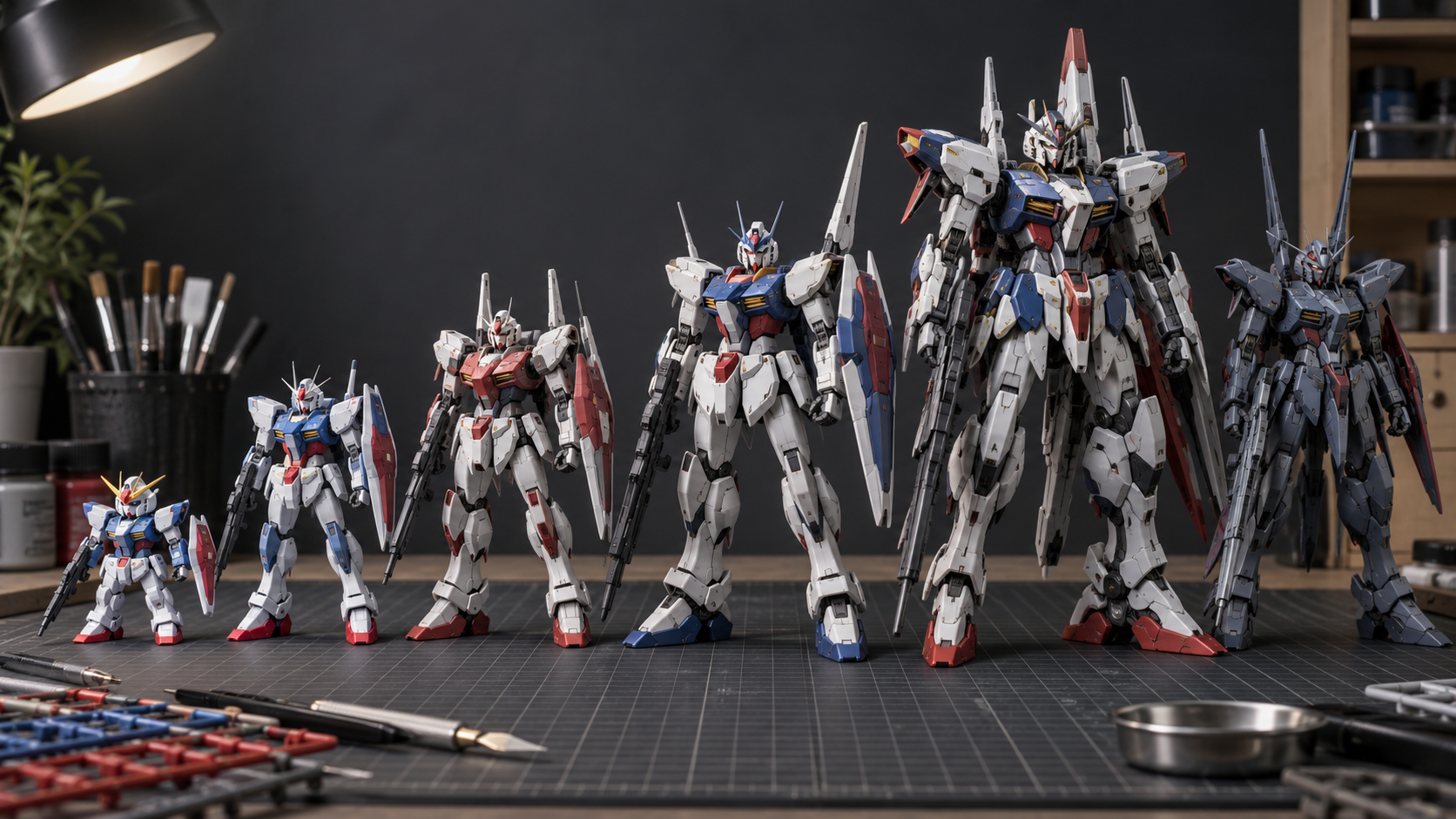
EG. HG. RG. MG. PG. Gunpla boxes do enjoy an abbreviation. To a new builder, the shelf can look less like a hobby and more like an eye test.
Gunpla grades are Bandai’s way of grouping Gundam model kits by their typical scale, construction, detail and overall building experience. Entry Grade (EG) offers the most direct introduction, High Grade (HG) gives you the widest choice, Real Grade (RG) packs intricate engineering into 1/144 scale, Master Grade (MG) moves into the larger 1/100 format, and Perfect Grade (PG) is built as a major 1/60 project. SD and MGSD use stylised proportions. None of these labels is a universal score for quality, difficulty or enjoyment.
That last point matters. A recent High Grade can be more satisfying to pose than a much older Master Grade. A Real Grade may be physically smaller than a Master Grade while asking for greater care during assembly. An Entry Grade is not a lesser kit simply because it is straightforward. Release date, the design of the mobile suit and the engineering of that particular model all matter alongside the letters on the box.
If this is your first encounter with the hobby, our complete beginner’s guide to Gunpla explains what the kits are and how they go together. Here, we are concentrating on one question: what do the grades actually mean?
The Bomran Guide
Guide type: Gunpla reference guide
Best for: New and returning builders
Covers: EG, HG, RG, MG, PG, SD, MGSD and related Bandai lines
Key point: Grade describes a product range, not whether a kit is “good”
Estimated reading time: 16 minutes
Related guide: Building your first Gundam model kit
Gunpla grades explained at a glance
This table is a map, not a league table. If you are comparing HG vs RG vs MG, the biggest practical differences are scale, part size, construction density and the amount of time you want to spend at the desk. Words such as “simpler” and “intricate” describe the usual build, while individual kits can - and regularly do - break the pattern.
| Range | Usual scale | What defines it | Particularly suitable for |
|---|---|---|---|
| Entry Grade (EG) | 1/144 | Streamlined construction and parts designed to separate without nippers | First builds, relaxed projects and clean results with minimal equipment |
| High Grade (HG) | Usually 1/144 | Broad selection, compact size and relatively direct construction | Variety, collecting, customising and builders at almost any experience level |
| Real Grade (RG) | 1/144 | Dense mechanical and surface detail in a compact model | Builders who enjoy intricate parts, layered construction and detailed display pieces |
| Master Grade (MG) | Usually 1/100 | Larger format, more involved construction and frequently extensive internal engineering | Substantial projects and models with greater shelf presence |
| Perfect Grade (PG) | Usually 1/60 | Large flagship kits built around ambitious engineering and presentation | Experienced or patient builders wanting a major centrepiece project |
| SD Gundam | Non-scale | Deliberately exaggerated proportions and a compact format | Characterful collections, accessible builds and something different from standard proportions |
| MGSD | Non-scale | SD proportions combined with intricate internal and external construction | Builders who want a sophisticated project in a compact, stylised form |
Grade and scale are not the same thing
This is the knot worth untying first. Grade describes the product range. Scale describes the model’s size in relation to the fictional machine.
High Grade and Real Grade are normally 1/144, yet their intended building experiences are quite different. Master Grade is generally 1/100, while Perfect Grade is generally 1/60. SD and MGSD kits use stylised proportions and are normally described as non-scale.
Scale does not guarantee one fixed finished height, either. Mobile suits are not all the same size in their respective stories, so two 1/144 kits can stand noticeably apart on the shelf. A separate guide in this series will examine the difference between 1/144, 1/100 and 1/60 without muddling scale up with grade.
Entry Grade: clever simplicity, not a cut-price compromise
Bandai introduced the current Entry Grade range in 2020 as an accessible line of plastic models. It should not be confused with earlier Bandai kits that also carried the Entry Grade name.
Modern Entry Grade Gundam kits are designed around a beautifully clear idea: remove as many barriers as possible between opening the box and enjoying the finished model. Their parts are arranged and moulded so they can be separated from the runners without nippers, then assembled without glue. Clever colour separation and thoughtful part design do much of the visual work.
That makes EG a superb introduction, but “for beginners” is only half the story. Experienced builders also use Entry Grade kits for relaxed builds, painting projects and custom work. Fewer construction stages can be an advantage when the fun you want lies in a new colour scheme rather than a complicated inner frame.
What should you not assume? Entry Grade does not mean unarticulated, toy-like or disposable. Nor does it mean every release has precisely the same construction. It is best understood as Bandai pursuing an impressive result with an intentionally economical build.
A useful current example is the EG 1/144 Wing Gundam, which shows how much character Bandai can retain in a deliberately streamlined build.
Choose Entry Grade if: you want the clearest route into Gunpla, have few or no tools, or fancy a satisfying palate-cleanser between larger projects.
High Grade: the great Gunpla crossroads
High Grade first appeared in 1990, and the modern HG family is where an enormous amount of Gundam’s history has been translated into plastic. Most High Grade Gunpla are 1/144 scale, making them compact enough for a growing collection while leaving ample room for articulation, colour separation and recognisable mechanical detail.
The range’s real strength is breadth. Hero Gundams are only the beginning; HG is often where you will find mass-production machines, rival suits, specialist variants and wonderfully odd designs that may never receive a larger release. If you want to build a team, recreate a particular series or finally give a favourite supporting mobile suit its moment on the shelf, High Grade is usually the first place to look.
HG construction is generally more direct than RG or MG, although age matters enormously. A kit from an older production era should be judged as a product of its time, not measured against the latest release and dismissed for failing to match it. Newer does not automatically mean more appealing, either: sometimes the only kit of the machine you love is an older HG, and affection beats a specification sheet every time.
What do HGUC, HGAC and HGCE mean?
The letters following HG usually identify a setting or product family rather than a higher grade. HGUC means High Grade Universal Century. HGAC refers to After Colony, the timeline of Mobile Suit Gundam Wing, while HGCE refers to the Cosmic Era of Mobile Suit Gundam SEED. Other HG lines use their own series or timeline branding.
These suffixes help organise a very broad range. They do not turn one High Grade into a grade above another.
The HG 1/144 Gundam Calibarn is a good example of the crisp proportions and poseable, display-friendly construction found in modern High Grade kits.
Choose High Grade if: you want the widest choice of machines, a display-friendly 1/144 collection or a versatile base for painting and customisation.
Real Grade: big engineering in a small footprint
Real Grade arrived in 2010 with a mission to pursue a more “real” interpretation of mobile suits at 1/144 scale. In practical terms, RG Gunpla tends to mean dense surface detail, layered colour separation, small components and sophisticated articulation packed into a model roughly comparable in scale to most High Grades.
This is where the usual beginner-to-expert ladder starts to wobble. An RG is not simply an HG with more points on its stats. It offers a different rhythm: more pieces, finer tolerances and often more time spent assembling mechanisms beneath the armour. For some builders, that intricacy is the whole attraction. For others, the more direct character of HG is more enjoyable.
Early Real Grades made extensive use of the pre-moulded Advanced MS Joint system in their internal construction. Later RG releases vary their approach, often building more of the frame from conventional assembled parts while using Advanced MS Joint components selectively. That evolution is why blanket statements such as “every RG has a pre-built inner frame” are no longer accurate.
The age of an RG is therefore useful buying information. It is not a verdict - many early releases remain fascinating builds - but it helps you know what style of engineering awaits inside the box.
For a modern expression of the range, the RG 1/144 RX-78-2 Gundam Ver. 2.0 demonstrates how much layered engineering Bandai can now fit into 1/144 scale.
Choose Real Grade if: you like 1/144 scale but want a denser, more intricate project with plenty of mechanical and surface detail.
Compare three approaches to 1/144 Gunpla
These three kits put the differences between Entry Grade, High Grade and Real Grade into practical terms.
-
Bandai Entry Grade 1/144 Wing Gundam
£9.00 -
Bandai HG 1/144 Gundam Calibarn
£18.50 -
Bandai RG 1/144 RX-78-2 Gundam Ver. 2.0
£31.50


Master Grade: when the build becomes the main event
Master Grade launched in 1995, bringing Bandai’s more advanced Gunpla engineering to a larger 1/100 format. A typical Master Grade Gundam kit offers more construction, more physical presence and more room for mechanical detail than a typical HG.
MG is often associated with internal frames, opening armour, cockpit details, transformation systems and generous decal sheets. Those are tendencies, not promises attached to every box. Designs, release eras and individual engineering goals differ. Some Master Grades put the emphasis on a complete-feeling inner structure; others devote their complexity to a transformation, weapon loadout or external armour.
The larger components can actually be friendlier to handle than the tiny parts in a Real Grade. That is why “MG is harder than RG” is not a dependable rule. A Master Grade is usually a longer and more involved project than an HG, but a patient newcomer who follows the instructions carefully can absolutely build one. Gunpla does not require you to pass an exam before buying the bigger box.
The MG 1/100 RX-78-2 Gundam Ver.Ka makes a particularly fitting example here, combining the larger MG format with Hajime Katoki’s distinctive design direction.
Choose Master Grade if: you want a substantial 1/100 model, enjoy seeing a machine take shape layer by layer, or want a project that feels like an occasion.
Is Ver.Ka a separate grade?
No. Ver.Ka means “Version Katoki” and identifies kits produced with the involvement and design direction of mechanical designer Hajime Katoki. The best-known Ver.Ka releases belong to Master Grade, with their own visual interpretations, markings and presentation.
They are not a grade above MG and they do not all share one level of complexity. Treat Ver.Ka as a distinctive branch of Master Grade rather than the next rung on a ladder.
What is MGEX?
Master Grade Extreme is a specialised MG line in which each release explores an “extreme point” - a particular technical or expressive theme taken unusually far. That might involve lighting, structural expression or another headline feature chosen for the kit.
MGEX is not simply “the grade after MG”. It remains part of the Master Grade world, with a more focused flagship concept and a price to match.
Perfect Grade: the flagship project
Perfect Grade entered the Gunpla range in 1998. Usually produced at 1/60 scale, PG kits are large, ambitious projects in which Bandai has room to explore detailed structures, layered armour and complex features on a grander canvas.
The appeal is not merely that the finished mobile suit is bigger. A Perfect Grade is designed to make the process itself feel substantial. The internal build, external armour and presentation features are meant to reward slow, deliberate assembly. Specific features vary by release, so lighting, transformation and particular accessories should always be checked on the individual product rather than assumed from the PG badge.
Perfect Grade Unleashed is a further flagship expression within the PG family, introduced with the RX-78-2 Gundam. It is not a replacement for every earlier Perfect Grade and should not be used as the standard description of them all.
Bomran does not currently have a dedicated PG category, so we would rather explain the range honestly than wedge an unrelated product into this section. If Perfect Grade joins the rotating range, this article can link to it naturally.
Choose Perfect Grade if: you want a large centrepiece, relish a long-form project and are happy to give both the build and the finished model plenty of space.
SD Gundam: a style with a family tree
SD stands for Super Deformed: familiar mobile suits reinterpreted with enlarged heads, compressed bodies and exaggerated character. These are generally non-scale models, because the proportions deliberately depart from the fictional machine.
It is tempting to treat SD as one basic grade, but SD Gundam kits are a wider family of ranges. SD Gundam EX-Standard, SD Cross Silhouette and other lines have their own construction ideas, proportions and levels of colour separation. Always check the full range name rather than assuming every SD box offers the same experience.
Some SD kits use stickers for details that a larger model might reproduce with separate coloured parts. That is not a failure of the format; it is part of the balance between compact size, price and construction. For painters, those broad stylised surfaces can also be a wonderfully inviting canvas.
The SD Gundam EX-Standard 00 Gundam is an affordable illustration of the range’s compact proportions and direct construction.
Choose SD if: you love the proportions, want a compact collection or fancy a shorter build with bags of personality.
MGSD: Master Grade thinking, SD proportions
MGSD is not simply a small Master Grade, nor is it a standard SD kit with extra panel lines. The range combines the compressed, stylised form of SD Gundam with intricate internal construction, layered detail and sophisticated articulation.
The result is a non-scale model with a surprisingly substantial build inside it. That contrast is the charm: a compact figure with the mechanical drama and staged assembly more commonly associated with larger premium kits.
Bomran’s MGSD Gunpla range is small compared with HG or MG because the line itself is much younger and has fewer releases. It is an excellent example of why grade cannot be reduced to scale or difficulty alone.
The MGSD Freedom Gundam captures that contrast neatly: unmistakably SD in silhouette, but designed as a far more involved mechanical build.
Choose MGSD if: you enjoy SD design but want a detailed, involved project rather than the most straightforward route to a finished model.
Detailed builds and stylised alternatives
These examples show three very different ways to move beyond the familiar 1/144 HG format.
-
Bandai MG 1/100 RX-78-2 Gundam Ver.Ka
£31.50 -
Bandai MGSD Freedom Gundam
£35.00 -
Bandai SD Gundam EX-Standard GN-0000 00 Gundam
£6.00


Full Mechanics, RE/100 and “No Grade” kits
Not every Bandai Gundam model sits inside the main grade system.
Full Mechanics kits are commonly 1/100 models designed to deliver a large, detailed representation through their own construction approach. They should not be described as cheaper Master Grades. Full Mechanics is a separate line, and its features need to be judged release by release.
RE/100, short for Reborn-One Hundred, is another distinct 1/100 line. It was developed around mobile suits that had not received Master Grade releases, with an emphasis on capturing their appearance in the larger scale without simply copying the MG formula.
No Grade is informal shorthand used by builders and retailers for a kit without one of Bandai’s named grade labels. It is not an official grade called “NG”, and it does not describe one consistent scale or level of engineering. Read the exact product description and box information instead.
These lines prove the larger point: 1/100 is a scale, not a synonym for Master Grade.
Premium Bandai is not a grade
Premium Bandai - often shortened by fans to P-Bandai - describes a sales and distribution route for limited-order products. A Premium Bandai kit may be HG, RG, MG or another line entirely. The designation tells you how the product is sold, not how it is engineered.
Limited distribution can affect availability and price, but it does not automatically make the plastic better, the build harder or the finished model superior to a general-release kit.
So, which Gunpla grade should you choose?
Start with the experience you want, not the grade you think you are supposed to have reached.
| If you want… | Look at… | Why |
|---|---|---|
| The most approachable first build | Entry Grade | Streamlined construction and minimal tool requirements |
| The widest choice of mobile suits | High Grade | Huge variety in a compact, versatile format |
| Intricate detail without moving to 1/100 | Real Grade | Dense construction and surface detail at 1/144 |
| A larger project with strong shelf presence | Master Grade | Usually 1/100, with a more involved, layered build |
| A major centrepiece project | Perfect Grade | Flagship 1/60 presentation and ambitious engineering |
| A compact model with playful proportions | SD Gundam | Stylised designs and generally direct construction |
| SD looks with a sophisticated build | MGSD | Detailed engineering in a non-scale SD form |
There is no universally best Gunpla grade. HG may be best for one builder because they want a squad of obscure mobile suits. MG may be best for another because they enjoy larger parts and internal construction. Someone else may build almost nothing but SD because those proportions make them grin every time they look at the shelf. All three have understood the assignment.
If you are choosing your first box, a separate guide in this series will look beyond the grade label and explain how to choose your first Gunpla using the design, age, accessories, build style and display space that actually matter.
Explore Gunpla across the grades
Browse Bomran’s complete range of Gundam model kits or use the grade links above to compare the styles that appeal to you. Stock rotates regularly, so the best choice is not simply whichever kit happens to appear first in a product feed.
Gunpla grade questions, answered
What is the best Gunpla grade?
There is no single best grade. The right choice is the range that matches the mobile suit and building experience you want.
Which Gunpla grade is best for beginners?
Entry Grade is the simplest recommendation, while High Grade is also an excellent starting point when your chosen mobile suit is unavailable as an EG. Patient newcomers can build more involved grades too.
Is Real Grade better than High Grade?
No. RG generally offers denser detail and more intricate construction at 1/144, while HG provides a more direct build and far greater choice. More parts do not automatically make a better kit.
Is Master Grade harder than Real Grade?
Not necessarily. MG kits are normally larger and often take more assembly, but their larger parts may be easier to handle. RG kits pack intricate mechanisms and small components into 1/144 scale. The particular release matters more than a blanket ranking.
Are High Grade and Real Grade the same size?
They are usually both 1/144 scale, but that does not guarantee identical height. The fictional mobile suits differ in size, and their models reflect that. RG also tends to contain more layered and detailed construction within the same general scale.
Does every Master Grade have a complete inner frame?
No. Internal engineering is a hallmark of MG, but its extent and design vary by release. Never assume a particular frame, opening feature or transformation from the grade alone.
Is Ver.Ka a separate Gunpla grade?
No. Ver.Ka identifies releases created with mechanical designer Hajime Katoki’s involvement and design direction. The best-known examples are part of Master Grade.
Is Full Mechanics the same as Master Grade?
No. Full Mechanics is a separate Bandai line, commonly at 1/100 scale. It has its own engineering goals and should not be treated as a budget MG.
Is Premium Bandai a grade?
No. Premium Bandai is a limited-order sales channel. A P-Bandai kit still belongs to its stated grade or product line.
Do higher-grade Gunpla need glue or paint?
Contemporary Bandai Gunpla are generally colour-moulded snap-fit kits, including the more involved grades, so glue and full painting are not normally required. Stickers, decals and optional finishing methods vary by release; always check the individual kit.
Final word: read the box, then choose the experience
Gunpla grades are genuinely useful once you stop asking them to do a job they were never meant to do. They organise Bandai’s ranges. They set expectations. They help you compare the compact directness of HG with the dense engineering of RG, or the measured theatre of MG with the cheerful punch of SD.
What they cannot do is tell you how much you will love a kit.
For that, look at the exact release, the mobile suit, the scale, the engineering era and what you want from the evening at your desk. The right grade is not the highest one. It is the one that makes you want to open the box.