

A tiny water cup is an excellent thing to get excited about. Admittedly, it helps if it is sitting inside Takumi Fujiwara’s black-and-white Toyota AE86. Alongside the tofu box and Fujiwara Tofu Shop lettering, that little detail on CaDA’s large model brings a familiar car wonderfully close. You can admire the shape from across the room, then lean in and find something that makes you smile.
That is the pleasure of CaDA Initial D: giving these much-loved cars a life beyond the page and screen, with the added satisfaction of putting them together yourself. Takumi’s Trueno has company in Ryosuke Takahashi’s white RX-7 and his brother Keisuke’s yellow RX-7. Across the six sets here, the same cars take on surprisingly different personalities as builds. A small, smooth-bodied FD and a much larger FC with flip-up headlights offer rather different ways to spend an evening with your favourite Mazda. And if you have come for the bricks and barely know the drivers’ names, you are in for a good introduction.
The Bomran Guide
Collection Guide
Reading time: 9–11 minutes
Perfect for: Initial D fans choosing a CaDA model, brick builders discovering the series, and collectors planning a matching display.
In this guide you’ll learn: Which driver belongs with each car, how FC3S and FD3S differ, which of the six featured versions suits your shelf, and what to check before choosing optional motorisation.
Related guides: Best CaDA Cars · How to Choose Your First CaDA Set · CaDA Master Series Explained
A tofu delivery, two RX-7s and a very good reason to start building
For anyone discovering the series through CaDA, Initial D began as Shuichi Shigeno’s manga and became an anime centred on Japanese mountain-road racing. Takumi develops his driving through deliveries for his father’s tofu shop around Mount Akina. His Toyota Sprinter Trueno AE86, wearing its black-and-white “panda” livery, is a gloriously unlikely star: a family delivery car with the shop’s name still on the door. That everyday identity is a huge part of its charm.
Then come the Takahashi brothers and their Mazdas. Ryosuke drives the white FC3S RX-7; Keisuke drives the yellow FD3S RX-7. Keep those two straight and the model names start making much more sense. There is no need to memorise a race history before opening a box, and we can leave the story’s surprises where they belong.
FC3S and FD3S: two generations of RX-7
FC and FD identify two generations of RX-7. The second-generation FC has crisp, angular bodywork; the third-generation FD is softer and more rounded. That makes the brothers’ cars a lovely subject for bricks. How much of the Mazda can you suggest with a few changes of angle? How do you give the yellow FD its curves? Put the models beside each other and you have two approaches to car design, as well as two familiar faces from the same story.
Meet the six builds
All six are officially licensed Initial D construction sets with the relevant Toyota or Mazda vehicle approvals. Here is the line-up before we get into the good bits. Keep an eye on the set codes: when there are two versions of your favourite car, those little strings of letters and numbers save a surprising amount of confusion.
| Character and set | Scale | Pieces | Main model details |
|---|---|---|---|
| Takumi’s Toyota AE86 C55018W | 1:35 | 72 | Moulded body sections; opening bonnet |
| Keisuke’s Mazda RX-7 FD3S C55017W | 1:35 | 66 | Moulded body sections; rear wing |
| Ryosuke’s Mazda RX-7 FC3S C55012W | 1:24 | 282 | Brick-built body; opening bonnet and engine detail |
| Keisuke’s Mazda RX-7 FD3S C55013W | 1:24 | 278 | Brick-built body; opening bonnet and engine detail |
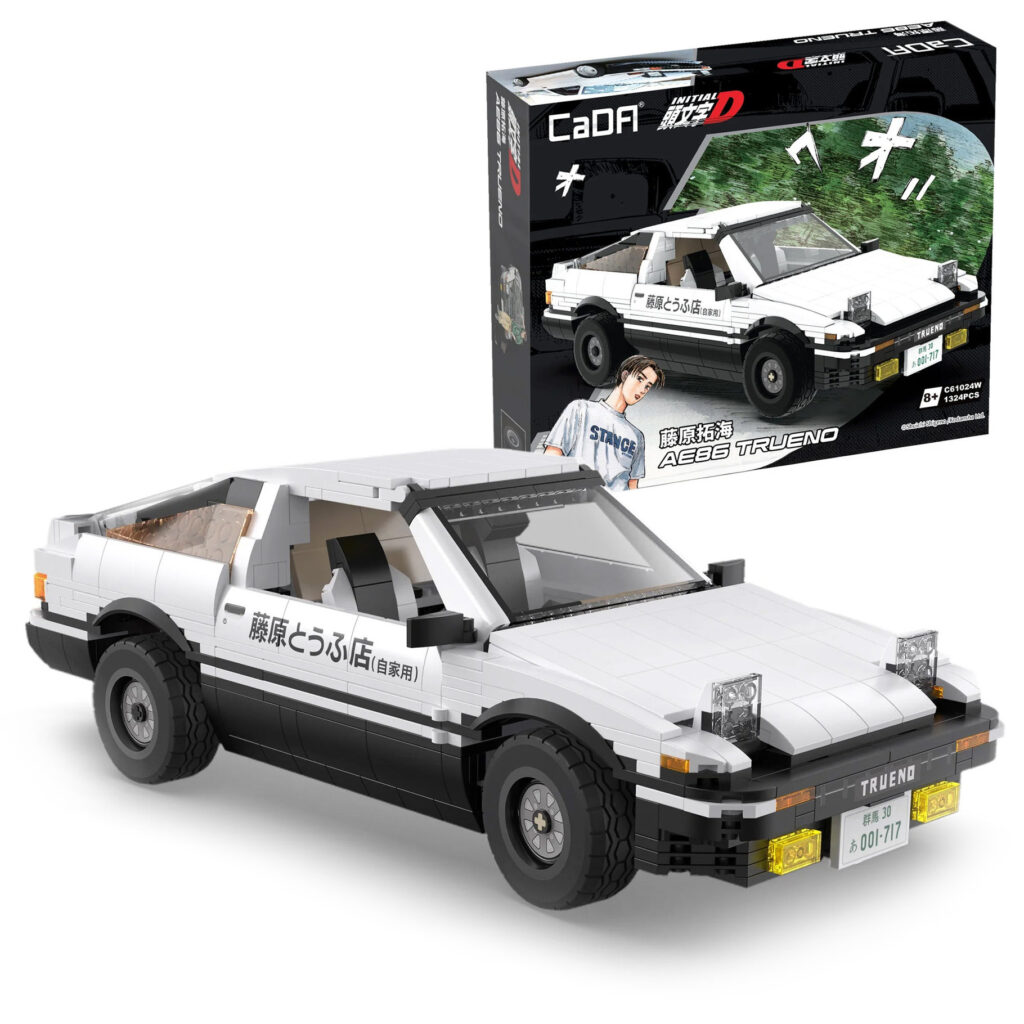
| Takumi’s Toyota AE86 C61024W | 1:12.5 | 1,324 | Opening panels, steering, suspension and styling options |
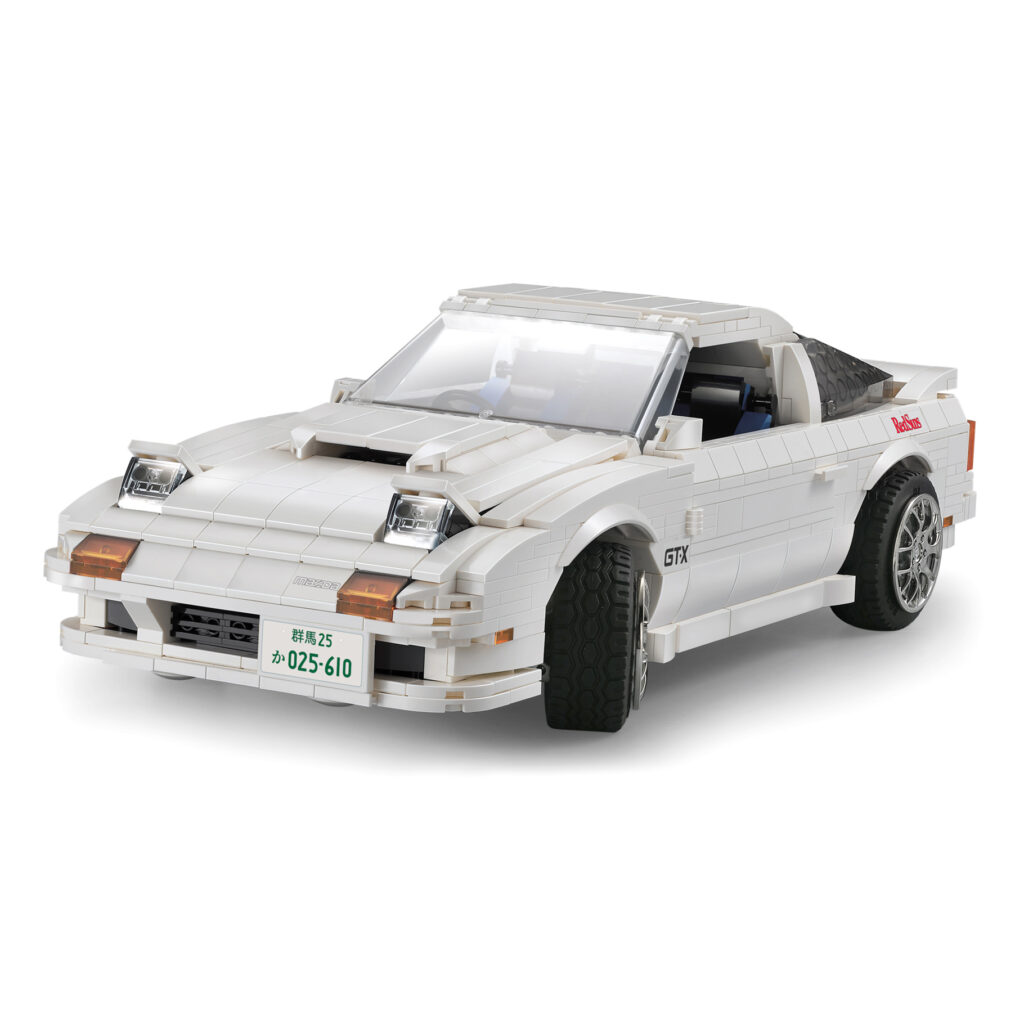
| Ryosuke’s Mazda RX-7 FC3S C61022W | 1:12 | 1,552 | Opening panels, flip-up headlights and display stand |
On a phone, swipe across the table to see every column. All six base sets are non-motorised. Compatible power systems for the two large cars are an optional, separate purchase; their standard boxes do not include electronics.
Small cars with plenty of shelf appeal
Takumi and Keisuke at 1:35: room for a little rivalry
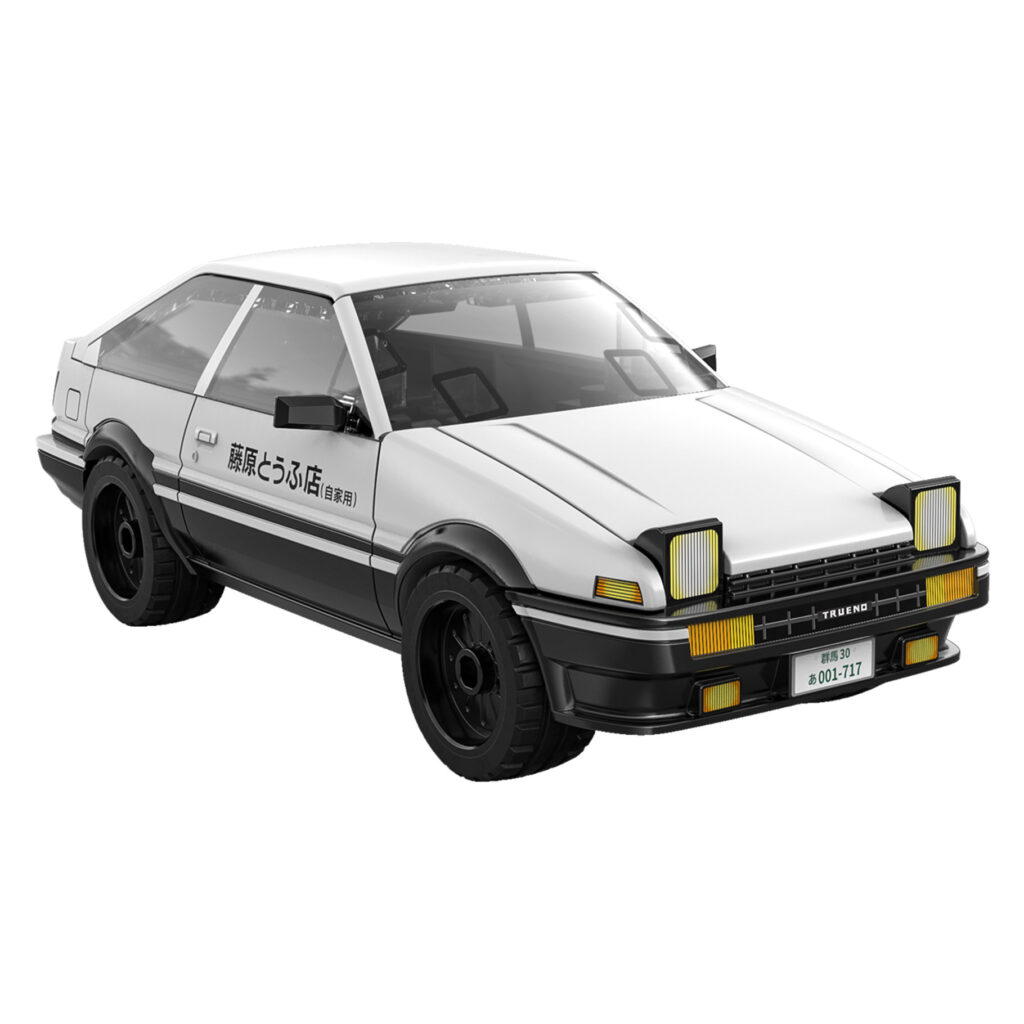
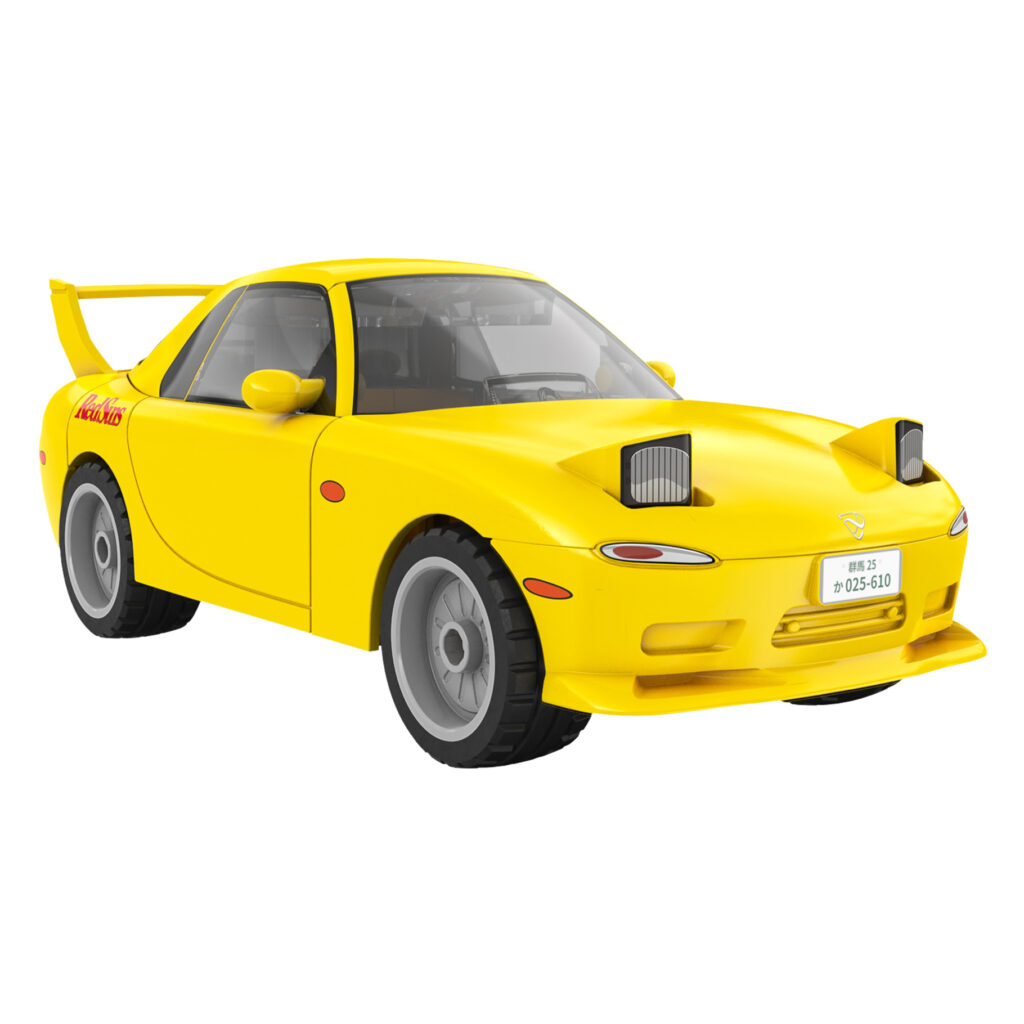
There is something immediately appealing about Takumi’s Toyota and Keisuke’s Mazda small enough to sit beside a stack of manga. The 1:35 Toyota Trueno AE86 C55018W and 1:35 Mazda RX-7 FD3S C55017W keep the black-and-white and yellow pairing on a very modest scale. You get the recognisable cars without first having to find a home for a substantial display model.
Their bodywork explains the low piece counts. Moulded exterior sections fit over a small brick-built structure, so much of each car’s shape is already there in those larger pieces. The 72-piece AE86 even has an opening bonnet. Keisuke’s 66-piece FD gets its character from the yellow body, rear wing and RedSuns markings. A handful of familiar details goes a long way when the subject means something to you.
For someone who loves Initial D and has never tried a construction set, these are an approachable place to begin. But a dedicated brick builder may already be wondering about the bodywork: what if you want to make more of those shapes yourself? That is where the next pair becomes interesting.
The Takahashi brothers at 1:24: a natural double act
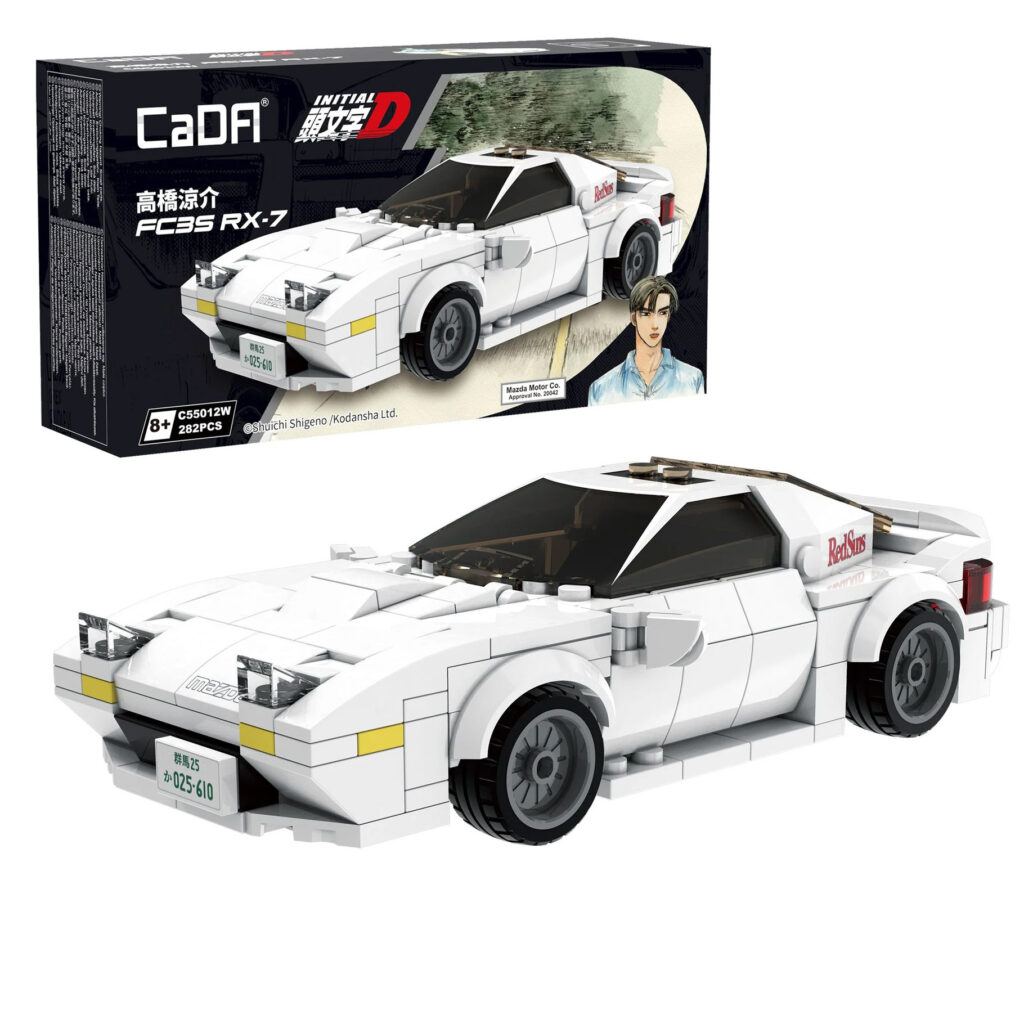
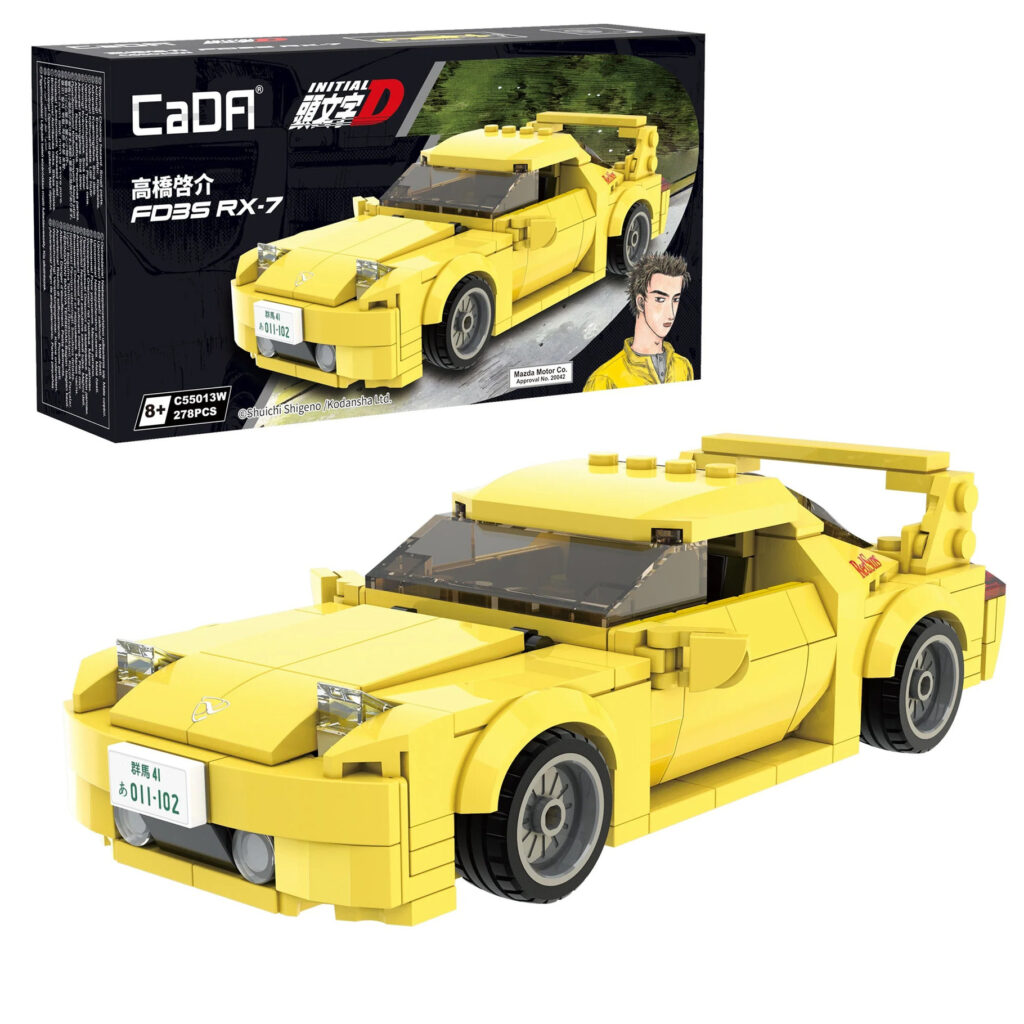
Look at the white nose of the 1:24 FC3S C55012W, then the yellow curves of the 1:24 FD3S C55013W. You can see the bricks at work. These more visibly brick-built bodies give the two generations of RX-7 their own character, with Ryosuke and Keisuke represented at the same stated scale. If the attraction is watching separate elements become a car you recognise, this is a particularly tempting double act.
There are 282 pieces in the FC and 278 in the FD, and both bonnets open to reveal engine detail. That is a welcome little invitation to look beyond the finished outline. The RedSuns decoration matters, too: these are the brothers’ cars, right down to the team markings. Some of that branding uses stickers, so give yourself time to line them up. They are small details you will notice every time you look at the models.
Happily, displaying the brothers together need not become a furniture project. The FC measures 16.6 × 8.7 × 4.6 cm and the FD 17.1 × 8.7 × 4.9 cm, in length × width × height. Only half a centimetre separates their lengths. Leave a little space between them and you can enjoy the change from the FC’s straight-edged shape to the FD’s rounded body without either car overwhelming the other.
The compact Initial D models
The larger cars: lift the bonnet, open the door
Takumi’s AE86 C61024W: make room for the tofu
Open the bonnet of the large CaDA AE86 C61024W and there is a representation of Toyota’s 4A-GE engine. Open a door and the cabin has seats, a gear lever, a handbrake and that wonderfully inconspicuous water cup. The tofu box is here as well. This is where the larger model earns its place: you can keep looking past the famous panda paintwork and find more of Takumi’s everyday world.
There is plenty for the builder to get absorbed in along the way. At 1:12.5 and 1,324 pieces, the AE86 has steering, front and rear suspension, and opening doors, bonnet and boot. Those mechanisms give you more to assemble beneath the familiar outline, while the opening panels let you see the work that would otherwise be hidden inside. Even with the bonnet down and the doors shut, the tofu-shop lettering keeps it unmistakably Takumi’s car.
You also get a choice about its appearance. CaDA supplies alternative bonnet and aero detailing for what it calls classic and Project D styling. We will leave the later story alone, but the build question is a good one: which version of the Trueno do you most want on your shelf? The familiar black-and-white look makes a strong case. The darker bonnet and altered body details might pull you the other way. It is worth looking at both before deciding how to finish your car.
Ryosuke’s FC3S C61022W: a closer look at the white RX-7
And then there are the headlights. The 1:12 Mazda RX-7 FC3S C61022W has working flip-up headlights, one of those details that can make a car model very difficult to leave alone. Ryosuke’s white FC already has that crisp shape and the RedSuns decoration going for it. Being able to change its expression with the lights is an excellent extra reason to keep it within reach.
Under the bonnet is a representation of the twin-rotor 13B-T engine, giving Mazda enthusiasts something quite different to inspect from the Toyota’s engine bay. The doors and boot open, and there is steering and suspension beneath the body. At 1,552 pieces, this is the largest build in the six-set selection. The included adjustable display stand is a thoughtful finishing touch: once you have assembled all that bodywork, you can choose the angle that shows it off.
The car itself measures 34.2 × 14.7 × 10.7 cm, before allowing for the stand and its position. CaDA also supplies alternative bonnet, wing, front-light and engine-detail parts. Between choosing those details, setting the display angle and deciding whether to leave the headlights up, there is quite a bit of arranging to enjoy after the instructions are finished.
The larger AE86 and FC3S
The shelf gets a vote
Of course, it is easy to picture two large cars together and rather harder to persuade a bookshelf to grow. Scale gives you the first clue: a smaller number after the colon means a larger model, so a 1:12 car is much bigger than a 1:24 version of the same subject. The finished measurements tell you what will actually fit.
For a matched pair from these six sets, you can put Takumi and Keisuke together at 1:35 or Ryosuke and Keisuke at 1:24. The large AE86 and FC3S would make an enticing feature shelf, too, though their stated scales are slightly different: 1:12.5 and 1:12. That is worth knowing if an exactly matched collection is part of the appeal.
The two FCs make the size difference especially clear. At 34.2 cm, the large car is a little over twice the length of its 16.6 cm companion. It also needs 14.7 cm of width before you open a door or position the stand. Measure the depth of the shelf as well as its length, particularly if you want that three-quarter view rather than a straight side profile.
There is no same-scale trio within this selection. If you want all three drivers represented at matching scales, that needs a wider plan. For these six, a well-chosen pair gives you plenty to enjoy: the two brothers invite a comparison of their Mazdas, while the tiny AE86 and yellow FD put two very different cars together in hardly any space.
Taking your Initial D build off the shelf
The large AE86 C61024W and FC3S C61022W can take the project beyond the shelf with optional powered conversion. It is a separate purchase, so decide whether driving the model is part of the fun for you before ordering. The four compact models are non-motorised, and none of these six standard car kits includes electronics.
If you do want to add power, match the exact car code to a compatible power pack and check the contents of both boxes. “Motorisable” and “RC-compatible” tell you that an upgrade is possible; the motor, battery and remote still need to be accounted for. For a shelf build, you can simply enjoy the large cars’ opening panels and mechanical details as they come.
And those FC headlights? The flip-up action is part of the standard model. Making them light up requires the optional power system. You can have the pleasure of popping them up without buying electronics.
Which CaDA Initial D car would you build first?
- For Takumi fans: the 1:35 AE86 keeps his car close in miniature; the large AE86 gives you a centrepiece with cabin details, opening panels and styling choices.
- The brothers belong together: the 1:24 FC3S and 1:24 FD3S make the neatest matched-scale RX-7 pairing here.
- For a white RX-7 of your own: choose the 1:24 car for a compact brick build, or explore the large 1:12 version for its opening features, headlights and stand.
- Keisuke’s yellow FD catches your eye: compare the moulded-body 1:35 model with the more visibly brick-built 1:24 version. Think about which sort of bodywork you would enjoy putting together.
- Choosing a gift? find out the favourite driver and where the car will live. A well-chosen little AE86 can be a far more personal present than simply picking the biggest box.
Browse our CaDA Initial D sets to check the current models, prices and availability.
Still weighing up your first brick build? Our guide to choosing your first CaDA set goes into the wider building questions. And if the mechanisms have caught your imagination, the CaDA Master Series guide has more substantial projects to explore beyond these licensed cars.
Whichever box you settle on, leave the finished car somewhere you can get a proper look at it. The RX-7s deserve a moment side by side; the large FC deserves to have its headlights flipped up now and again. And Takumi’s AE86 deserves a closer look inside. After all that choosing, building and finding room on the shelf, there is still a tiny water cup waiting to make you smile.