

The best CaDA cars are not simply the biggest ones. If they were, choosing would be easy: buy the box with the most pieces and start negotiating for shelf space. Helpful? Not even slightly.
CaDA’s automotive range now stretches from pocket-money mini cars to
1:8 machines more than half a metre long. Some are cheerful evening
builds destined for a bookshelf. Others hide gearboxes, steering and
suspension beneath bodywork that can take several evenings to complete.
Then there are the motorised models, ready to escape across the
living-room floor by remote control or through the CaDA Smart app.
They all have four wheels, but they are not remotely the same hobby
experience. The best CaDA car is the one that gets the balance right for
you: a subject you care about, a challenge you will relish, functions
you will actually use and a finished model your shelves can accommodate
without emergency negotiations.
If you want the short answer, start with the CaDA Lotus Evija
1:24 for an approachable first build. Choose the
Initial D Toyota Trueno AE86 if JDM culture and anime
authenticity matter more than winning a specification contest. The
Lotus Exige Cup 430 is our value-minded route into
CaDA’s big 1:8 cars; the Mercedes-AMG GT3 is the one
for builders who genuinely enjoy a formidable mechanical project. If you
want the finished car to move, lift and generally show off, the
BYD Yangwang U9 is in a class of its own.
The Bomran Guide
Best CaDA Cars – Quick Guide
📖 Reading time: Approximately 18-22 minutes
👤 Perfect for:
- Builders choosing their first CaDA car
- Adult fans looking for a substantial automotive project
- Car collectors comparing sizes, functions and prices
- Parents and gift buyers trying to judge difficulty
- LEGO Technic builders curious about CaDA’s vehicle range
🎯 In this guide you will learn:
- Which CaDA cars suit different types of builder
- How 1:24, 1:20, 1:14, 1:12 and 1:8 models differ
- When remote control adds value and when a manual model makes more
sense - Which features justify moving up to a larger set
- What to check before buying a CaDA car as a gift
📚 Related Bomran Guides:
- What Is CaDA? The
Complete Beginner’s Guide - How to
Choose Your First CaDA Set - The Best
CaDA Sets for Adults - CaDA Master
Series Explained - CaDA vs LEGO: What’s
the Difference?
Prices, availability and specifications were checked in September
2026 and may change. Recommendations are based on published
specifications, functions, scale, value and suitability. We do not claim
to have personally built every model in this guide.
The best CaDA cars at a
glance
| Our pick | Scale | Pieces | Best for | Main appeal | Price when checked |
|---|---|---|---|---|---|
| Lotus Evija C55044W | 1:24 | 276 | A first CaDA car | Printed details and compact display size | £14.95 |
| Citroën 2CV | 1:24 | 298 | A relaxed budget build | Plenty of character for under £10 | £9.99 |
| Renault 5 Maxi Turbo C51095W | 1:20 | 282 | Affordable RC fun | Remote and app-controlled driving | £21.95 |
| Maserati MC20 GT2 | 1:14 | 549 | A larger RC race car | Remote control, app control and programming | £39.95 |
| Initial D Toyota Trueno AE86 | 1:12 | 1,324 | Initial D and JDM fans | Pop-up lights, engine detail and Project D options | £62.95 |
| Lotus Exige Cup 430 | 1:8 | 3,730 | Large-scale value | Printed parts, suspension and removable roof | £151.95 |
| Mercedes-AMG GT3 | 1:8 | 5,466 | A serious technical project | Eight-speed transmission and race-car engineering | £244.95 |
| BYD Yangwang U9 | 1:8 | 3,671 | Maximum motorised interaction | RC driving, chassis lift, tank turns and dancing | £234.95 |
Think of this as a grid of starting points rather than a podium.
Every car below answers a different buying question. Crowning one
universal winner would only ignore the awkward truth that a 60 cm,
multi-thousand-piece masterpiece is a dreadful recommendation for
somebody with one free evening and a narrow bookshelf.
Best first CaDA car: Lotus
Evija 1:24
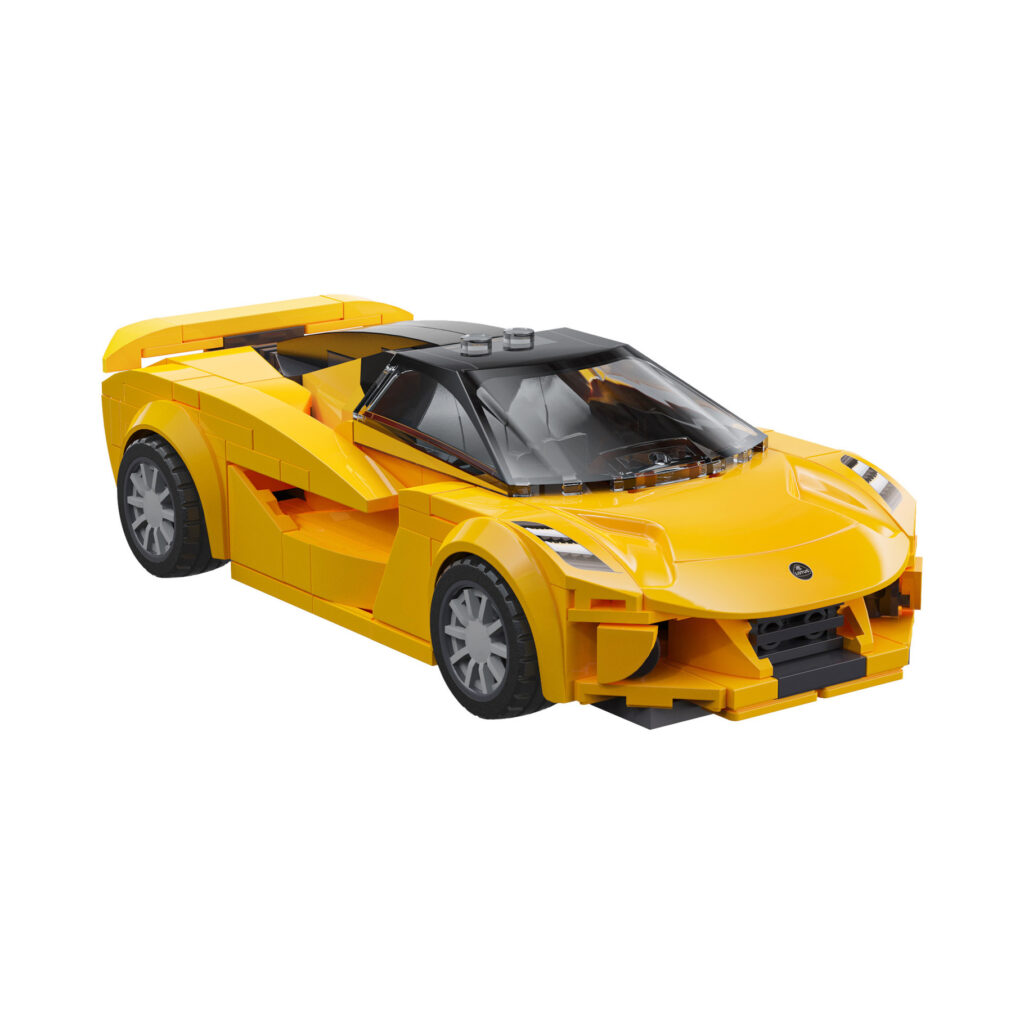
The 1:24 Lotus Evija is where we would point somebody who wants to
discover what a CaDA car feels like without handing over a weekend, a
large sum of money or an entire shelf.
It uses 276 pieces and measures approximately 15.2 cm long when
complete. That gives the build enough substance for the Evija’s shape to
emerge properly, but keeps it approachable. The bright yellow body, dark
canopy and unusual rear light treatment also help it look like a
specific car rather than a generic sports-car silhouette.
The printed components are particularly welcome. Stickers can work
well on larger race cars, but on a compact model even a slightly crooked
graphic becomes conspicuous. Here, the important decoration is already
aligned, and the finished car includes a commemorative display tile.
Do not expect a working gearbox or a motorised drivetrain. The Evija
rolls, looks good and knows its job. Its real trick is turning a modest
276-piece build into something recognisable enough to deserve a place
beside much larger models.
Choose it if: you want a manageable first CaDA car,
a compact Lotus collectible or an inexpensive gift with proper display
appeal.
Look elsewhere if: the mechanism is the main event
for you. The Renault 5 Maxi Turbo adds remote control for only a modest
increase in price, while the larger cars provide far more
engineering.
Explore
the CaDA Lotus Evija 1:24
Best CaDA car under £10:
Citroën 2CV
Supercars tend to dominate brick-built car ranges. The little Citroën
2CV is a cheerful reminder that interesting cars do not need enormous
wings or four-figure horsepower.
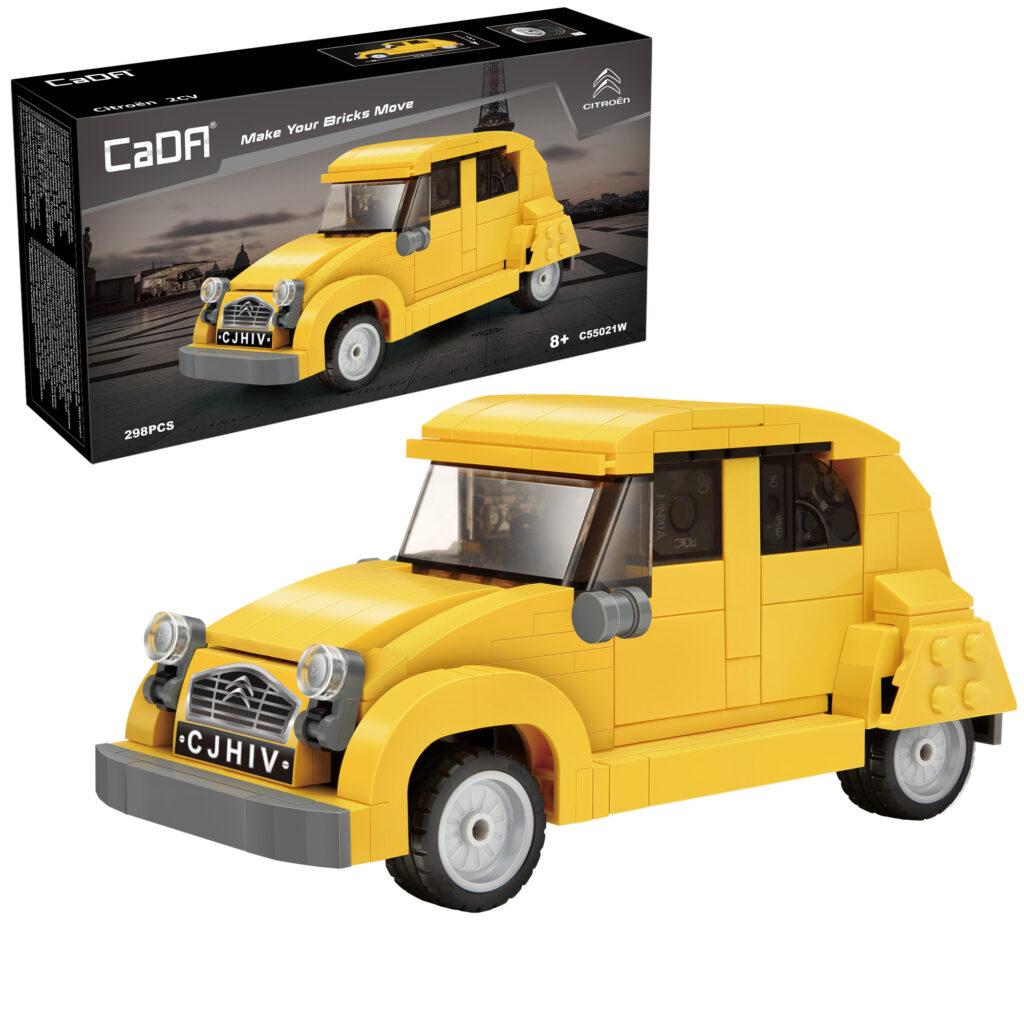
CaDA’s 1:24 model contains 298 pieces and carries an easy difficulty
rating. More importantly, the source material is perfectly suited to a
smaller set. The upright cabin, rounded bonnet and wonderfully unhurried
proportions give the finished model an identity of its own.
At £9.99 when we checked, it is one of the least expensive automotive
builds in Bomran’s CaDA range. That makes it a sensible trial run for
someone who has never built CaDA before, but do not mistake it for a
consolation prize. A collection containing nothing but modern hypercars
can start to resemble a very expensive doorstop convention. The 2CV
brings a new shape, a different mood and a much earlier chapter of
motoring history to the shelf.
Do keep expectations sensible. This is a straightforward 298-piece
display model, not a miniature engineering laboratory. That simplicity
is the point. It is the sort of set you can build for the pleasure of
watching a familiar little car appear, rather than spending three
evenings debugging a transmission.
Choose it if: you want an inexpensive, relaxed build
or know somebody with a soft spot for classic French cars.
Look elsewhere if: you are buying for a builder who
measures value by mechanisms and moving functions.
More compact CaDA cars to
consider
CaDA’s
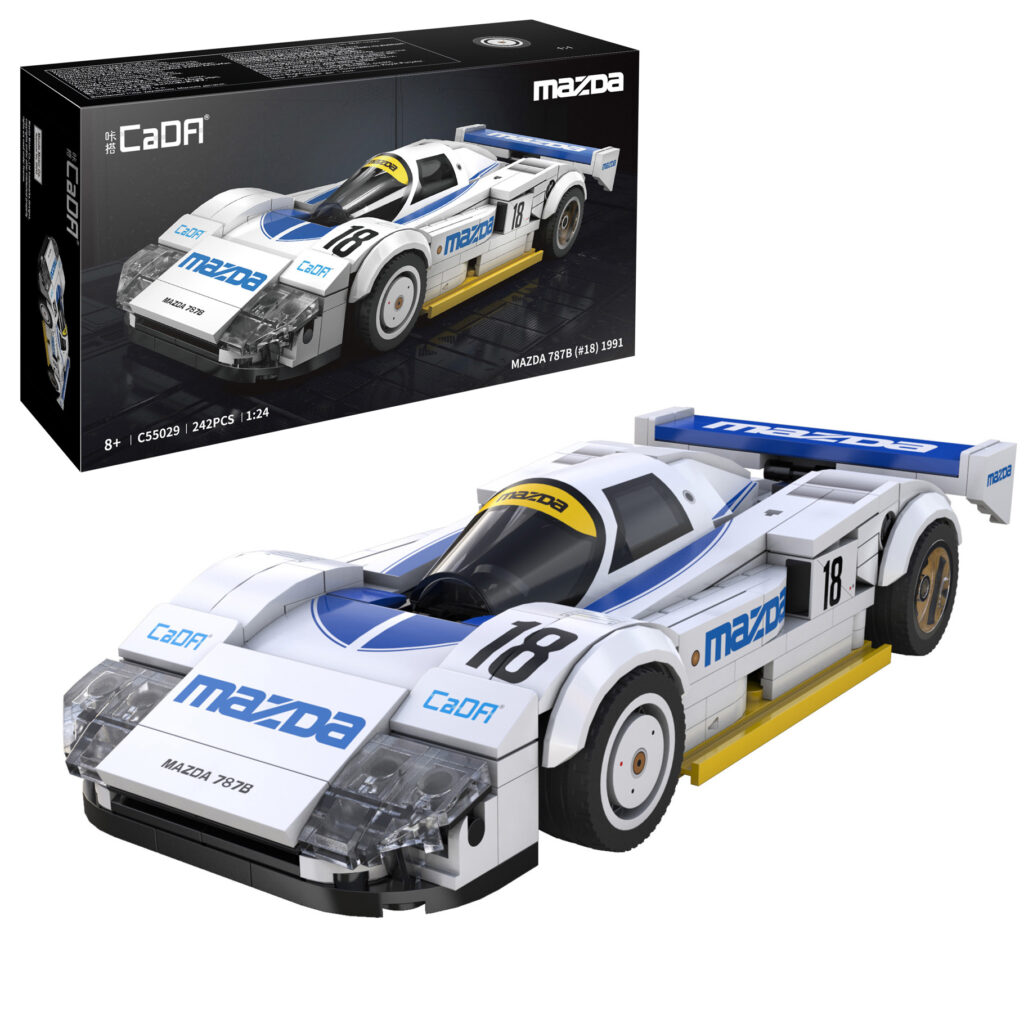
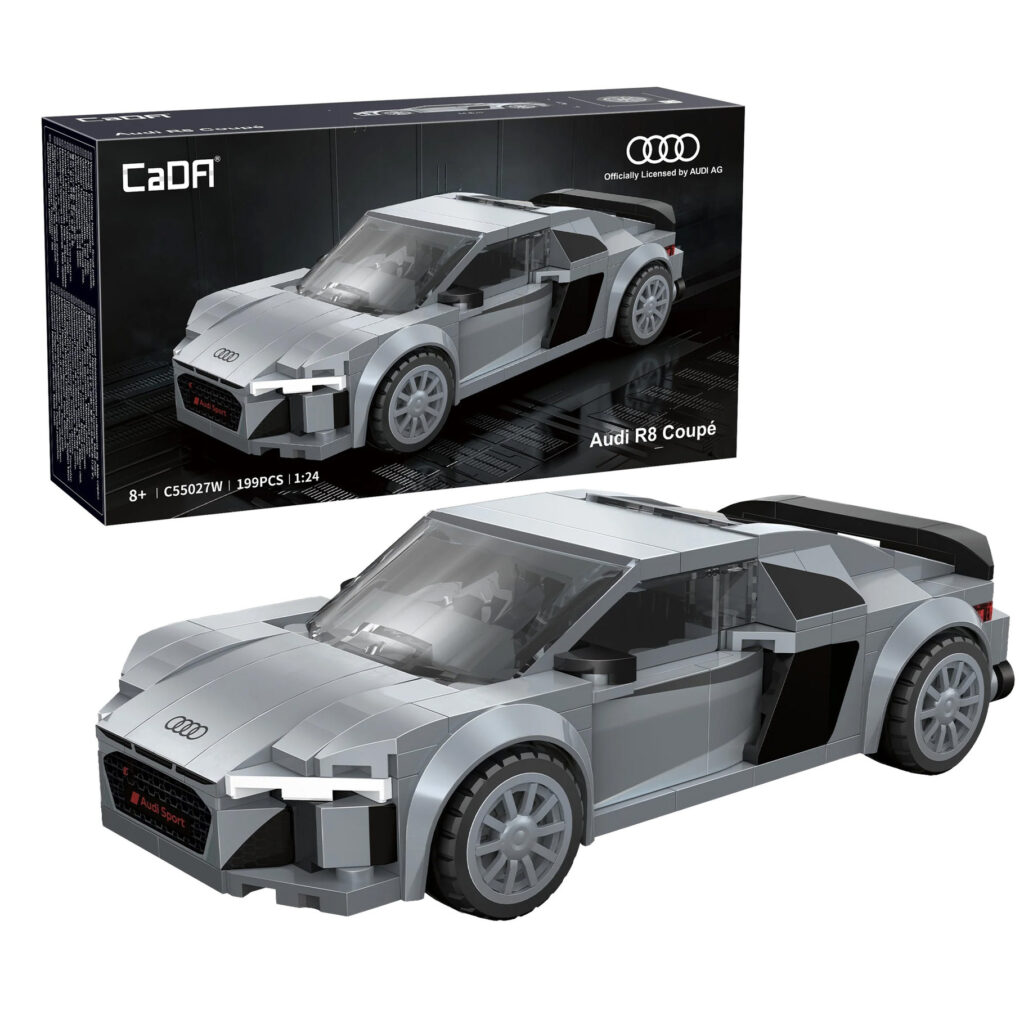
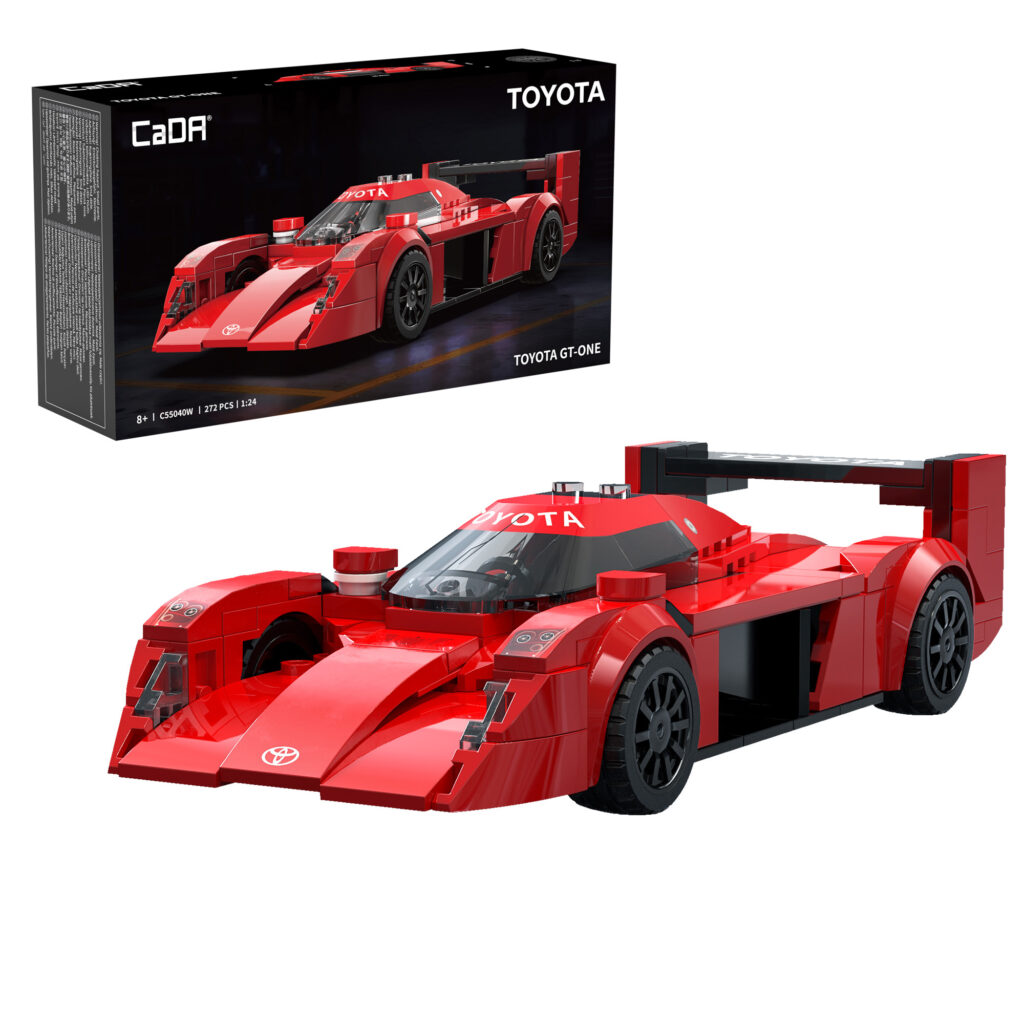
1:24 range is one of its most useful entry points. The Lotus Exige
Cup 430, Audi R8 Coupé, Mazda 787B, Renault 5 Maxi Turbo, Toyota GT-One
and Initial D RX-7 models all fit the same broad collecting scale while
offering very different subjects.
This is where collecting can become pleasantly dangerous. One 15 cm
car barely troubles a shelf; six of them begin to look like a grid.
Compact CaDA Cars for a First Build
Best
affordable CaDA RC car: Renault 5 Maxi Turbo 1:20
The Renault 5 Maxi Turbo occupies one of the range’s sweetest spots.
It is compact, affordable and, once the last piece clicks into place,
still has plenty left to do.
The 282-piece build sits on a motorised chassis and can be driven
using the supplied control system or the CaDA Smart app. Printed
detailing gives the little Renault its rally character without asking
the builder to line up a sheet of livery stickers.
The subject helps enormously. The boxy cabin, swollen arches and
short wheelbase of the real Maxi Turbo translate beautifully into brick
form. Better still, there is something inherently funny about watching
this famously unruly rally silhouette scoot obediently across the
carpet. At 1:20 scale it is also far easier to store and operate indoors
than one of CaDA’s heavyweight 1:8 RC models.
The trade-off is straightforward. With 282 pieces built around a
motorised chassis, the Renault cannot offer the structural depth of
CaDA’s larger manual cars. You are swapping a detailed engine, complex
suspension and multi-speed gearbox for accessibility and movement. For
younger builders – and anyone who wants a car to drive rather than
merely admire – that may be exactly the right deal.
Choose it if: you want remote-control enjoyment at
an approachable price, especially if rally cars have more appeal than
another low-slung supercar.
Look elsewhere if: you want the building process to
last much longer than the driving session.
View
the CaDA Renault 5 Maxi Turbo RC model
Best mid-sized
RC race car: Maserati MC20 GT2 1:14
If the Renault feels a little too pocket-sized, the 1:14 Maserati
MC20 GT2 adds more race-car presence without making the enormous leap to
a 1:8 flagship.
Its 549 pieces create a broader, more substantial race-car body,
while the Code STEAM system supports 2.4 GHz remote control, CaDA Smart
app operation and programmable movement. This is a good example of where
CaDA’s car and STEAM
ranges overlap: it is recognisably a licensed motorsport model, but
interaction and simple coding are part of the appeal rather than an
afterthought.
The 1:14 size also gives the bodywork more room to capture the low
stance and wide shape of the MC20 GT2. Printed components keep the key
decoration tidy, which matters on a modern racing car where graphics
form part of the visual identity.
For a child or family, the Maserati has a useful second life after
the build: first construct it, then drive it, then experiment with
programmed movement. Adult collectors should ask themselves a blunter
question. Will it ever leave the shelf? If the honest answer is no, a
display-led model may devote more of its budget to bodywork and
mechanical detail you will appreciate every day.
Choose it if: you want a larger RC car with app
control and programming, or a build that bridges vehicle modelling and
STEAM play.
Look elsewhere if: you want a detailed scale engine
or a long advanced build. This remains an accessible 549-piece powered
model.
Explore
the CaDA Maserati MC20 GT2
Best
CaDA car for Initial D fans: Toyota Trueno AE86 1:12
Some cars are admired. Others arrive with a soundtrack already
playing in your head. For Initial D fans, Takumi Fujiwara’s Toyota
Trueno AE86 belongs firmly in the second camp – and that is before the
headlights have even popped up.
CaDA’s 1:12 model uses 1,324 pieces, placing it in a rewarding middle
ground between the compact car range and the vast 1:8 projects. The
larger body allows for opening doors, bonnet and boot, linked steering,
manually operated pop-up headlights, rear suspension and a detailed
4A-GE engine. There is even a tofu box in the boot, because leaving it
out would rather miss the point.
Project D styling options allow details including the bonnet, lights
and spoilers to be changed. That gives the model a little narrative
progression instead of freezing the AE86 at a single point in the
series.
The AE86 does not need to win a specification contest. Other cars
offer remote control, larger transmissions and far more pieces. It earns
its place because CaDA has understood the subject. Here, the pop-up
lights, tofu box and Project D options are not decorative trivia; they
are the details fans came to see.
The one caution is scale. CaDA’s
Initial D cars are available in several sizes, so collectors should
not assume that every model in the range will line up neatly beside this
1:12 AE86. Our CaDA Initial D guide compares the AE86 and RX-7 versions, their scales and the details that matter when building a collection.
Choose it if: Initial D, Japanese performance cars
and the AE86’s mechanical character are the reason you are shopping.
Look elsewhere if: you simply want the most
engineering per pound and have no particular attachment to the car or
series.
See
the CaDA Initial D Toyota Trueno AE86
Best-value 1:8 CaDA
car: Lotus Exige Cup 430
Large CaDA cars become serious projects with remarkable speed. The
Lotus Exige Cup 430 offers a comparatively accessible way into that
world while still delivering the size, complexity and unmistakable shelf
presence people expect from 1:8 scale.
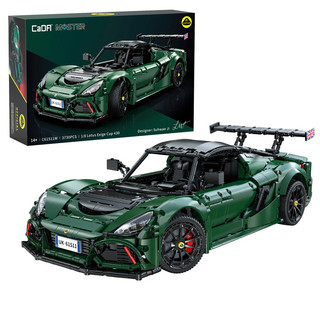
The set contains 3,730 pieces and builds a model approximately 53.8
cm long. It includes manual steering, opening doors, four-wheel
independent suspension and a removable roof. Printed parts are used
instead of stickers, which is a meaningful advantage on a large display
car: there is no long decal application session waiting after the
bodywork is complete, and the finish should remain consistent across the
model.
At £151.95 when checked, it sits noticeably below Bomran’s other
in-stock 1:8 cars. That does not make it inexpensive, but it makes the
step from a mid-sized build to a flagship project less severe.
The mechanical specification is sensibly focused rather than
desperate to win Top Trumps. It will not perform the BYD Yangwang U9’s
motorised party tricks or give you the Mercedes-AMG GT3’s eight-speed
transmission. What it offers is a substantial, coherent manual build
with convincing Lotus proportions and a choice of closed-roof or
open-top display.
This is perhaps the most balanced large car in the current Bomran
range for someone who wants the 1:8 experience without automatically
chasing the largest piece count or longest list of electronics.
Choose it if: you want a substantial adult project,
printed decoration and strong display presence at the more approachable
end of CaDA’s 1:8 pricing.
Look elsewhere if: remote control or the deepest
possible drivetrain is essential.
Explore
the CaDA Lotus Exige Cup 430
Best
CaDA car for a serious technical build: Mercedes-AMG GT3
The Mercedes-AMG GT3 is for the builder who sees a 5,466-piece count
and thinks, “Excellent. That should keep me quiet for a while.”
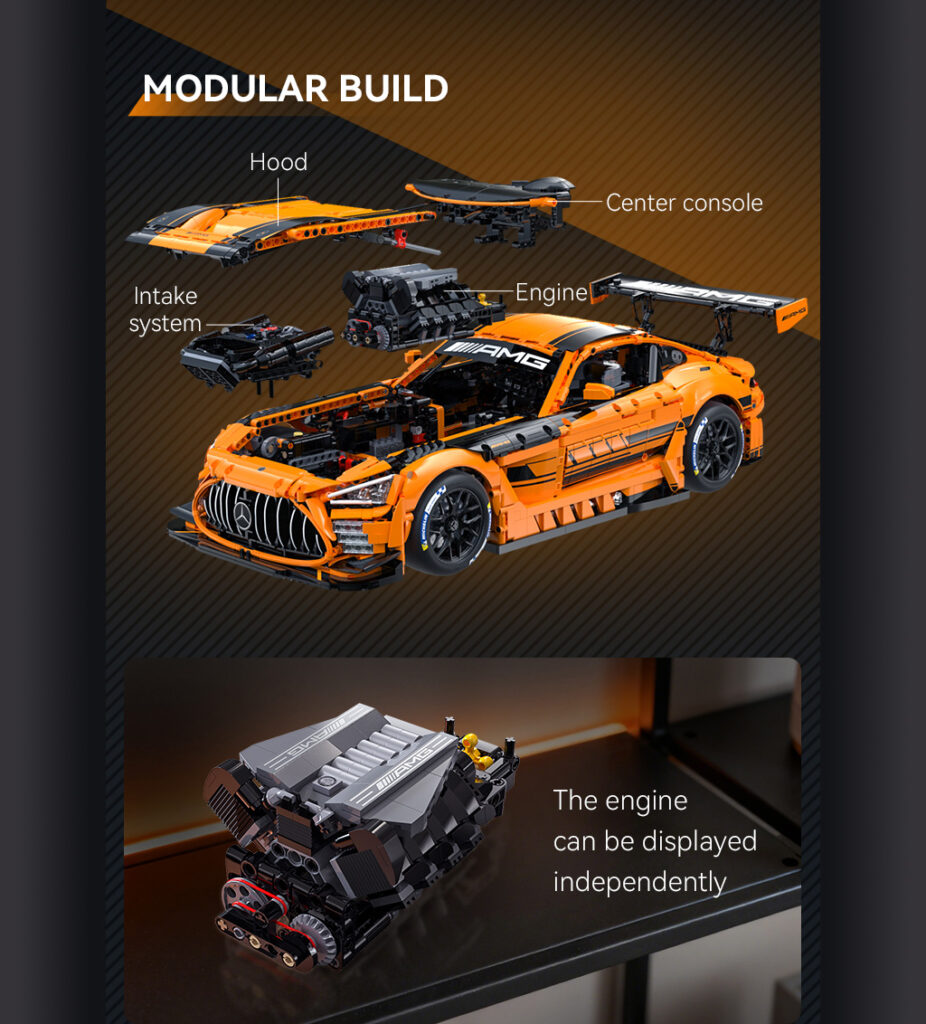
Based on the 2020 Mercedes-AMG GT3 Evo, this 1:8 model is
approximately 59 cm long. Beneath its orange and black racing bodywork
are an eight-speed transmission, independent suspension, adjustable
shock absorbers, linked steering details and modular roof, engine and
dashboard sections. Lighting components and lockable doors add further
interest, while tyre-changing accessories bring a little pit-lane
theatre to the completed display.
Its appeal is not simply that it contains more pieces than anything
else in this guide. Piece count can be a blunt instrument; hundreds of
tiny decorative elements do not automatically create a rewarding
mechanism. Here, that imposing number accompanies a genuinely broad
technical specification, wrapped around a race car that makes complete
sense as an engineering subject.
That depth comes with a warning label. Build carefully, test
frequently and do not treat the gearbox pages as an opportunity to catch
up with the television. A wrong connection buried early in the chassis
will not become more convenient once several thousand pieces of bodywork
surround it. This is not where we would start a nervous first-time
builder.
Nor is it small. Before ordering, find a display area with
considerably more than 59 cm of usable length and enough depth for a 1:8
GT car. “It will probably fit” is how dining tables acquire permanent
residents.
Choose it if: the construction process, internal
engineering and GT racing subject matter all matter as much as the
finished display.
Look elsewhere if: you want a casual build, have
limited display space or would prefer remote-controlled movement to a
complex manual transmission.
View the
CaDA Mercedes-AMG GT3
Most interactive
flagship: BYD Yangwang U9 1:8
The BYD Yangwang U9 takes a wonderfully different route to flagship
status. Where the Mercedes-AMG GT3 concentrates on a conventional
mechanical build, the U9 turns its 1:8 chassis into an electrically
powered performance. Subtle, it is not.
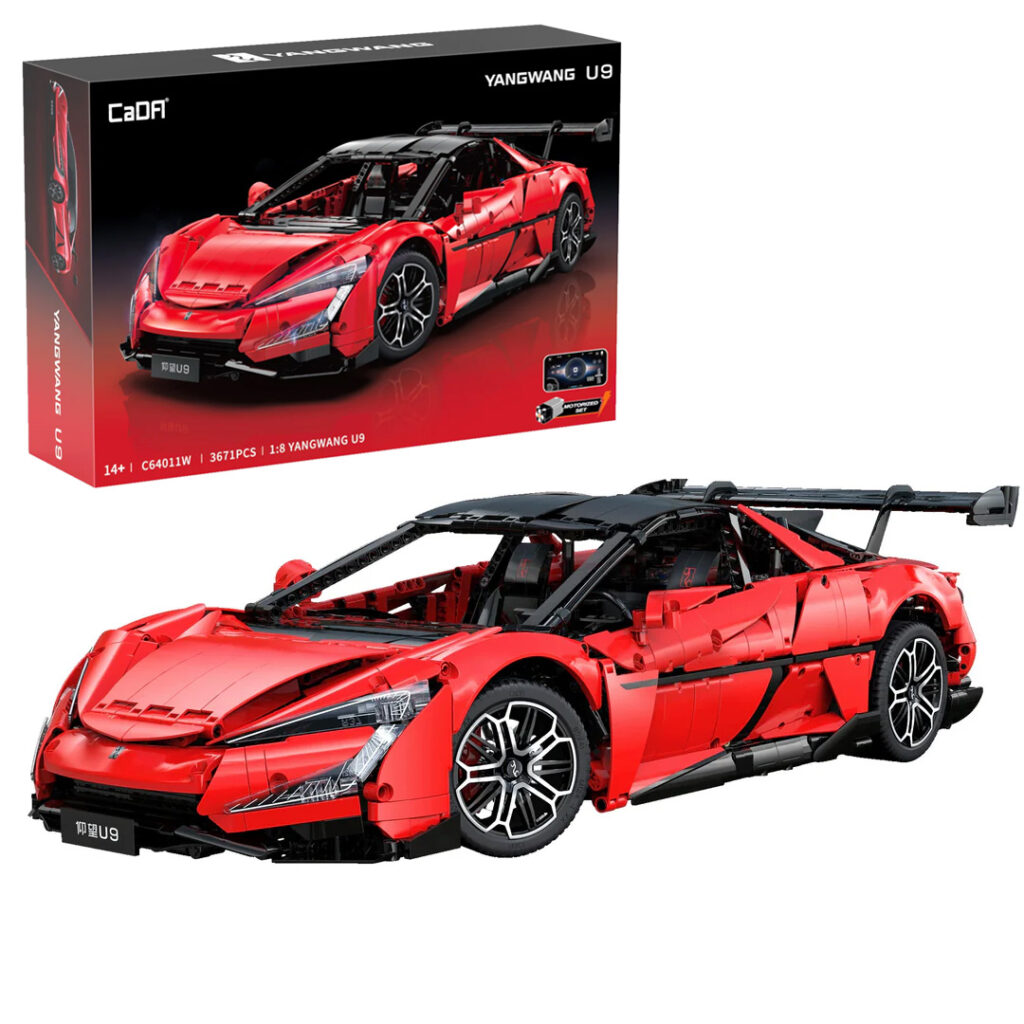
The 3,671-piece model includes remote-controlled driving, LED
lighting, adjustable suspension, chassis lifting, tank turns and
four-wheel independent dancing. Customisable dance movements mirror the
unusual dynamic demonstrations associated with the real electric
supercar. Opening butterfly doors and a finished length of approximately
60.3 cm ensure it still looks like a flagship display model when it is
standing still.
It is supplied with an extensive electronics package, including
multiple L Motor Pro and Servo Motor Pro units, rechargeable batteries,
hubs, lights and a controller. That helps explain both its capability
and its price.
For some builders, this will be the most exciting car in the range
because it does things most brick-built display cars simply cannot. For
others, the electronics will perform two triumphant demonstrations
before spending retirement on a shelf. Be honest about which owner you
are likely to become.
There is also a practical point: a 60 cm car needs room to manoeuvre
as well as room to display. Tank turns and dancing functions are less
impressive when the available test track is the width of a placemat.
Choose it if: you want CaDA’s motorised engineering
pushed to the foreground and will genuinely enjoy operating the
completed model.
Look elsewhere if: you prefer a traditional manual
mechanism, a classic marque or a display-first build.
Explore
the CaDA BYD Yangwang U9
Other flagship CaDA
cars worth considering
The recommended models above are not the only strong choices among CaDA’s
1:8 cars.
The CaDA
Mazda RX-7 combines remote-controlled driving with a
manually operated four-speed gearbox, linked simulated Wankel rotary
engine, working lights and independent suspension. For a rotary or
Japanese performance-car enthusiast, that combination may be more
persuasive than any general “best” award.
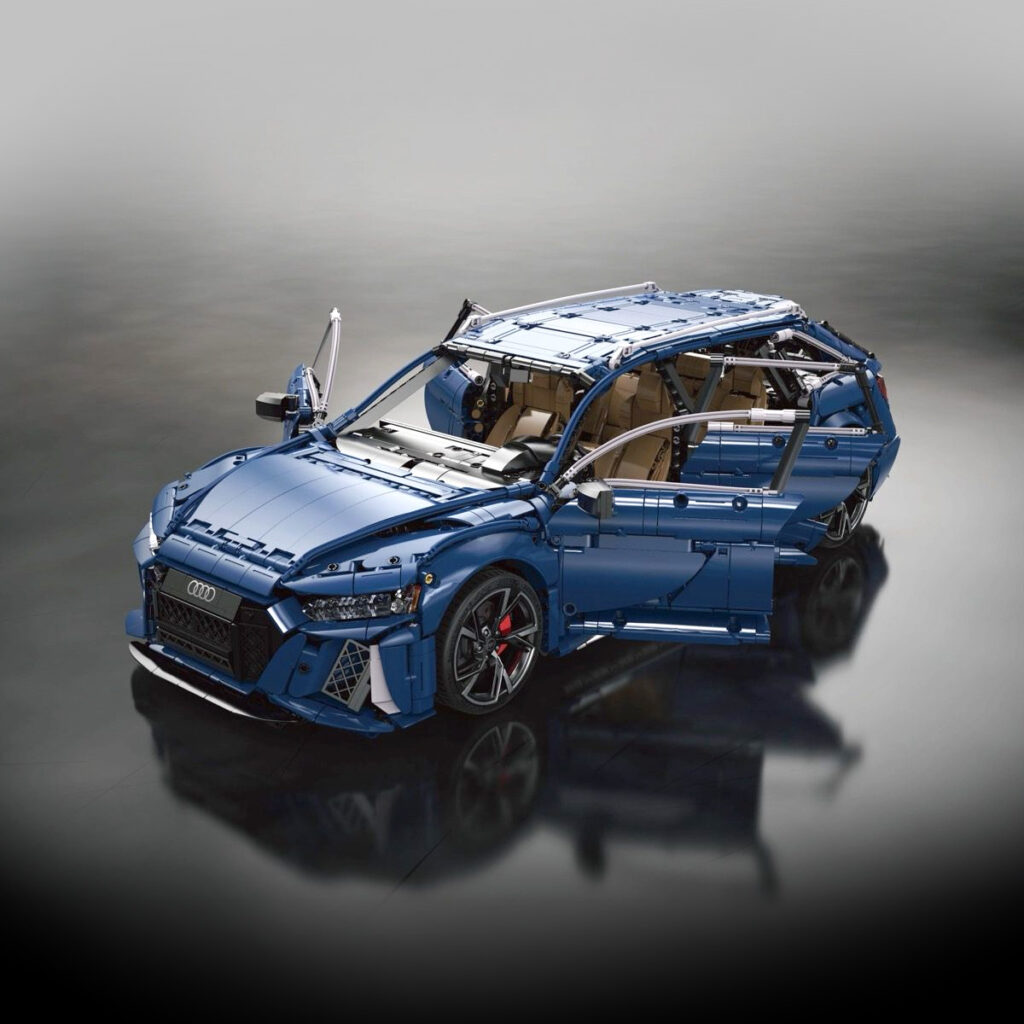
The new Audi
RS 6 Avant takes a display-led approach, using 4,663 pieces
to recreate the C8-generation performance estate at 1:8 scale. It
measures 60.3 cm long and uses printed details rather than stickers.
Working steering, opening panels and a detailed V8 engine provide
mechanical interest, but its real distinction is the subject: a large
performance estate stands out in a field crowded with supercars.
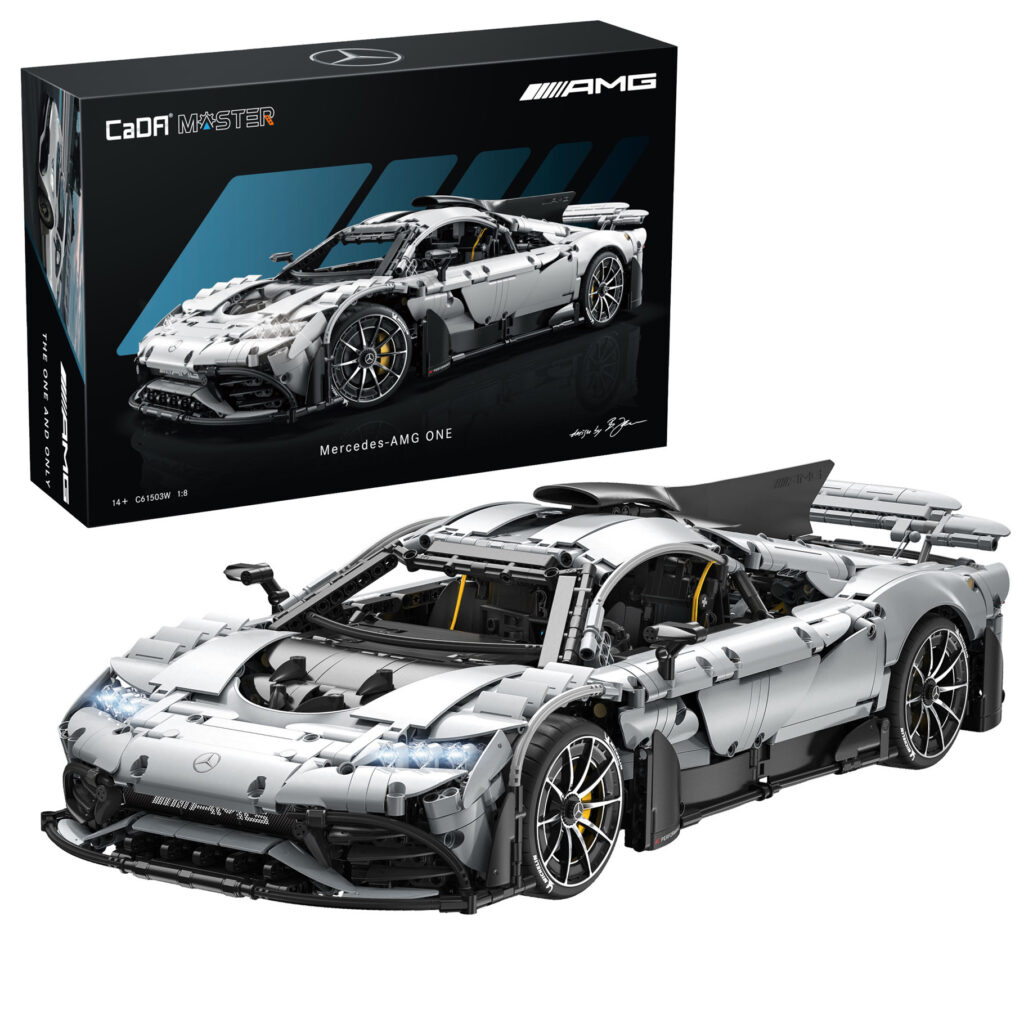
The Mercedes-AMG
Project ONE remains another important Master Series choice.
Its Formula One-derived hypercar shape and complex engineering offer a
different sort of spectacle from the U9’s motorised showmanship.
CaDA 1:8 Cars for a Serious Building Project
How to choose the right CaDA
car
Recommendations help, but understanding the trade-offs will stop
somebody else’s favourite car becoming your expensive mistake.
Start with the car, not
the piece count
A build lasting several evenings is a long time to spend with a
subject you only mildly like. If you care about Initial D, the AE86’s
pop-up lights and tofu box will probably mean more than an extra
thousand anonymous pieces elsewhere. If you follow GT racing, the
Mercedes-AMG GT3’s cockpit and pit accessories give the mechanical build
context.
Start by making a shortlist of cars you would actually enjoy seeing
every day. Then compare their specifications.
Treat scale as a space
requirement
Scale affects far more than visual detail.
- 1:24
cars are compact, approachable and easy to collect in
groups. - 1:20
cars remain manageable but often introduce pull-back or
powered functions. - 1:14
and 1:12
cars provide more body detail and mechanical room without
reaching flagship dimensions. - 1:8
cars are major projects and large display objects, commonly
measuring around 54-60 cm in the current Bomran range.
The ratio is not an exact finished-size guarantee because real cars
have different dimensions. A 1:8 estate and a 1:8 compact sports car
will not occupy identical shelves. Always check the measurements of the
specific set.
We will explore this properly in our dedicated guide to CaDA car
scales.
Decide
whether you want to build, display or drive
Most people want a mixture, but one usually matters most.
If building is the priority, look for gearboxes, steering systems,
suspension, engines and chassis construction. If display matters most,
consider shaping, printed decoration, colour, licence and physical
presence. If you want to drive the completed model, check exactly what
is included: remote control, app compatibility, motors, battery
equipment and lights vary between sets.
Do not assume every large car is motorised, or that every powered
model has a detailed transmission. Those are separate design
choices.
Check what the price is
paying for
A higher price may buy more pieces, a larger licence, specialist
panels, printed decoration, a complex mechanical system or a complete
electronics package. Two similarly priced cars can therefore offer very
different experiences.
The Lotus Exige Cup 430 puts its budget into a large manual display
build. The BYD Yangwang U9 puts far more emphasis on motors, servos and
movement. Neither approach is automatically better, but one may suit you
far more closely.
Be realistic about
difficulty
Age recommendations are useful safety and complexity indicators, but
experience varies. A patient younger builder who already understands
pins, axles and gears may manage a set that frustrates an adult new to
technical construction.
For a first build, a compact model provides an inexpensive way to
learn CaDA’s instructions and connections. If you jump directly into a
multi-thousand-piece car, slow down and test every moving system as the
instructions introduce it. Discovering a mistake before the bodywork
goes on is a small correction. Discovering it afterwards is
archaeology.
Which CaDA car is best for
you?
Choose the Lotus Evija 1:24 if you want a safe,
compact introduction to CaDA cars.
Choose the Citroën 2CV if budget and personality
matter more than mechanisms.
Choose the Renault 5 Maxi Turbo if you want
affordable remote-control fun.
Choose the Maserati MC20 GT2 if you want a larger RC
model with app control and programmable movement.
Choose the Initial D Toyota Trueno AE86 if the
story, car culture and small authentic details are the heart of the
purchase.
Choose the Lotus Exige Cup 430 if you want an
attractively priced route into large 1:8 construction.
Choose the Mercedes-AMG GT3 if you want the most
involved traditional technical project in this selection.
Choose the BYD Yangwang U9 if you want a flagship
model that moves, lifts, turns and dances once the building is over.
And if your favourite car is not on that list, buy the car you
actually care about. A technically “better” model is rarely the better
possession when you would rather have an RX-7, Audi RS 6 or Toyota rally
car on your shelf.
Frequently asked questions
What is the best CaDA
car for beginners?
The CaDA Lotus Evija 1:24 is a strong first choice. It has 276
pieces, printed details and a compact finished size, providing a
recognisable licensed car without the cost or complexity of a large
technical model. The Citroën 2CV is an even less expensive alternative
for a relaxed first build.
What is the best CaDA car
for adults?
That depends on the adult. The Lotus Exige Cup 430 offers a
substantial 3,730-piece 1:8 project at a comparatively accessible
flagship price. Experienced technical builders may prefer the
5,466-piece Mercedes-AMG GT3, while RC enthusiasts may get more from the
BYD Yangwang U9 or Mazda RX-7.
Which CaDA car has the most
pieces?
Among the current cars covered in this guide, the CaDA Mercedes-AMG
GT3 has the highest piece count at 5,466 pieces. Piece count should not
be the only deciding factor, but it accompanies a detailed specification
including an eight-speed transmission and independent suspension.
Are all CaDA cars remote
controlled?
No. CaDA produces static display cars, manually operated mechanical
models, pull-back cars and remote-controlled models. Check the
individual product specification rather than assuming that a large size
or technical appearance means motors are included.
Are CaDA car details
printed or stickered?
This varies by set. Several current models, including the Lotus Evija
1:24, Lotus Exige Cup 430 and Audi RS 6 Avant, use printed components
for their principal decoration. Always check the individual listing if
avoiding stickers is important to you.
What size is a CaDA 1:8 car?
Current CaDA 1:8 cars in this guide measure roughly 54-60 cm long,
but the exact size depends on the real vehicle being modelled. The Lotus
Exige Cup 430 is approximately 53.8 cm long, while the Audi RS 6 Avant
and BYD Yangwang U9 are approximately 60.3 cm long.
Are CaDA cars suitable for
display?
Yes. Many CaDA cars are designed with display in mind, particularly
licensed 1:24 models and large 1:8 builds. Before buying, check the
finished dimensions, decoration method and whether moving features or
electronics matter enough to justify their space and cost.
Is a larger CaDA car
always more difficult?
Usually, a larger piece count and more complex mechanism create a
longer, more demanding build, but scale alone does not determine
difficulty. A powered model built around a pre-arranged chassis may be
more approachable than a manual car with an intricate gearbox. Check the
age guidance, piece count and functions together.
Final verdict
CaDA’s car range is interesting because it refuses to be one thing.
At one end sits a £9.99 Citroën that offers a pleasant evening with a
wonderfully characterful little car. At the other is a 60 cm electric
supercar capable of lifting itself and performing a dance. In between
are Le Mans racers, rally cars, Initial D favourites and serious
mechanical projects that expose the engineering beneath the
bodywork.
That variety makes “best” a question of fit, not status.
For most newcomers, we would begin small enough to enjoy the build
without intimidation. Experienced builders face the more enjoyable
dilemma: manual engineering or electronics, road car or racer, display
presence or movement. Settle those arguments first and the right model
usually introduces itself.