

Warhammer 40,000 can look wonderfully inviting from the outside: ranks of painted miniatures, extravagant tanks and a galaxy in which nearly every problem is answered with an even larger weapon. Then you try to work out what to buy first and discover starter sets, Combat Patrols, codexes, paints, rules, dice and several dozen armies competing for your attention.
Fortunately, you do not need to understand all of it before you begin. You do not need a 2,000-point army, a cabinet full of paint or an encyclopaedic knowledge of the Imperium. You need one project that gives you a satisfying first taste of the part that caught your attention. That may be a complete game, a small painting set or simply a handful of models you cannot stop looking at.
The Bomran Guide
Starting Warhammer 40,000 – Quick Guide
📖 Reading time: Approximately 15 minutes
🎯 Quick recommendations:
- Trying every part of the hobby: Warhammer 40,000 Introductory Set
- Trying miniature painting at low cost: a Space Marines, Orks or Tyranids models-and-paints set
- Two people learning together: Warhammer 40,000 Starter Set
- Starting Space Marines or Orks with paints included: a Getting Started with… set
- Beginning another chosen faction: that army’s Combat Patrol
Most important advice: start with a manageable project, finish some models and play a small game before buying a full army.
Products, rules and availability were reviewed in September 2026. Warhammer 40,000 is a living game, so always check the current rules for your chosen faction.
What is Warhammer 40,000?
Warhammer 40,000, usually shortened to Warhammer 40K or simply 40K, is a tabletop miniature wargame set in a far-future science-fantasy universe. Players collect and build plastic miniatures, paint them in colours of their choosing and use them as armies in games fought with dice, rulers and terrain.
That description hides an important point: Warhammer is not one hobby but several hobbies sharing the same miniatures.
You may love painting characters and never feel any urge to play competitively. You might care about the game and be perfectly happy with a neat, straightforward paint scheme. Perhaps the background stories are what pull you in, or perhaps you simply want to build an army that looks magnificent on a shelf.
None of those is the wrong way to enjoy Warhammer. Deciding which part interests you most is the easiest way to avoid buying things you do not yet need.
Start before you buy anything
Your first useful step costs nothing. Look through Bomran’s current Warhammer 40,000 range and make a short list of the miniatures that immediately appeal. Do not worry if that shortlist changes three times before lunch. Choosing between ancient skeletal robots, power-armoured zealots and an army of cheerful green hooligans is not supposed to be an instant decision.
Download the current Core Rules, then watch part of a recent beginner game or ask to see a small game in person. You are not trying to memorise the rules. You are checking whether moving units, measuring ranges, rolling attacks and contesting objectives looks enjoyable.
If the fiction interests you more than the tabletop game, follow that instinct. A novel, audiobook or background book can be a perfectly legitimate first Warhammer purchase. If painting is the attraction, begin with a models-and-paints set. There is no prize for forcing yourself through the gaming side simply because that is how somebody else entered the hobby.
This small research stage also prevents a common mistake: confusing Warhammer 40,000 with one of Games Workshop’s other settings and games. Age of Sigmar is fantasy rather than far-future science fantasy; The Horus Heresy depicts an earlier civil war in the same broad universe; and Kill Team concentrates on small squads rather than armies. The miniatures and rules are not automatically interchangeable, so check the name on the box before buying.
Choose your starting route before choosing a box
The usual beginner advice is to buy a Combat Patrol. That can be excellent advice, but only for the right beginner. Someone testing whether they enjoy assembling miniatures has a different need from two friends who want a complete game, while a future T’au Empire player gains little from being steered towards a box containing Space Marines and Orks.
| What you want to do | Sensible first route | Why it fits |
|---|---|---|
| Try building, painting and playing without a large commitment | Introductory Set | A small self-contained sample of the whole hobby |
| Try miniature building and painting without paying for gaming contents | Models + Paints set | A few push-fit models, six selected paints and a brush |
| Learn together with a friend or family member | Starter Set | Two playable Combat Patrol forces plus rules, board, terrain and gaming accessories |
| Begin either Space Marines or Orks and acquire paints at the same time | Getting Started with… set | One full faction force, selected paints, a brush and guided material |
| Start a particular army that is not in the starter range | Combat Patrol | A defined small force for your chosen faction |
| Concentrate on painting rather than gaming | A small model set plus chosen hobby supplies | Avoids paying for gaming components you may not use |
| Return after playing an older edition | Free current rules plus a small force from your existing collection | Lets you learn 11th Edition without restarting the hobby |
This is the central decision. Everything else becomes easier once you know which row describes you – including resisting the enormous box that is excellent value but contains nothing you actually wanted.
The current Warhammer 40K beginner sets explained
Introductory Set: the smallest complete taste
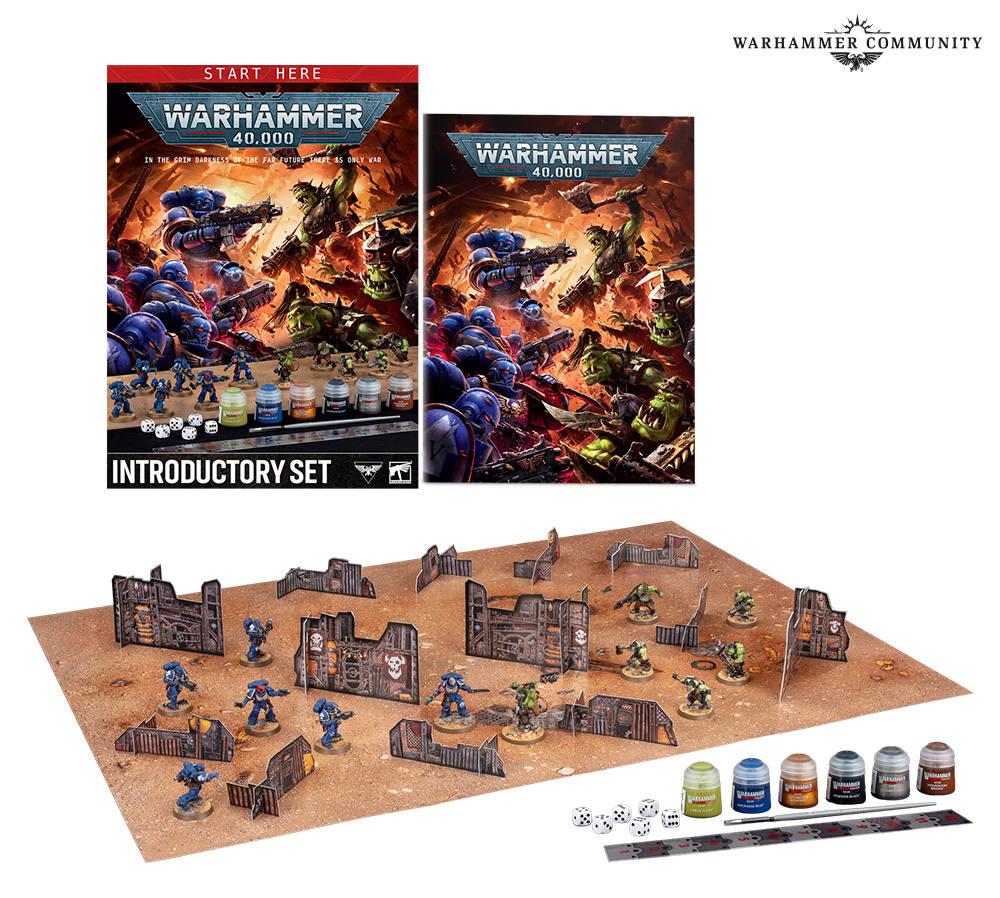
The current Warhammer 40,000 Introductory Set is for someone who is intrigued but not yet ready to pledge several evenings and a section of the dining table to an army. It includes 12 push-fit miniatures – a Space Marine Lieutenant, five Intercessors, an Ork Nob and five Boyz – along with six paints, a starter brush, six dice, a range ruler, a playmat, card terrain and a 48-page handbook.
Its strength is breadth. In one box you can experience the pleasing moment when a collection of unpromising grey pieces becomes a recognisable Space Marine, discover how paint behaves once it leaves the pot, and learn the shape of a small game. Push-fit construction also means you do not need glue for these particular miniatures.
Its limitation is equally important: this is an introduction, not two complete armies. Buy it to discover whether the hobby appeals, not because you expect it to provide the long-term depth of a Combat Patrol.
Models + Paints sets: the focused painting route
If painting is the part that caught your attention, you do not need to pay for dice, terrain or two small forces simply to try it. Bomran currently carries focused sets for Space Marines Intercessors, Ork Boyz and Tyranids. Each combines a handful of push-fit miniatures with six paints selected for the scheme shown on the box and a starter brush.
These are small, approachable projects rather than playable forces. That is precisely their advantage. You can learn how much paint belongs on a brush, why patience between coats matters and how satisfying a finished base can be before choosing an army-sized box. The first model may not resemble the one in the photograph. The second will already be better.
They also make more sense than the Introductory Set for somebody who is interested in modelling and painting but has no immediate plans to play.
There is also a Warhammer 40,000 Paints & Tools Set containing 13 paints, starter clippers, a starter brush and a mould-line scraper. It does not include miniatures, but it is a practical supporting purchase for someone who has chosen a separate model set or Combat Patrol and needs a broad basic hobby kit.
Try Painting Your First Warhammer Miniatures


Starter Set: the strongest two-player route
The current Warhammer 40,000 Starter Set goes considerably further. It contains two complete Combat Patrol armies, Space Marines and Orks, as well as a Core Rules book, a Starter Guide, 15 pieces of unpainted terrain, a double-sided board, dice and range rulers.
That makes it the most complete route for two people who want to learn together and continue into proper Combat Patrol games. There is real pleasure in learning from the same box: painting two very different forces, gradually adding terrain and discovering which of you has been saving all the improbable dice rolls for the final turn.
It also suits one player who genuinely wants both forces, or who has a reliable plan to split the box with somebody else.
It is not automatically the best purchase simply because it contains plenty of models. If you want to collect Necrons, Chaos Space Marines or Adepta Sororitas, a large saving on the wrong armies is still money spent on the wrong armies.
Getting Started with Space Marines or Orks: one army plus painting supplies
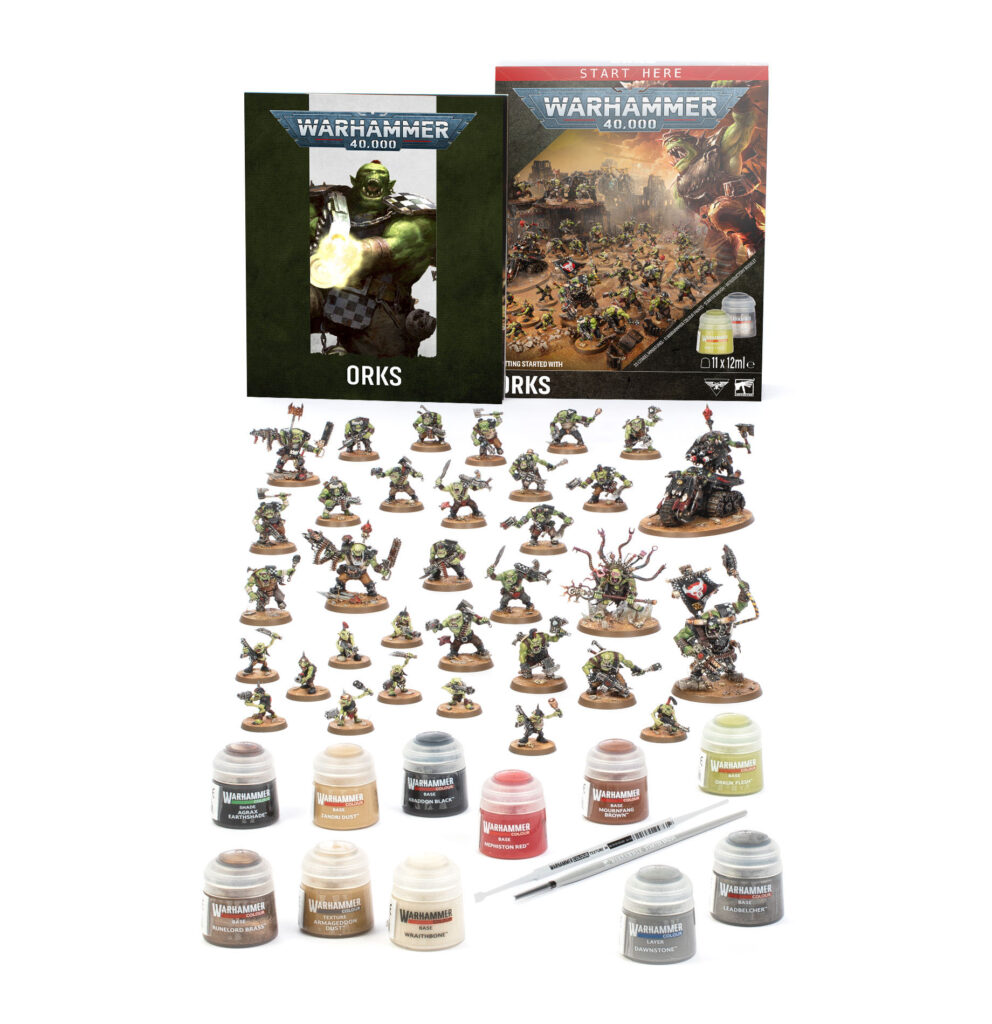
The current Getting Started with Space Marines and Getting Started with Orks boxes sit between a hobby starter and an army starter. Each contains a full Combat Patrol for its faction, an introductory guide, a starter brush and 11 selected paints. The miniatures are push-fit, so glue is not required for the included models.
These sets make sense if you have already chosen Space Marines or Orks but have no painting supplies. They remove much of the awkwardness from a first shopping list: models, guidance and the beginnings of a paint collection arrive together. Instead of wondering which of several dozen blues or greens is the one you meant to buy, you can sit down and begin.
They are less compelling if you already own suitable paints and tools, or want a colour scheme that needs a very different palette. In that case, the appropriate Combat Patrol and separately chosen supplies may be the cleaner purchase.
Combat Patrol: the best route into a chosen faction
A Combat Patrol is both a boxed force and a smaller way to play Warhammer 40,000. Each patrol uses a set roster and its own Combat Patrol rules, which means beginners can play without first mastering normal points-based army construction.
This is usually the right route when you already know which faction you want. It gives you a coherent first project and models that can later become part of a larger army. More importantly, it sets a finish line you can actually see.
Do check the current rules for the exact patrol before buying. You can browse Bomran’s Warhammer 40,000 armies and Combat Patrols once a faction has caught your attention. The miniatures in a box may have build options, but the Combat Patrol roster tells you which models and equipment its dedicated game rules expect. Combat Patrol is designed to make different boxed forces playable against one another, although their model counts and battlefield style can vary considerably.
Choose Your First Warhammer 40K Set


How should you choose your first Warhammer 40K army?
Choose the army whose miniatures and background you want to spend time with, not the faction that happens to be strongest this month.
Warhammer rules change. Points are adjusted, books are updated and a powerful tournament list can be overtaken by the next balance change. The miniatures on your painting desk remain. If you dislike building and painting them, no favourable win rate will rescue the project.
Start by making a shortlist based on appearance and theme. Then use play style and practical considerations to separate the finalists:
- Would you rather command a compact elite force or a large mass of infantry?
- Do you enjoy tanks and heavy weapons, speed and manoeuvring, close combat, shooting, or a mixture?
- Are you excited by a demanding painting project, or would a simpler scheme help you get an army finished?
- Does the range contain several units you genuinely want, rather than one impressive centrepiece?
- Is there a Combat Patrol or another manageable first purchase for the faction?
Try not to choose solely because somebody calls an army “beginner-friendly”. Space Marines have an enormous range and many different ways to play, which is helpful, but that same choice can be bewildering. An elite army may require fewer models, but each model can matter more on the table. A horde may involve more painting, yet repeating a simple colour scheme can be quite forgiving. Every supposed advantage comes with a trade-off.
Our separate beginner faction guide will compare those trade-offs across the current armies. For now, the sound rule is simple: choose models you would still enjoy owning after the rules have changed – and after you have painted the fifth shoulder pad in the same colour.
From sprue to squad: building your first miniatures
Once an army has caught your imagination, the next surprise is that the heroic warrior on the box begins life as several small pieces of grey plastic. Most Warhammer miniatures arrive on frames called sprues. You remove the parts, clean the attachment points and assemble them by following the supplied instructions.
For a typical multipart plastic kit, the useful basics are:
- a pair of hobby clippers;
- a mould-line remover or suitable hobby tool for cleaning parts;
- plastic glue, unless your chosen miniatures are push-fit;
- a clear, well-lit workspace.
Cut a short distance away from the component first, then trim the remaining plastic more carefully. Trying to cut perfectly flush while the part is still tightly connected can mark the model. Dry-fitting unfamiliar pieces before applying glue is also a very good habit.
You do not need an elaborate tool collection on day one. Bomran’s Warhammer hobby tools cover the essentials as well as equipment for more ambitious projects. A cutting mat, files, pin vice and other modelling tools become useful as your projects become more involved, but they are not prerequisites for discovering whether you enjoy building miniatures.
There is also a practical consideration rarely mentioned in buying guides: space. You need somewhere safe to build and paint, even if it is only a tray that can be packed away after each session. Protect the working surface and keep clippers, blades, glue and paint away from young children.
Finished models need somewhere safe too. A foam case, magnetic storage or a suitable display cabinet can wait, but it is worth thinking about before delicate weapons begin colonising every available shelf.
Painting your first miniature without chasing perfection
Building creates the model; painting makes it yours. At its simplest, miniature painting needs primer, a few appropriate colours, a brush, water and a palette. A palette can be as humble as a clean tile or a purpose-made wet palette. The important part is having somewhere to control and thin the paint rather than moving it straight from pot to miniature.
Primer gives subsequent paint a reliable surface. After that, aim for a neat, achievable first scheme: a main colour, the most important secondary areas, a shade or controlled shadow, and a finished base. Thin layers are easier to control than one heavy coat, and allowing paint to dry before revisiting an area prevents a surprising amount of frustration.
Your first miniature does not need to match the studio model on the box. Those photographs are a destination, not an entry requirement. A completed squad with a consistent, readable scheme will teach you more than one model repeatedly stripped and restarted in pursuit of perfection. Paint will occasionally land on the wrong belt, boot or boltgun. Let it dry, cover it and carry on; the miniature has not noticed.
If you want to paint your army in a different colour scheme from the box art, do so. Established factions have famous colours, but the hobby leaves ample room for successor Chapters, custom warbands, personal heraldry and entirely original schemes.
Getting your first battle on the table
For a normal game, both players need suitable armies and their current rules. You will also need six-sided dice, a tape measure or range rulers, a battlefield, terrain, objective markers and a mission. The current 11th Edition Core Rules are available as a free official download, so buying the large hardback rulebook is not necessary simply to learn the core game.
Army-specific rules are a separate question. Depending on the faction and current release cycle, relevant rules may be found in current official downloads, a codex or supported digital resources. Always check the current status of your army rather than assuming an older book remains all you need.
Warhammer 40,000 is a living game. Points, balance and army rules can change after you buy a model. Previously unlocked codex content remained accessible when the official app moved into 11th Edition, but beginners and returning players should still check the current official status of their faction before buying an older discounted rulebook. The cheapest codex on the shelf is no bargain if it describes a game your opponents are no longer playing.
The models themselves do not ordinarily become useless because the core edition changes. Rules for particular units can be revised or moved over time, however, so returning players should confirm the current status of unusual or discontinued miniatures before planning an army around them.
This is another reason Combat Patrol is useful. It removes conventional list building from your earliest games and gives each force dedicated rules. The Starter Set goes further by supplying the board, terrain, dice, rulers and guided material that two new players would otherwise need to assemble separately.
If a local player, club or shop can teach your first game, accept the offer. If you are nearby, our guide to buying Warhammer and finding Bomran in Essex is a useful local starting point. Learning from a patient opponent turns rules that appear dense on the page into a sequence of straightforward decisions. Keep the first battle small, expect to consult the rules and do not worry about playing everything perfectly.
When asking for a teaching game, say clearly that it is your first. A good introductory opponent will use a small, straightforward force, explain choices as they arise and avoid unveiling an obscure six-part rules combination with the solemnity of a courtroom ambush. Combat Patrol is a natural common format because it removes ordinary list construction, but the quality of the teacher matters more than whether the first game follows a particular competitive mission.
Games Workshop now also provides Warhammer Academy material aimed at structured learning. That can be useful alongside the Core Rules, particularly if you prefer a guided sequence to reading the complete rules document from beginning to end.
Setting a budget that survives first contact
Ask five hobbyists what Warhammer costs and you may receive five answers, followed by a lengthy debate about whether unopened boxes count as part of an army. There is no honest single figure because “starting” can mean painting one miniature, sharing a two-player box, fielding a Combat Patrol or constructing a full tournament-sized force. Prices also change, and different armies reach larger game sizes through very different combinations of kits.
A better way to budget is in stages:
- Trial stage: choose an Introductory Set or a small model-and-paint project.
- First force: move to a Starter Set, Getting Started set or Combat Patrol once you know what you want.
- First expansion: add one unit that fills a clear role or particularly excites you.
- Larger army: expand towards the game size your regular opponents actually play.
Budget for the supporting hobby as well as the miniatures. Tools, glue, primer and paints are reusable, so their cost is spread across many future projects, but they are still part of the genuine starting total.
The cheapest box is not always the cheapest route. Buying a discounted force and replacing half of it because you dislike the models is more expensive than choosing a smaller, better-targeted start. Equally, buying an entire army before completing your first squad can leave you with the beginning of what hobbyists affectionately – and sometimes guiltily – call the “pile of shame”.
Time is part of the budget too. Building and painting a Combat Patrol is a satisfying project, but it is not the same commitment as opening an ordinary board game and reading the rules that evening. Model count, the complexity of the colour scheme and your desired finish all affect the time involved. If free evenings are scarce, a small painting set or a compact elite force may provide far more enjoyment than a nominally better-value box full of infantry.
Terrain is the other cost that broad estimates often hide. You do not need to buy a full battlefield for your first guided game if a friend, club or shop provides one. At home, sturdy books, boxes and the occasional strategically vital food container can stand in while you learn, although purpose-made terrain eventually produces a clearer and more satisfying battlefield. Two entirely new players should include terrain in their comparison of starter products rather than comparing the miniature count alone.
Buying for somebody else?
If you are buying for somebody else, avoid guessing their army from the box that looks most impressive. Established players usually have strong faction preferences, and even beginners may already have fallen for a particular army through a video game, novel or model they have seen online.
The safest questions are: do they want to build and paint, do they want to play, and have they named a faction? A models-and-paints set is a manageable gift for somebody who wants to try painting. The Introductory Set suits a curious newcomer who wants to sample the wider hobby. The two-army Starter Set makes most sense when two people will learn together or the recipient actively wants both Space Marines and Orks. A Combat Patrol is only the safer choice once the faction is known.
Check the age and safety information on the exact product. These are detailed hobby models rather than ordinary ready-to-play toys, and tools, small components, glue and paints need sensible supervision and handling.
Your first project in four stages
1. Choose a finish line you can see
Decide which part of the hobby interests you and buy the smallest set that properly serves it. A painting set, Introductory Set or Combat Patrol gives you a defined project rather than an open-ended obligation.
2. Build carefully, a few models at a time
Read the instructions before clipping, organise the components and dry-fit unfamiliar joins. Finishing a few models teaches you more than hurriedly assembling an entire army.
3. Find a paint scheme you can repeat
Test your colours on one model. Make notes if the order matters, then paint the rest of the unit in small batches. The aim is a scheme you enjoy and can repeat, not winning a painting award on your first attempt.
4. Play, reflect and only then expand
Use the guided scenarios in your starter material or arrange a small teaching game. Concentrate on the basic rhythm rather than playing every interaction perfectly. Afterwards, let experience identify the next need: another unit, better brushes, storage for finished models or simply another evening with the models you already own.
This measured approach is slower at the checkout and much faster at creating an army you actually enjoy. The second army will begin whispering eventually; there is no need to invite it in during the first week.
Six ways to make starting harder than it needs to be
Buying too much before building anything
A wall of unopened boxes creates pressure rather than momentum. One finished unit is a better foundation than an army-sized plan you no longer fancy assembling.
Choosing an army for its current rules
Rules and points are temporary. Models, theme and the time invested in painting are not.
Assuming every starter product suits every beginner
The Introductory Set, Starter Set, Getting Started sets and Combat Patrols solve different problems. Decide what you need before comparing their contents.
Buying every paint listed in a tutorial
Advanced recipes often use several colours for small refinements. Begin with the colours required for a coherent basic scheme, then add to the palette when you know what effect you want.
Treating mistakes as ruined models
Most painting errors can be covered once dry. A visible mould line or awkward join is a lesson for the next miniature, not a reason to abandon the current one.
Rushing towards 2,000 points
Large games are not the only “real” Warhammer. Combat Patrol and smaller learning games let you finish projects, understand units and discover your preferences sooner.
Where should you start?
If you remain unsure whether Warhammer 40,000 is for you, the Introductory Set is the cleanest sample of building, painting and playing. If two of you want a guided route into complete Combat Patrol games and are happy with Space Marines and Orks, the Starter Set is the stronger long-term beginning. If you already want one of those two factions and need painting supplies, look at the matching Getting Started set. If another army has won you over, begin with its Combat Patrol or a similarly manageable selection of models.
The galaxy can wait. Pick one project, build it carefully, put some colour on it and play a small game. By then, the next step will be far clearer than it is while staring at the entire Warhammer range at once.
Frequently asked questions
Is Warhammer 40K difficult to learn?
The complete game has substantial depth, but beginners do not need to learn everything together. Guided starter scenarios and Combat Patrol reduce the number of decisions, while the free core rules let you revisit unfamiliar sections. Most of the complexity arrives gradually through unit and army rules.
Do I need a codex to start Warhammer 40K?
Not necessarily. The free core rules cover the game itself, starter products provide guided material and Combat Patrol has dedicated rules. Army-specific requirements depend on the faction and the current stage of the 11th Edition release cycle, so check the official current rules for your chosen army before buying a codex.
Do Warhammer miniatures come painted?
Standard Warhammer miniatures are normally supplied unpainted and require assembly. Some beginner miniatures use push-fit construction, but they still arrive unpainted. Product descriptions should confirm the exact requirements.
Do push-fit Warhammer miniatures need glue?
Push-fit models are designed to assemble without glue. Carefully remove mould lines and test the fit before pressing parts fully together. Many hobbyists still choose to glue some push-fit joins, but it is not required to begin.
Can I play Warhammer 40K by myself?
Warhammer 40,000 is primarily designed as a game between opponents. You can practise movement and attack sequences alone, and some players devise solo scenarios, but the standard game is at its best with another person.
Is Combat Patrol a full army?
It is a complete force for the dedicated Combat Patrol format and a useful foundation for a larger collection. It is not normally equivalent to a conventional full-sized 2,000-point army.
Should I paint my models before playing?
You can learn with assembled, unpainted miniatures unless an event or venue specifies otherwise. Painting a small unit before your first game can be satisfying, but waiting for an entire army to be finished may delay the part of the hobby you most want to try.
Can I start with Warhammer 40K lore instead of the game?
Yes. The setting supports novels, audiobooks, background books, video games and animation as well as miniatures. If the universe interests you more than building or playing, begin there and choose models later, once a faction or character has caught your imagination.
Is the Warhammer 40,000 Starter Set suitable for one person?
It can be, particularly if you want both Space Marines and Orks or would enjoy painting two contrasting forces. Its clearest advantage is as a two-player package, however. If you only want one different faction, that faction’s Combat Patrol and carefully selected supplies may be a better use of the budget.