

The bedroom above CaDA’s Japanese Steamed Bun Shop has a computer and a wardrobe. Downstairs, there are buns to sell. You set out to build a shop, and suddenly you are wondering about life upstairs. That is an endearing amount of everyday detail to tuck into a brick-built address.
It is also where CaDA Japanese buildings become so absorbing. A few small elements turn into cooking equipment, a patch of planting or a piece of furniture, and the address acquires a personality. Following an odd-looking assembly until you recognise what it is can be as enjoyable as seeing the frontage come together. Sometimes the smallest detail steals the show. There is a bookshop coming up with a model ship inside it.
Bomran’s nine-model selection offers two ways in: five larger buildings with rooms and details to explore, and four Mini models that squeeze their character into compact displays. They sit within the wider CaDA Building Series, which also includes subjects such as Shell buildings. Here, we are taking a closer look at the Japanese selection and the details that might tempt you to clear a little shelf space.
For a broader look at the collections, our guide to understanding the CaDA range puts these buildings in context.
The Bomran Guide
Collection Guide
Reading time: 10–12 minutes
Perfect for: Architecture fans, display builders and anyone choosing between Mini and larger CaDA Japanese buildings.
In this guide you’ll learn: How the nine models differ, which details make each one appealing, and how much display space to allow.
Mini or larger: what sort of build are you hoping for?
Would you rather spend time furnishing a kitchen, or see a tiny shop take shape beside your books or monitor? Start there. The larger buildings give you more room to explore behind the frontage; the Minis concentrate on the pleasure of a recognisable little building in remarkably little space.
The Mini models contain 279–352 pieces and carry 8+ age guidance. The five larger sets range from 861 to 1,292 pieces, with 14+ guidance. Neither number tells you exactly how fiddly a particular step will feel, but they help frame the project. A compact build can be a satisfying breather between bigger ones, too. Your desk does not have to become a town-planning exercise.
| Building | Pieces | A reason to look closer |
|---|---|---|
| Japanese-Style Canteen C66014W | 861 | Open kitchen, upstairs living space and entrance curtains |
| Kitty’s Japanese Grocery Store C66015W | 921 | Stocked shop, retractable awning and a planted outdoor setting |
| Japanese Corner Yakitori Izakaya Restaurant & Bar C66019W | 1,195 | Opening side walls for access to the interior |
| Japanese Steamed Bun Shop C66006W | 1,108 | Shop and bedroom behind an opening rear wall |
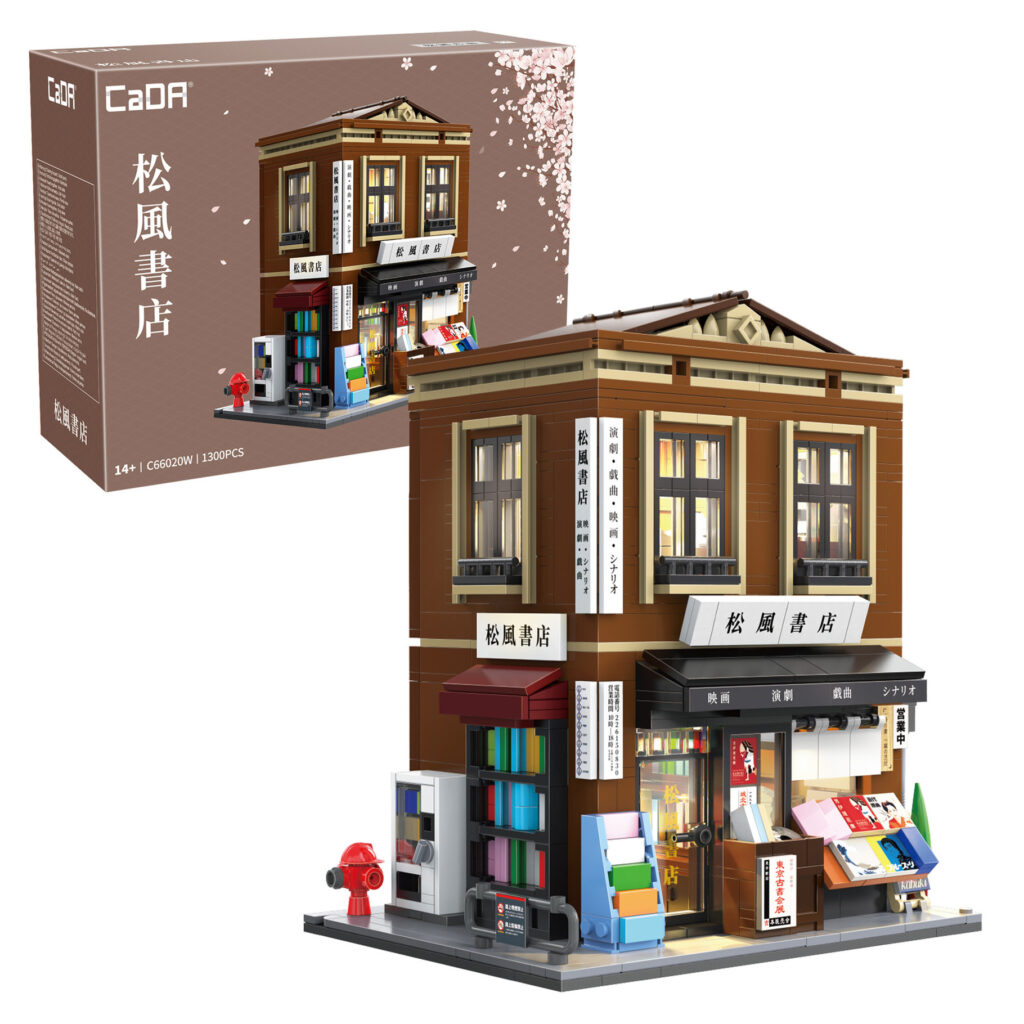
| Japanese Bookshop C66020W | 1,292 | Layered signage, printed details and a removable roof |
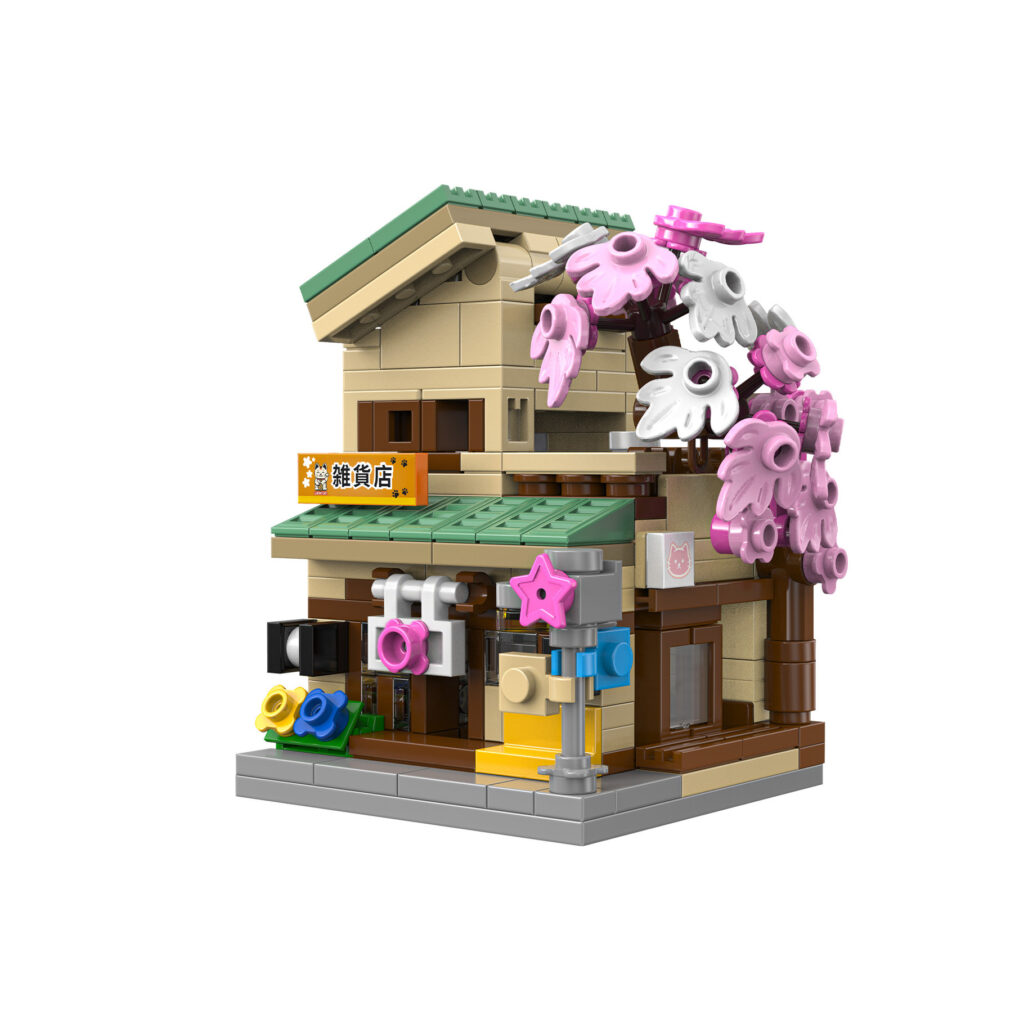
| Mini Kitty’s Japanese Grocery Store C66071W | 330 | Blossom, green roof and planted frontage |
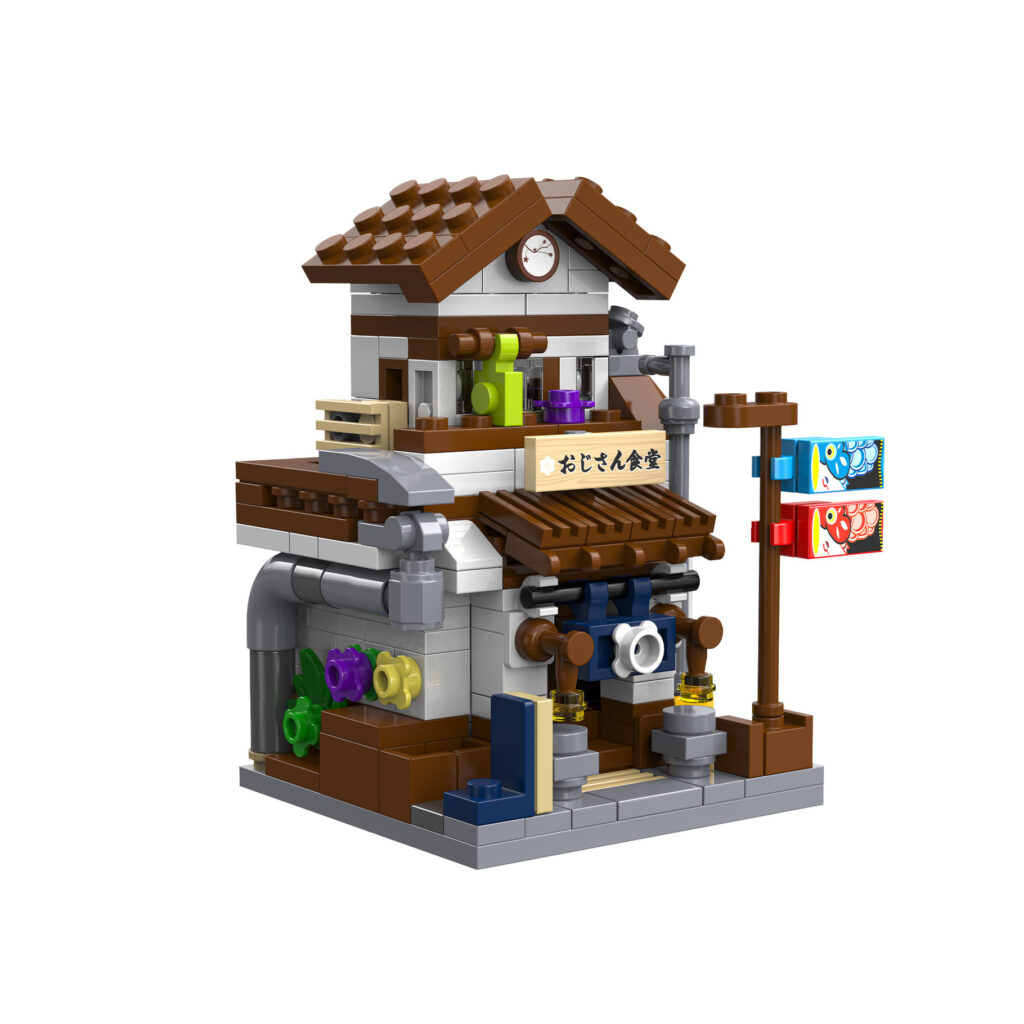
| Mini Japanese-Style Canteen C66072W | 313 | Gable clock, tiled roofs and planted balcony |
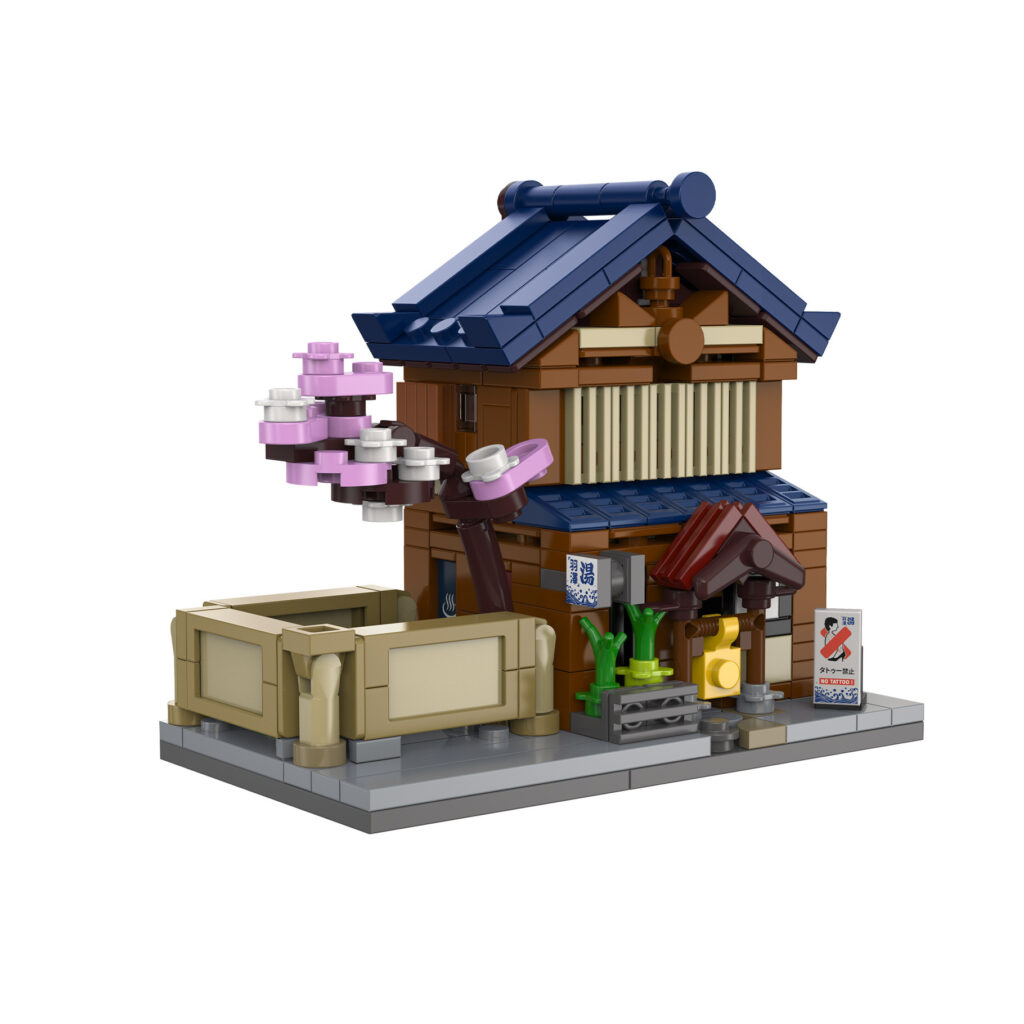
| Mini Japanese Sento Bathhouse C66073W | 352 | Blue roof, slatted façade and side forecourt |
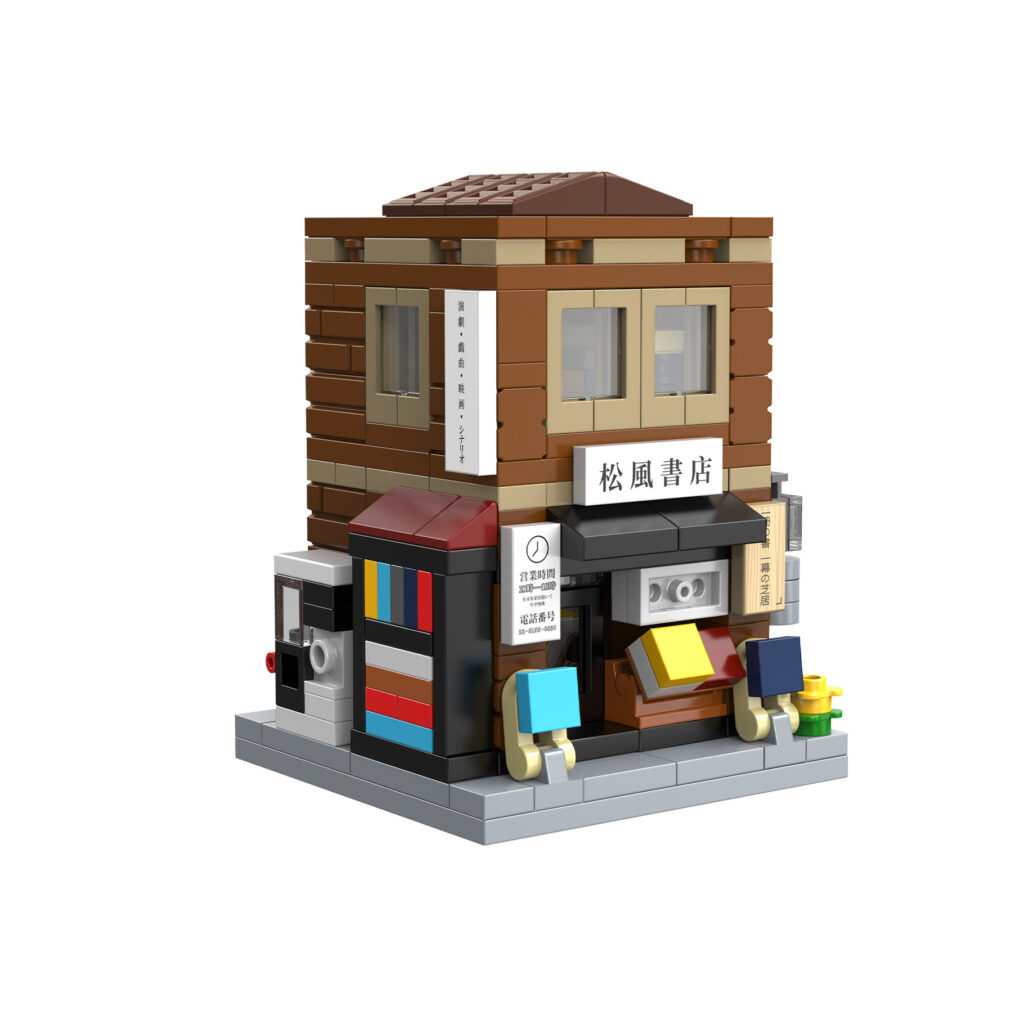
| Mini Japanese Bookshop C66074W | 279 | Vertical signage and a tiny bookshop frontage |
On a phone, swipe across the table to see every column.
Keep the model codes handy, especially for the grocery store, canteen and bookshop, which each appear in two formats. “Mini” describes a smaller finished model; it does not promise every feature of the larger namesake. Measurements below refer to assembled models, in length × width × height.
Explore the five larger Japanese buildings
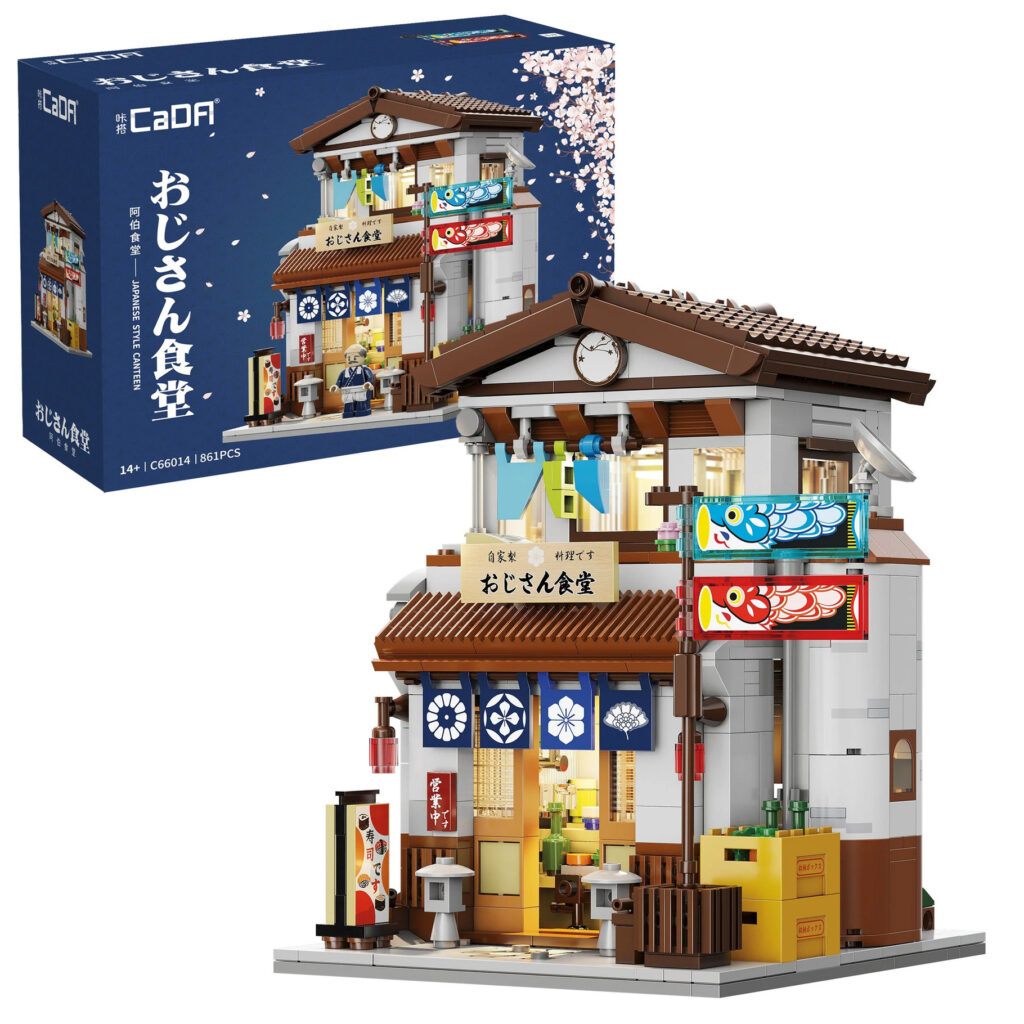
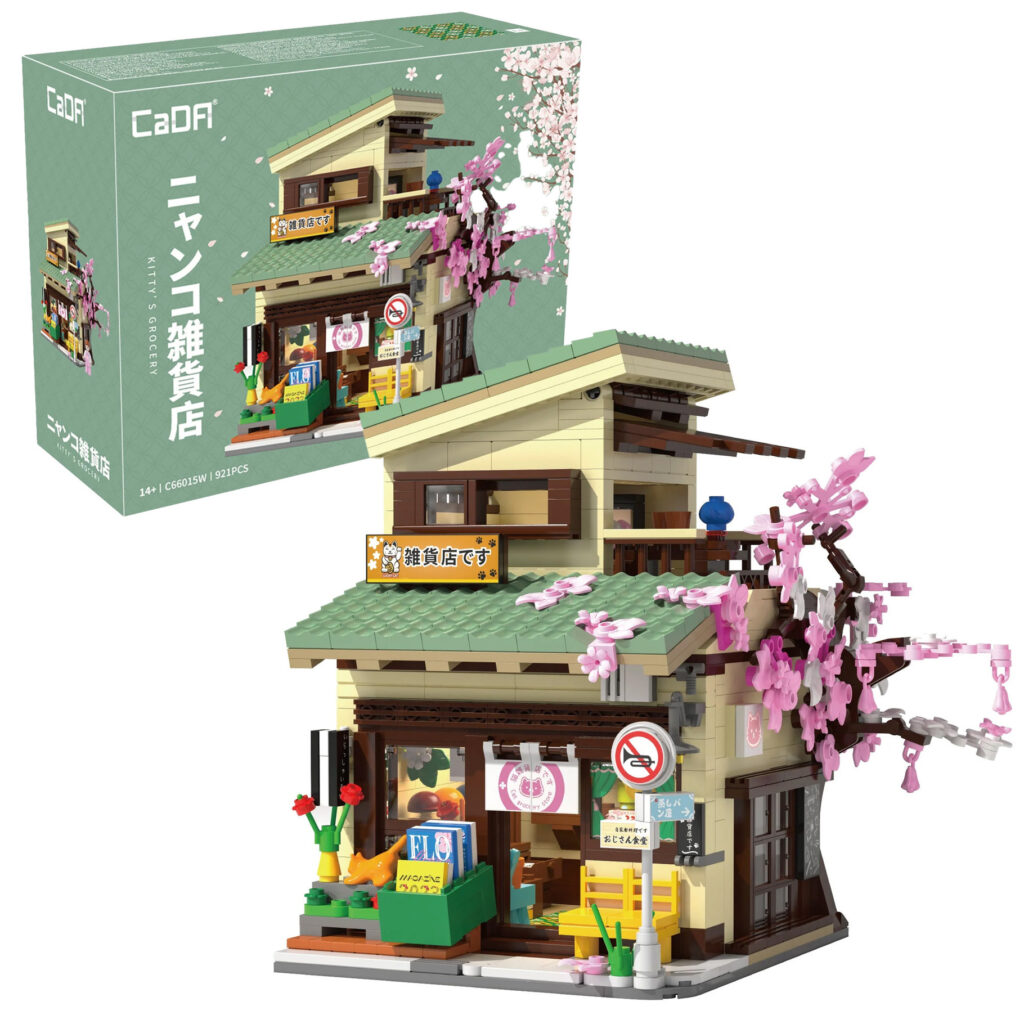
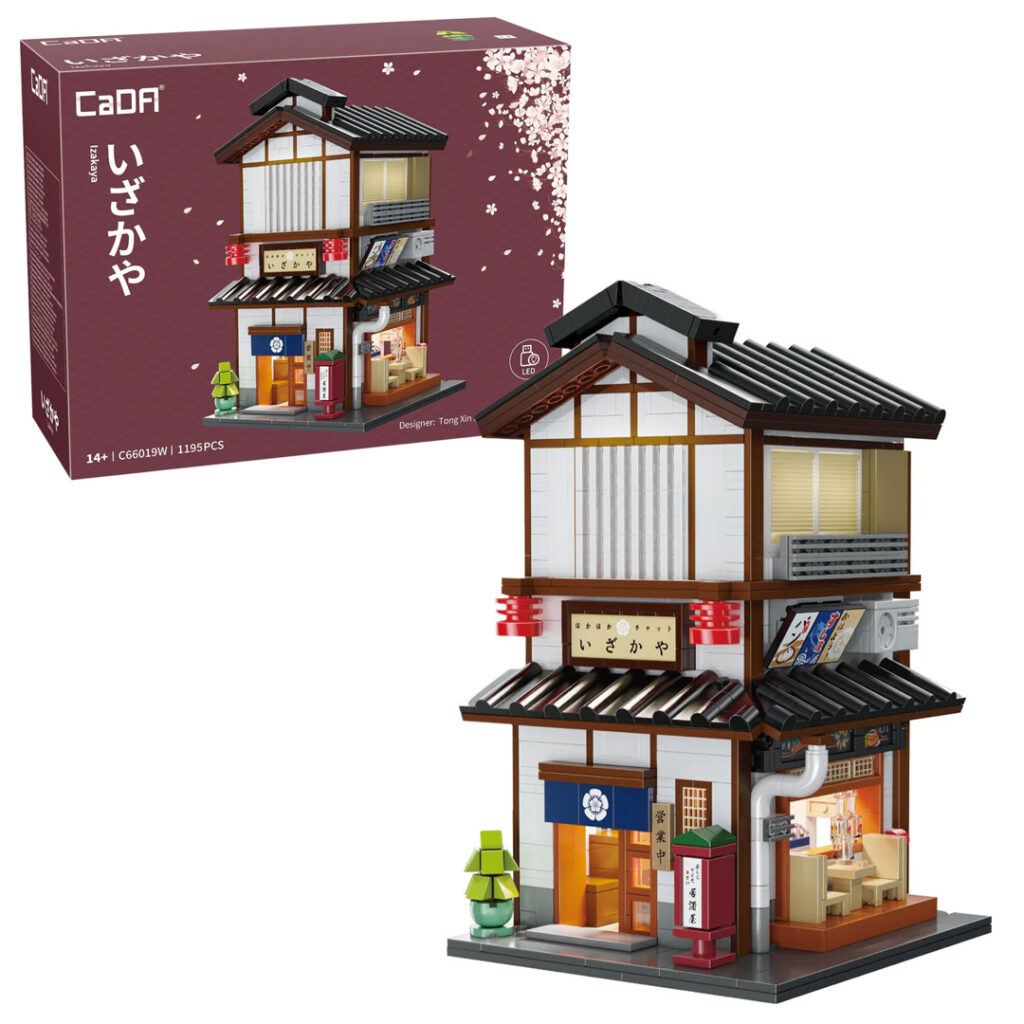
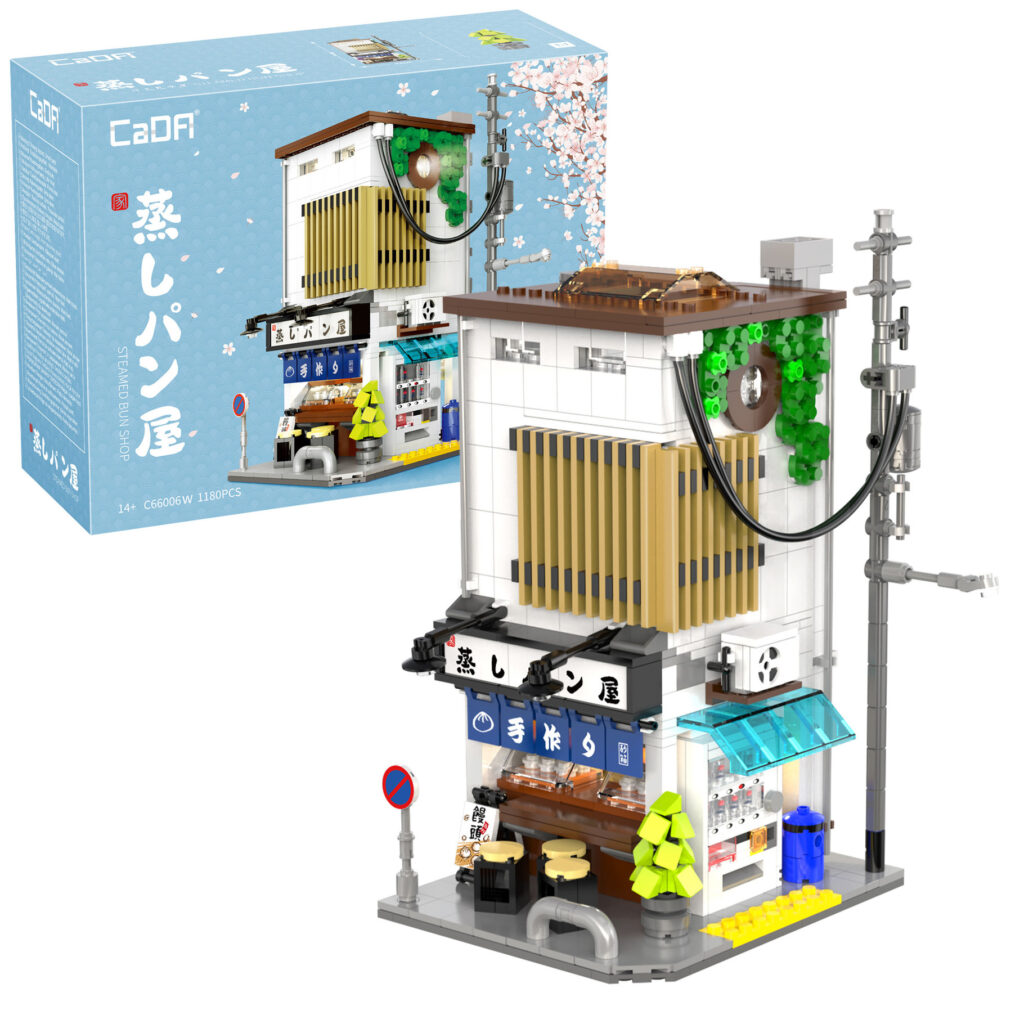
Five larger Japanese buildings to get absorbed in
All five include USB-powered LED lighting. First, though, there are kitchens to equip, shelves to fill and some unexpectedly appealing pipework to assemble.
Japanese-Style Canteen C66014W: pull up a miniature seat
Start with the kitchen. The Japanese-Style Canteen C66014W has an open one, complete with cooking tools: just the sort of miniature equipment that can hold your attention long after you have admired the roof. Upstairs, a furnished living space gives the little restaurant a home life as well.
There is plenty to catch your eye on the way in. Noren curtains frame the entrance, stone-style lamps stand outside and vines soften the frontage around the seating. Then look up: a clock sits in the roof gable, with red-and-blue carp-shaped banners adding a playful flourish. The kitchen may draw you in, but the building keeps offering reasons to look somewhere else.
At 861 pieces and 13.6 × 17.6 × 18.5 cm, this is both the lowest-piece-count and shortest of the five larger models. It is an inviting first stop if cooking tools, small rooms and the idea of a late-night canteen appeal. There is a lot of ordinary life to enjoy in those 18.5 centimetres.
Kitty’s Japanese Grocery Store C66015W: the tree deserves its space
You could come for the shop and end up particularly attached to the bench. The larger Kitty’s Japanese Grocery Store C66015W gives its surroundings proper attention, with cherry blossom, flowers and a little cat detail to discover. Beside the upstairs sitting area is a fishpond detail. It is easy to imagine a quiet break up there.
The shop itself has household goods and a till behind sliding doors. A side wall opens for a closer look, while the retractable awning supplies a satisfying bit of movement. It is easy to see the appeal of returning to this model after the last brick: open the wall, inspect the shelves, adjust the awning, then notice the planting again.
Those surroundings need room. Kitty’s has 921 pieces and measures 20.8 × 20.8 × 20 cm, so it occupies a broader patch of shelf than the canteen or bun shop despite having fewer parts than three of the larger buildings. Give the blossom room to spread. The tree is a large part of the pleasure here, rather than something to tuck behind the next shop.
Japanese Corner Yakitori Izakaya C66019W: go on, look inside
The red lanterns and blue noren do a good job of inviting you into the Japanese Corner Yakitori Izakaya Restaurant & Bar C66019W. Happily, the walls oblige. The side walls open fully, the main entrance slides, and other doors and windows open too.
Inside, bottles and crockery gather around the kitchen’s grill counter; upstairs, a low table and cushions set a quieter scene in the tea room. If you have ever dismantled half a build to reach one wrong piece, a wall designed to open feels particularly civilised. Here, access is part of the finished model’s appeal, with the lanterns and tiled overhangs waiting when you close it up again.
Its 1,195 pieces form an upright, 14.4 × 15.2 × 24.8 cm building. There is a stated right-side connection for other CaDA Japanese buildings, useful if a larger streetscape is calling. Check the intended neighbouring model first: it does not establish that every set here connects, especially the Minis.

Japanese Steamed Bun Shop C66006W: even the utilities have charm
A ventilation duct is an unlikely object of affection. On the Japanese Steamed Bun Shop C66006W, it belongs to a wonderfully busy exterior: utility pole and cables, drainpipe, upper slatted screen and flat roof. A menu board and drinks vending machine keep the pavement interesting. These are the bits of a real street you might walk past, then happily spend an evening admiring in miniature.
Behind them is a kitchen and serving area, with that bedroom, computer and wardrobe upstairs. The opening rear wall lets you revisit both sides of this little working day, and the USB light module illuminates the shop and bedroom. Giving the room above the buns as much attention as the counter below makes the whole address feel lived in.
The 1,108 pieces build upwards: the model stands 24.3 cm tall on a 12.8 × 15.2 cm footprint. Compare it with Kitty’s spreading blossom and the contrast is immediate. The bun shop stacks its life above the pavement, with a cable, screen or bit of pipework to catch your eye on the way up.
Japanese Bookshop C66020W: a model within a model
There is a miniature ship upstairs in the larger Japanese Bookshop C66020W. A model inside a model is a lovely little nod to the people building it. It shares the upper floor with a typewriter and rocking chair, while downstairs the shelves, book stacks and street-facing magazine rack suggest plenty of browsing ahead. Even the counter has a computer.
The brown-and-tan frontage is busy in the best way: layered signs draw the eye upwards past contrasting front and side canopies to an upper-window railing. The roof lifts away and a side wall opens, so the details behind that frontage remain accessible. You will want another look at the ship.
At 1,292 pieces, this is the largest project here by part count, measuring approximately 15.5 × 19.5 × 27.5 cm. Leave clearance above it for the removable roof. The decoration uses printed details rather than stickers, too. If lining up a tiny sign makes you hold your breath more than building the wall beneath it, that is a welcome detail before you even open the box.

The four Mini Japanese buildings
The Minis have a different trick to pull off: make you recognise the place with far less space to work in. A roofline, a sign, a branch of blossom, and suddenly there is a little shop beside your monitor. Look closely and there is still plenty to enjoy.
These compact, exterior-led buildings make a collection of their own, or a change of pace between more involved projects. Spotting what gives each its identity is part of the fun.
Mini Kitty’s Japanese Grocery Store C66071W
The blossom gets its moment here, too. On the Mini Kitty’s Japanese Grocery Store C66071W, a pink tree curls around the cream-and-tan frontage, meeting the green roof and awning above tiny flower details. It is a lot of garden to fit around such a small shop.
The 330 pieces produce a 9.1 × 7.5 × 9 cm model. That pink-and-green pairing makes the family resemblance immediate, even at desk size. Set it somewhere you can see the planting: the little flowers deserve better than being hidden behind a pen pot.

Mini Japanese-Style Canteen C66072W
A tiny clock in the upper gable gives the Mini Japanese-Style Canteen C66072W a lovely focal point. Follow the building down past the brown tiled roofs and planted balcony, and there are blue entrance accents, a projecting signpost and grey exterior pipework. Even at this scale, someone remembered the plumbing.
Its 313 pieces fit into 7.6 × 7.4 × 9.5 cm, with the details stacked neatly above the entrance. A shallow tray is a useful companion for the small parts. A piece escaping towards the carpet can turn an otherwise peaceful canteen build into a surprisingly energetic search.
Mini Japanese Sento Bathhouse C66073W
The Mini Japanese Sento Bathhouse C66073W gives the little street somewhere different to go. Its dark-blue gabled roof and matching lower awning set off a timber-coloured façade, with vertical slats upstairs. Then the scene opens out to one side, where blossom and an enclosed forecourt give the building some breathing room.
At 352 pieces, it has the highest Mini part count; the finished model measures 12.1 × 7.1 × 9.6 cm. That side area is worth looking at when arranging a display. Between busy shopfronts, a patch of enclosed space can be just as pleasing as another sign or canopy.
Mini Japanese Bookshop C66074W
There is no mistaking the ambition of that long white sign. The Mini Japanese Bookshop C66074W draws your eye up its brown-and-tan frontage, with a black front awning, red side canopy and coloured book-display details doing the rest. The little frontage already feels ready for a browse.
At 279 pieces and 6.7 × 6.8 × 8.6 cm, it is the smallest project here, with an almost-square footprint. Beside your favourite paperbacks, the bookshop is likely to be shorter than the books. That seems an entirely appropriate place for it.
Explore the four Mini Japanese buildings
Making room for the finished street
A shelf can look generous until a blossom tree moves in. Measure depth and height as well as width, and leave room for opening walls and removable roofs. Being able to fit a building is only half the satisfaction; you want to reach the rooms you enjoyed furnishing, too.
All five larger sets include USB-powered LED lighting. Plan the power source and cable route before arranging the street, and check each listing for the supplied components and power requirements. Fishing a cable out from behind a carefully positioned row is less entertaining than making the row in the first place.
Connection claims need a little care. The canteen, Kitty’s, bun shop and Izakaya advertise connections, but the descriptions are model-specific. Check your intended pairing: shared Japanese styling does not guarantee physical connection or matching scale. The Minis make a natural display of their own, with a little space between buildings to let those different rooflines show.
Give the small assemblies their moment
Before closing a room or capping a wall, compare that section with the instructions while you can still reach it. One similar-looking piece facing the wrong way is much easier to sort out now. A photograph of the interior is worthwhile, too: after furnishing a tiny kitchen, you have earned the right to show somebody.
Good light and a clear patch of table help with intricate assemblies. Stop at a sensible section rather than racing through the last few pages. There is no prize for getting the roof on before you have enjoyed what sits underneath it. For broader advice on getting started, our guide to choosing your first CaDA set covers the fundamentals.
Which Japanese building would you like to spend time with?
Perhaps it is the canteen’s kitchen tools, Kitty’s blossom or the Izakaya rooms opening out for inspection. Perhaps the bun shop has made you unexpectedly keen on miniature utility poles. And if the ship inside the bookshop is still on your mind, that is a fairly strong clue.
For a smaller project, the Minis offer their own satisfying details, from a gable clock to a tree wrapped around a tiny grocery. Choose the place you are curious to make, check that it has somewhere to live, and give yourself time to enjoy the little assemblies. The shelf is the destination. Plenty of the pleasure happens before the roof goes on.