
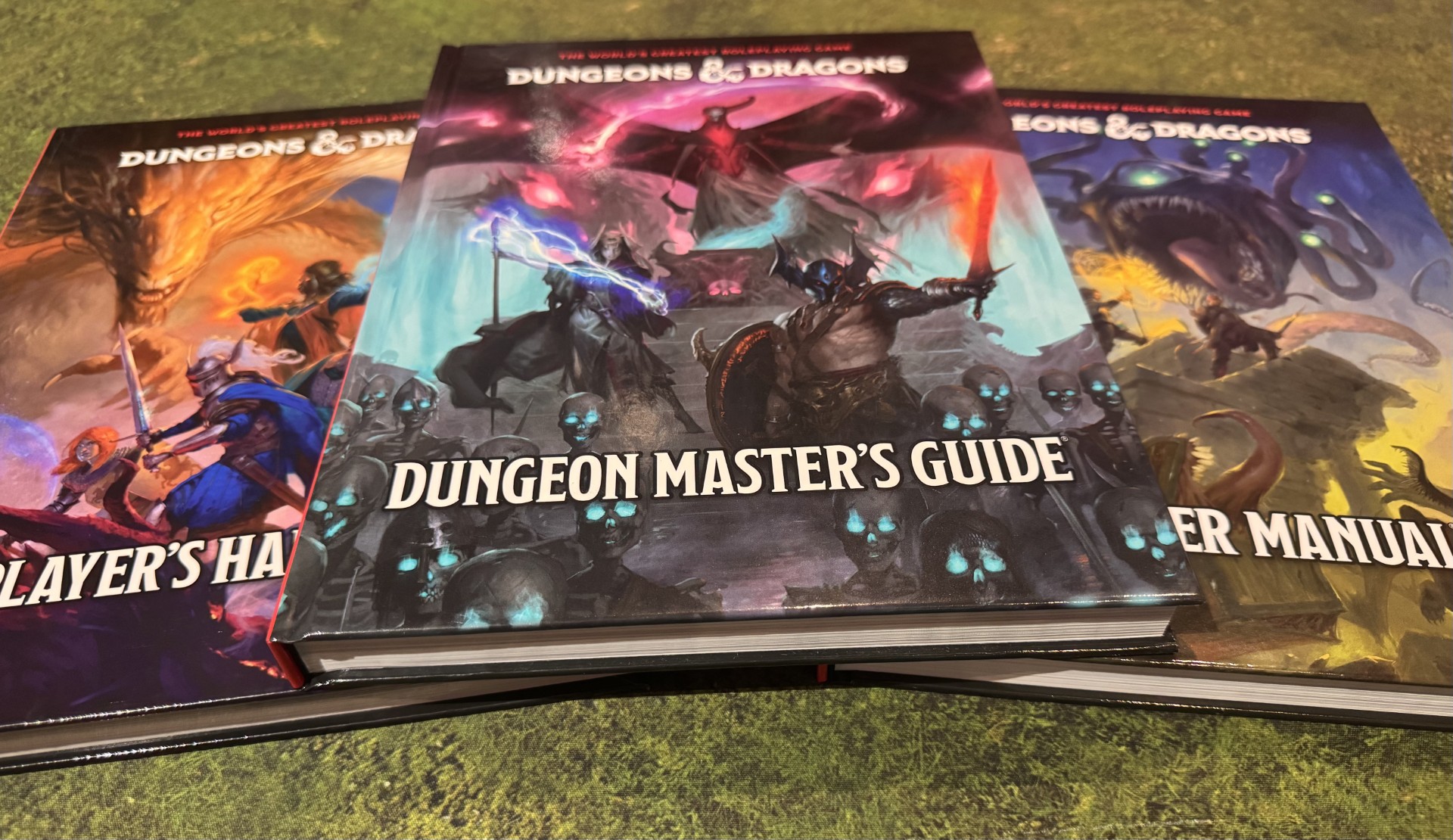
Dungeons & Dragons players are usually delighted to name things. Swords, taverns, familiars, suspiciously elaborate backstories – give us five quiet minutes and everything on the character sheet acquires a title. The revised rules, however, may have given us one name too many.
Ask which version of D&D somebody plays and you may hear “2014”, “2024”, “revised fifth edition”, “5e” or “5.5e”. Often, two people are describing the same game while sounding as though they have arrived from rival timelines. Add a decade of adventures, characters and sourcebooks, and buying the correct Player’s Handbook begins to feel like a riddle posed by a particularly unhelpful sphinx.
So let us put a torch on the wall and make this D&D 2024 vs 2014 comparison easier to navigate. The 2024 rules are an updated version of fifth edition, not a completely new edition, and they were designed to work with books published for the 2014 rules. D&D Beyond now officially labels the 2014 rules as 5e and the revised 2024 rules as 5.5e.
That means your treasured shelf of adventures has not turned to parchment dust. Old campaigns remain playable, established groups are not being marched towards a compulsory changeover, and a character created under the original rules can still sit down beside one built from the revised books.
There is one important catch: “compatible” does not mean “identical”. Classes, character creation, spells, equipment, monsters and several rules heard around almost every table have been revised. Mixing material is entirely possible, but it works best when everybody knows which set of shared rules is steering the cart.
Bomran Guide summary
- Is D&D 2024 a new edition? No. It is a revision of fifth edition.
- What does 5.5e mean? Since March 2026, it is D&D Beyond’s official clarity label for the revised 2024 rules. The 2014 rules are labelled 5e.
- Can you run old adventures with the revised rules? Yes. Earlier fifth-edition adventures remain usable.
- Can 5e and 5.5e characters play together? Yes, although the group should agree which shared rules it is using.
- Do old subclasses, species and backgrounds still work? Options that have not been replaced by a revised version can continue to be used, with the conversion guidance in the revised rules where needed.
- Do you need to replace your 2014 books? No. Buy revised books because you want their updated rules and guidance, not because your old collection has expired.
- Which rules should a new group choose? In most cases, start with the revised 2024/5.5e rules.
- Should an existing campaign change? Only if the group wants to. Between campaigns is the simplest time, but a mid-campaign move is supported.
In this guide
- What the different names mean
- Whether D&D 2024 is a new edition
- The differences at a glance
- What backward compatibility really means
- Using old adventures and monsters
- Mixing 5e and 5.5e characters
- Using older character options
- The best choice for a new group
- Advice for established campaigns
- Which books, if any, need replacing
- Frequently asked questions
First, what are the rules actually called?
For several years, the clearest labels were simply 2014 rules and 2024 rules. Those dates refer to the original fifth-edition Player’s Handbook and its revised successor. “Revised fifth edition” was also widely used, while players often adopted the unofficial shorthand “5.5e”.
In March 2026, D&D Beyond made that last distinction official on its platform:
- 5e identifies rules content associated with the 2014 version.
- 5.5e identifies the revised rules content that began with the 2024 Player’s Handbook.
D&D Beyond describes these as clarity labels rather than the announcement of another edition. No rules or purchases changed when the labels changed, and both versions remain supported on the platform.
You will still see “2014” and “2024” on physical books, shop listings and older articles, so this guide uses both sets of terms. When we say 5e or 2014, we mean the original fifth-edition rules. When we say 5.5e, revised or 2024, we mean the updated rules.
Is D&D 2024 a new edition?
No. The revised rules are still fifth edition. If you know how to play the 2014 game, nobody is going to confiscate your dice and make you learn D&D from the beginning.
This is more than a branding technicality. A genuinely new edition usually places a much wider ravine between old and new: different underlying maths, substantially different character structures and adventures that need serious conversion before the first door can be kicked open. That is not what happened here.
The familiar engine is still rumbling underneath. Characters retain the six ability scores. A d20 resolves attacks, saving throws and ability checks. Advantage and Disadvantage remain gloriously capable of turning confidence into panic. Armour Class, Hit Points, proficiency bonuses, spell slots, levels and Challenge Ratings all perform recognisable jobs.
However, calling the books “just a reprint” would undersell the changes. Every class in the revised Player’s Handbook received attention. Character origins work differently, subclasses follow a more consistent progression, many spells and feats were rewritten, weapons gained Mastery properties for characters able to use them, and the rules glossary makes frequently disputed situations easier to find.
A useful way to think about it is this: the dungeon is in the same place, but somebody has repaired the signposts, moved a few doors and given the Fighter more interesting things to do with a battleaxe.
D&D 2024 vs 2014 at a glance
| Question | 2014 rules / 5e | 2024 revised rules / 5.5e |
|---|---|---|
| Edition | Original fifth-edition rules | Revised fifth-edition rules |
| Core rulebooks | 2014 Player’s Handbook, Dungeon Master’s Guide and Monster Manual | Revised Player’s Handbook and Dungeon Master’s Guide published in 2024; revised Monster Manual published in 2025 |
| Character creation | Ability score increases are commonly associated with race, subject to later optional rules | Ability score increases and an Origin feat come from the character’s background |
| Terminology | Uses terms including race and Inspiration | Uses terms including species and Heroic Inspiration |
| Classes | The original twelve Player’s Handbook classes | The same twelve core classes, extensively revised |
| Subclass timing | Varies by class | Core classes choose a subclass at level 3 |
| Weapons | Weapons mainly differ through damage, properties and proficiency | Eligible classes can use Weapon Mastery properties |
| Rules presentation | Rules are distributed through the books, with some later clarifications | Reorganised presentation and an expanded rules glossary |
| Compatibility | Remains playable and supported | Designed to be backward compatible with 5e content |
| Best fit | Groups happy with an existing campaign or established rules library | Most new groups and players who want the revised character options |
Start with the revised core books
If your group is moving to the revised rules, the Player’s Handbook is the essential starting point for players, while the Dungeon Master’s Guide adds the expanded tools and guidance discussed later in this comparison.
-
D&D Player’s Handbook (2024)
£32.50 -
D&D Dungeon Master’s Guide (2024)
£35.00

What are the biggest differences between D&D 2024 and 2014?
We could catalogue every revised spell, shifted feature and altered stat block, but somewhere around the third page of cantrip comparisons even the keenest rules scholar would start looking for a secret exit. The more useful question is the one groups ask while packing dice for the weekend: what will actually feel different at our table?
The changes you are most likely to notice fall into a handful of broad areas.
Character creation has been reorganised
Under the revised rules, a character’s background supplies their ability score increases and an Origin feat, alongside proficiencies and starting equipment. Species still provides distinctive traits, but it no longer carries the same job of determining ability score increases.
This makes character creation feel more deliberate, but it also means rebuilding a veteran hero takes more than copying numbers onto a clean sheet. Check the revised class, background, species, feats and spells, preferably before the session rather than while the rest of the party is already negotiating with a dragon.
Classes received substantial revisions
The revised Player’s Handbook retains the twelve core classes, but their progression and individual features have been reworked. Subclasses now arrive at level 3 for the core classes, while many martial characters gain Weapon Mastery and spellcasters encounter revised spell lists or class features.
The character’s heart remains intact. A Rogue is still checking the shadows, a Cleric is still asking a higher power to fix the Fighter, and the Wizard is still explaining why everyone should have allowed another twenty minutes for preparation. The route through each class can nevertheless feel noticeably different, particularly when a favourite feature has moved, changed or acquired a new partner.
Many familiar rules now work differently
Some changes appear constantly in play. Grappling and shoving are handled through the revised Unarmed Strike rules. Heroic Inspiration can reroll a die. Drinking or administering a potion is a Bonus Action under the revised rules. Several healing spells restore more Hit Points, and numerous conditions, actions and spells have been clarified or rewritten.
This is why a mixed table benefits from choosing one shared rules framework. If half the group remembers one version of a spell or condition and the other half remembers another, the problem is not compatibility; it is that two correct answers are trying to occupy the same chair.
The Dungeon Master received revised tools
The revised Dungeon Master’s Guide reorganises its advice, expands subjects such as crafting and introduces Bastions for characters of level 5 and above. The revised Monster Manual updates creatures and its stat-block presentation. None of that prevents a DM from using an older adventure or monster, but it does provide newer versions to use when desired. If you are preparing to take the chair for the first time, our beginner’s guide to running your first D&D campaign takes you from preparation to the opening session.
Are the 2024 rules backward compatible with 2014 D&D?
Yes. Wizards of the Coast describes the revised rules as backward compatible with the original fifth-edition rules.
Backward compatibility means material written for 5e can cross the bridge into a revised 5.5e game. The adventure on your shelf, the setting covered in pencilled notes and the subclass somebody has wanted to play for three years do not all need shiny replacement editions before they can return to the table.
It does not mean that every old rule and its revised counterpart should operate simultaneously. Where the revised Player’s Handbook contains a new version of a rule, class, subclass, spell, feat, item, species or background from the 2014 Player’s Handbook, the revised book intends its version to replace the older one when you are playing with the revised rules.
That distinction solves much of the apparent contradiction:
- Old content without a revised replacement remains useful.
- When the revised rules replace something, use the revised version in a revised-rules game.
- Your group can remain entirely with the original 5e rules if it prefers.
Compatibility is a bridge between the libraries, not an instruction to empty every rulebook onto the table and settle disputes by weight.
Can you use 2014 adventures with the revised rules?
Yes. Earlier fifth-edition adventures can be run with the revised rules.
The locations, plots, encounters, treasure and characters in an adventure do not depend on which cover sits on your Player’s Handbook. Official Adventurers League guidance kept previously published adventures as written while applying updated core rules as the revised books became available. That provides a useful model for home campaigns as well.
A DM can lift an older adventure from the shelf, admire the campaign notes left by their past self and run it for revised characters. When the adventure refers to a general rule, use the version chosen by the group. When it calls for a monster, trap, spell or magic item, use the printed entry or its revised counterpart.
There is no need to rebuild the campaign stone by stone. Check the material likely to appear in the next session, particularly named spells, monsters and magic items with revised versions, then get on with the adventure. The castle is still haunted, the villain is still monologuing and that lever remains an obviously dreadful idea.
Can you use old monsters with 5.5e characters?
Yes. Monster stat blocks from 2014-era books remain usable. The revised Monster Manual offers updated versions of its creatures, but an older adventure does not become unplayable because it references the earlier stat block.
For a smooth session, decide which version of a creature you are using before combat and use that complete stat block. Avoid assembling a monster from half of one version and half of another unless you are deliberately creating a house-ruled creature.
Challenge Rating continues to perform the same broad job, but encounter difficulty has never been an exact science. Party size, player experience, terrain, available resources and character choices can all matter. Watch how the group is coping and adjust encounters as you normally would, rather than assuming that every older encounter demands conversion.
Can 5e and 5.5e characters play in the same campaign?
Yes. D&D Beyond explicitly supports using 5e and 5.5e content together in campaigns and character creation.
A character built with the 2014 class rules can therefore adventure alongside one built from the revised book. One may have Weapon Mastery while the other carries a class feature preserved from an older build; both still know that splitting the party is a terrible idea and will probably do it anyway. Each player runs the features on their own sheet. Nobody must rebuild a beloved character merely because somebody else has arrived with the newer Player’s Handbook tucked under one arm.
The Dungeon Master should still establish which version controls rules shared by everybody. Agreeing this before play prevents most confusion. Useful points to settle include:
- Which version of general actions, conditions and combat rules applies?
- Which version of a spell is used when both players can cast it?
- Are revised equipment and potion rules in effect?
- Will newly created characters use one version by default?
- When a character levels up, will it remain with its original class progression or be rebuilt?
The cleanest arrangement is usually to choose one set of core rules for the campaign while allowing character options from the other version where they remain compatible. A mixed party is supported; a mixed ruling for the same grapple made on the same turn is simply a headache.
Will revised characters be more powerful?
Many revised classes and spells were strengthened, streamlined or made more flexible, but power did not move in only one direction and character effectiveness depends on far more than the date on the book. Class, subclass, level, feat choices, magic items and the situations created by the adventure all matter.
Do not assume that a 2014 character is automatically obsolete or that every revised character will dominate the party. If a genuine imbalance appears during play, discuss that specific character and encounter rather than trying to solve a theoretical problem before anybody has rolled a die.
Do old subclasses and character options still work?
Yes, with one important rule of thumb: check whether the option has received a revised version.
If a subclass, spell or feat from an older sourcebook has not been updated, official guidance allows the most recently published version to continue in use. This preserves a large library of options from books beyond the original Player’s Handbook.
If the revised Player’s Handbook includes an updated version of that option, use the revised version when building under the revised rules. The same principle applies to options from Xanathar’s Guide to Everything or Tasha’s Cauldron of Everything that were brought into and revised for the newer Player’s Handbook.
Older species and backgrounds also remain usable, but they need to fit the revised character-creation structure. The revised rules include guidance for bringing options from older books forward, particularly because backgrounds now carry ability score increases and an Origin feat.
Before using an older option with a revised character, check three things:
- Has a revised version of the option been published?
- Does the revised class grant subclass features at different levels?
- Does the background or species need the conversion guidance from the revised Player’s Handbook?
This is a five-minute conversation with the DM, not a reason to abandon a favourite subclass.
Compatible fifth-edition books worth exploring
One of the revision’s greatest strengths is that earlier fifth-edition books still have a place at the table. Planescape offers a complete multiversal setting and adventure, while Monsters of the Multiverse brings together a substantial collection of creatures and player options.
-
D&D Planescape: Adventures in the Multiverse
£55.00 -
Dungeons & Dragons: Mordenkainen Presents: Monsters of the Multiverse
£32.95


Which version should a new D&D group choose?
For most completely new groups, we recommend the revised 2024 rules, now labelled 5.5e on D&D Beyond.
They are the current rules, the revised books are organised with new players in mind, and future releases will naturally build upon that foundation. Starting there also avoids learning one version of a class or spell and immediately wondering whether to change it.
The current introductory sets use the revised fifth-edition rules. If you have not chosen one yet, our guide to Heroes of the Borderlands and Welcome to the Hellfire Club compares the two routes into the game.
Starter sets and table essentials
-
Dungeons & Dragons Starter Set: Heroes of the Borderlands
£39.50 -
D&D Stranger Things: Welcome to the Hellfire Club
£40.00 -
Dungeons & Dragons Official Dice Set
£5.95

For a broader introduction to sessions, characters and the Dungeon Master’s role, read our complete beginner’s guide to starting D&D.
There are still good reasons to begin with the 2014 rules. Perhaps your Dungeon Master already knows them inside out, your group has access to a complete 2014 library, or you are joining a campaign that uses that version. A well-run 5e game is not a lesser experience because a revised book exists.
The most important rule for beginners is consistency. Learn from the same set of core assumptions, make clear which version the group is using and start playing. The owlbear will not ask to see a publication date before attempting to eat you.
Does an established group need to switch?
No. An established group can continue using the 2014 rules for as long as it enjoys them.
Your books still contain a complete game. The campaign does not require a software update, and revised rules cannot invalidate years of rulings, characters, victories and disasters that only become funnier every time the group retells them.
If the revised classes and systems appeal to the group, the easiest time to change is between campaigns. Everybody can create characters from the same starting point, and the DM can prepare using a single rules framework.
A mid-campaign switch is also possible. Official migration guidance recommends discussing the change with the whole group, reviewing the updates that affect each character and agreeing when the new rules will begin. A one-shot is a sensible way to test the revised rules before committing a long-running campaign.
A practical mid-campaign migration plan
- Agree why you are changing. Identify the revised features or rules the group actually wants.
- Choose a changeover point. The end of an adventure, level or story arc is easier to remember than “some time during Thursday”.
- Copy every character sheet. Keep the original intact before rebuilding anything.
- Rebuild each character using the revised class. Set it to the same level, then review subclass, background, species, ability scores, feats and spells.
- Keep equipment and campaign history. A rules migration does not erase the sword recovered from the lich or the tavern the party accidentally owns.
- Review the common rules. Concentrate on mechanics the group uses frequently instead of trying to memorise every revision.
- Allow an adjustment period. Correct mistakes without turning each session into a tribunal.
D&D Beyond’s migration guidance suggests allowing roughly 30 to 60 minutes to rebuild character sheets as a group. Complex, high-level characters may deserve more time, especially when their original build relies on several older options.
Which D&D books need replacing?
None of your existing books has to be replaced.
The right purchase depends on what your group wants to change.
If you are a new player
Begin with the revised Player’s Handbook or a current starter set. You do not need both the 2014 and revised Player’s Handbooks to create a character under the current rules.
If you already own the 2014 Player’s Handbook
Keep using it if your campaign remains on the original rules. Buy the revised Player’s Handbook if you want the reworked classes, backgrounds, feats, spells, equipment and rules presentation. It is an upgrade by choice, not a compulsory replacement.
If you are a Dungeon Master running an older adventure
You can run it with your existing books. The revised Dungeon Master’s Guide is useful for its reorganised advice, updated magic items, crafting guidance and Bastion system, but it is not required merely to keep an earlier adventure functioning.
The revised Monster Manual gives you the updated core bestiary. Older monster books and stat blocks remain usable, so you do not need to replace an entire shelf before opening the dungeon door.
If you own setting books and supplements
Keep them. Settings, lore, locations, adventures and options without revised replacements continue to have value. When a player option has been updated in a newer book, use the version appropriate to the rules framework chosen by your group.
If you are still working out what is genuinely essential, our beginner’s D&D buying guide separates the books and accessories you need now from those that can wait. You can also browse our Dungeons & Dragons range for current rulebooks, adventures and tabletop accessories.
So, are the revised rules worth changing to?
For a new campaign, the revised rules are our sensible default. They are the current version of the game, give most classes more toys to play with and provide the clearest starting point for books still to come.
For a campaign already roaring along under the 2014 rules, urgency is the wrong test. Ask whether the revision fixes a frustration or adds something the table is genuinely excited to try. If it does, plan the move together. If it does not, finish the adventure. There is no medal for changing rulebooks halfway through a dragon fight.
That freedom is the real triumph of this revision. Fifth edition’s enormous library did not vanish in 2024, and it did not tumble into a planar rift when D&D Beyond adopted the 5e and 5.5e labels in 2026. Old adventures still contain doors worth opening. Old settings remain worlds worth exploring. A favourite character does not become an antique because a new Player’s Handbook has joined the party.
Choose one dependable set of table rules, bring forward the compatible material that makes your game richer and return to the question that has united generations of adventurers: who was supposed to be keeping track of initiative?
For more practical help choosing books, starting campaigns and preparing for the table, visit the Bomran Dungeons & Dragons Guides.
Frequently asked questions
Is D&D 2024 the same as 5.5e?
Yes. On D&D Beyond, 5.5e is now the official clarity label for the revised rules introduced with the 2024 Player’s Handbook. Physical products and many articles still use “2024 rules” or “revised fifth edition”.
Is D&D 2014 the same as 5e?
In current D&D Beyond labelling, yes. The original fifth-edition rules associated with the 2014 core books are labelled 5e.
Is 5.5e a new edition of D&D?
No. Wizards describes 5e and 5.5e as two compatible versions of fifth edition. The 5.5e label distinguishes the revised rules; it does not turn them into sixth edition.
Can I use a 2014 character in a 2024 campaign?
Yes, if the Dungeon Master and group agree. D&D Beyond supports 5e and 5.5e content together. Decide which version governs shared rules and let each character use the features on its own sheet.
Can I use a 2024 character in Curse of Strahd or another older adventure?
Yes. Earlier fifth-edition adventures can be played using revised characters and rules. The DM can use the adventure as published while applying the group’s chosen core rules and preferred monster stat blocks.
Can I use 2014 subclasses with a 2024 class?
Older subclasses that have not received a revised version can continue to be used, following the revised rules’ compatibility guidance. If a revised version exists, use that version for a revised-rules character.
Do I need the 2014 Player’s Handbook to use an old adventure?
No. A DM can run an older fifth-edition adventure using the revised core rules. The adventure may refer to older terminology or stat blocks, but it does not require every player to own the 2014 Player’s Handbook.
Will Wizards stop supporting the 2014 rules?
D&D Beyond currently states that 5e and 5.5e remain supported and compatible on the platform. That describes the present position; it is not a promise that every future product will receive two separate rules versions.
Should our group mix individual 2014 and 2024 rules?
You can mix compatible content, but use one version for shared mechanics wherever possible. Agree which general rules apply, then use older character options when no revised replacement exists or when the group deliberately permits them.