
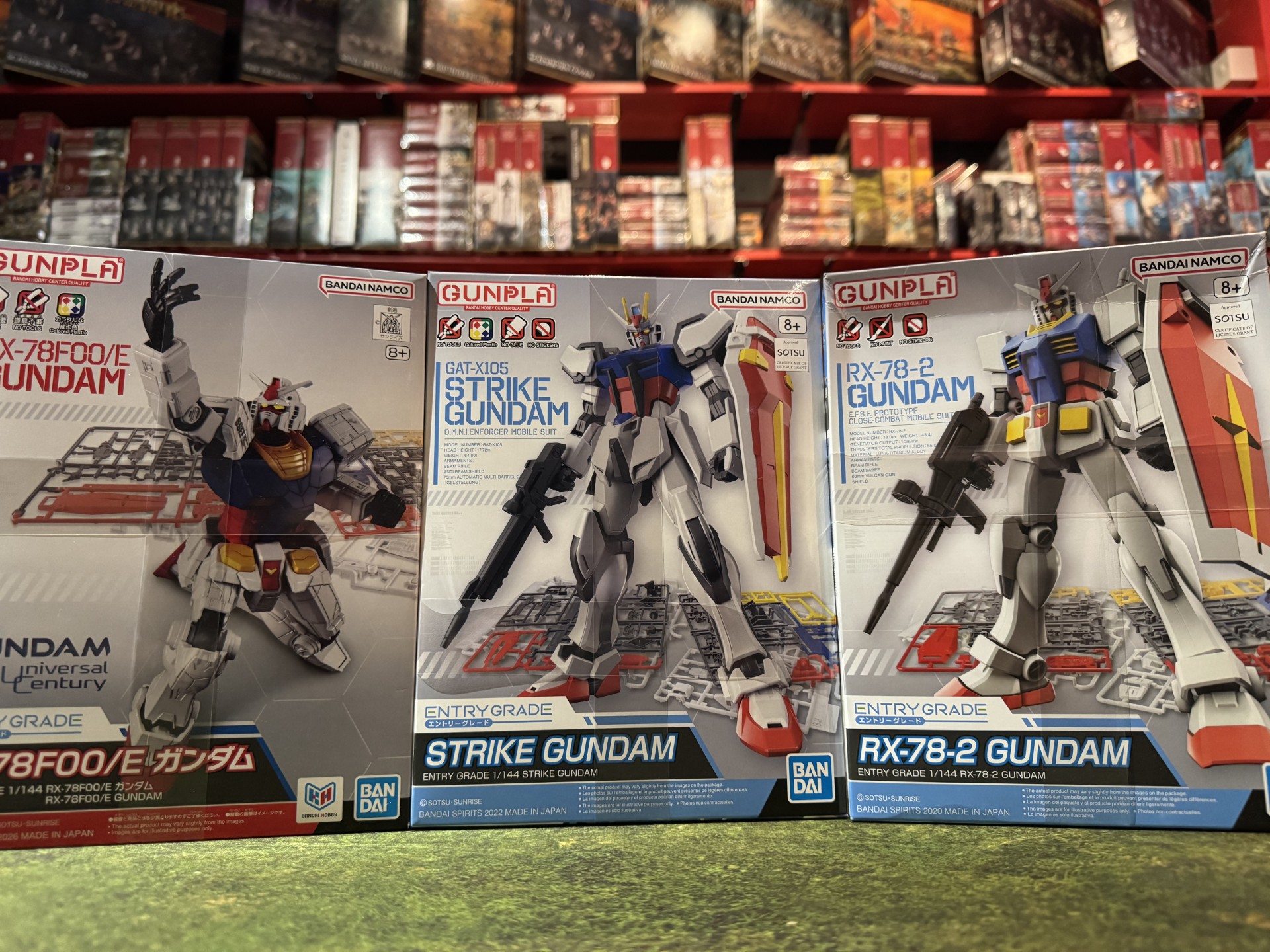
Choosing your first Gunpla ought to be the easy part. Then you see
the boxes.
They are glorious boxes, to be fair. Heroic artwork. Impossibly cool
machines. Enough letters, numbers and version names to make a Federation
engineer reach for the manual. The same mobile suit may appear as an
Entry Grade, High Grade, Real Grade or Master Grade. Two kits can both
say 1/144 on the front yet offer completely different evenings at the
desk.
This is where many beginner guides lose their nerve. One insists that
every new builder must report for duty with an RX-78-2 Gundam. Another
presents a numbered list of whatever happened to be available when the
page was written. Both approaches miss the best thing about Gunpla: the
first spark is personal.
There is a better way to choose.
The best Gunpla for beginners is not automatically the simplest kit,
the newest kit or the one somebody else has declared a classic. It is
the model that makes you pause over the box art and think, yes, that
one. Then it needs a building experience that suits your patience,
budget, hands and available shelf space.
This guide will help you choose that kit. It will not choose your favourite mobile suit for you.
If the abbreviations are still fighting for space in your head, our Gunpla grades explained guide covers EG, HG, RG, MG, PG, SD and MGSD in detail. Here, the question is more personal: which particular box should you open first?
The short answer
For most complete beginners, a modern Entry Grade or an approachable
High Grade is the right place to start.
- Choose Entry Grade if you want the smoothest introduction, minimal equipment and a quick build.
- Choose High Grade if you want a fuller model-making experience and do not mind using hobby nippers or handling a few more parts.
- Choose the mobile suit you actually like, even if it is not the
model that appears at the top of every beginner list. - Check the exact kit, not just its grade. Release age, accessories,
stickers and engineering can matter as much as the letters on the
box.
If you remember only one rule, make it this: buy the kit that
makes you want to open the box, then make sure its particular build
suits a beginner. That order matters. Excitement first,
sensible checking second.
Start with the mobile
suit, not the grade
The RX-78-2 is often treated as the official front door to Gunpla.
That makes sense. It is the original Gundam, it has been released in
beginner-friendly formats, and its clean red, white, blue and yellow
design is easy to read as it takes shape in your hands.
But it is not compulsory.
Perhaps Gundam Wing was your introduction to the franchise
and those wings still hit you with a bolt of nostalgia. Perhaps you
watched The Witch from Mercury and immediately wanted Gundam
Aerial and its Bit Staves on your shelf. Perhaps you have never watched
a Gundam series at all, but one angular, over-armed machine caught your
eye and refused to let go.
That emotional pull matters more than recommendation lists admit. A
technically straightforward kit you do not care about can feel like
homework. A slightly more involved kit of a favourite mobile suit can
carry you through every gate mark, tiny sticker and stubborn little hand
that pings off the desk and attempts to join Zeon under the
cupboard.
Begin by making a shortlist of designs you would be excited to own.
Only then compare the versions available. If your favourite exists in
Entry Grade and High Grade, you have a particularly easy decision to
make. If it is only available as a more complex kit, look at the exact
build before deciding whether to accept the extra challenge or save it
for later.
Entry
Grade or High Grade: which is better for a beginner?
Entry Grade and High Grade are both sensible starting points, but
they provide different first experiences.
| Entry Grade | High Grade | |
|---|---|---|
| Typical scale | 1/144 | Usually 1/144 |
| Build style | Streamlined and quick | More conventional Gunpla build |
| Tools | Parts are designed for easy removal; nippers can still improve cleanup |
Hobby nippers strongly recommended |
| Part count | Lower | Usually higher |
| Small details | Kept relatively simple | More likely to include small parts and stickers |
| Accessories | Often focused on the essentials | Varies widely by individual kit |
| Best for | A relaxed first build or minimal setup | A beginner who wants more time at the desk |
Choose
Entry Grade if you want an easy first victory
Entry Grade is Bandai rolling out the welcome mat. The components are
pre-coloured, the construction is snap-fit and the parts are designed to
separate from the runners without demanding a full tool kit. You still
get the lovely moment when a collection of flat runners becomes a
recognisable mobile suit. You simply reach that moment with less
resistance.
That does not make Entry Grade a disposable or childish range. A good
Entry Grade still produces an articulated display model with convincing
colour separation. What you give up is mostly build length, fine surface
complexity and, depending on the release, some accessories.
Entry Grade is an especially good fit if:
- you have never built a plastic model;
- you want to try Gunpla before buying tools;
- you prefer larger, more easily recognised components to a tray of
tiny pieces; - you want to finish your first model in one relaxed session;
- the kit is a gift and you do not know the recipient’s modelling
experience.
It is also a fine choice for an experienced modeller who wants a
shorter project between more demanding builds. Easy does not mean
unrewarding. Sometimes you want a weekend engineering epic; sometimes
you want to build Wing Gundam with a cup of tea and have it posing
before the evening is over.
Choose
High Grade if the building is part of the attraction
High Grade is the great, sprawling centre of the Gunpla universe.
This is where obscure favourites, hero suits, mass-production machines
and wonderfully strange enemy designs all get a chance to become
plastic. Most sit at the compact 1/144 scale, while the builds tend to
offer more construction, articulation and equipment than Entry
Grade.
For many people, HG is the ideal first Gunpla because it introduces
the real rhythm of the hobby. Clip a part from the runner. Clean the
gate. Check the diagram. Press two unpromising pieces together and
suddenly realise you are holding a Gundam’s head. That little
transformation never stops being satisfying.
Choose High Grade if:
- you are happy to buy or already own hobby nippers;
- you want the build to last longer than a single short sitting;
- your favourite mobile suit is not available in Entry Grade;
- accessories, transformation features or alternative display options
are important to you; - you have built other plastic kits, miniatures, brick models or
detailed craft projects.
A modern HG such as Gundam Aerial can be an excellent first kit. That
does not mean every HG is equally suitable, which brings us to the
detail most quick recommendation lists miss.
Three direct routes into Entry Grade
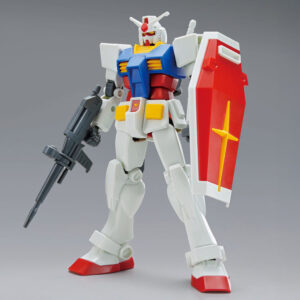
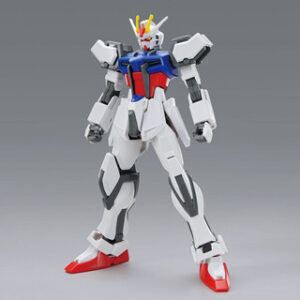
These three kits share an approachable Entry Grade philosophy while giving you very different designs to care about. Choose the mobile suit, not just the specification sheet.
-
Bandai Entry Grade 1/144 Wing Gundam
£9.00 -
Bandai Entry Grade 1/144 RX-78-2 Gundam
£9.00 -
Bandai Entry Grade 1/144 Strike Gundam
£6.25

The letters
on the box do not tell the whole story
High Grade is a product family, not a single standard frozen in time.
Bandai has been producing HG kits across decades, and the engineering
has evolved enormously. Buying by grade alone is a little like choosing
a car using only the word “hatchback”. It tells you the general format,
but not what the experience will be like.
An older High Grade can still be charming, accurate to its source and
great fun to build. It may also rely more heavily on stickers, use an
older joint arrangement or provide less natural articulation than a
recent release. A modern kit may separate colours into individual
plastic parts that an earlier design asks you to recreate with foil
stickers.
None of that makes the older kit bad. Older Gunpla can have enormous
character, and building one can feel like opening a time capsule from a
different era of the hobby. It simply means that “High Grade is
beginner-friendly” is not enough information on its own.
Before buying, confirm:
- The exact product name. RX-78-2 Gundam, for
example, has appeared in many different releases. Similar box titles do
not guarantee the same model. - The grade and scale. A 1/144 HG and a 1/144 RG may
stand at a similar height but offer very different levels of
complexity. - The release or version. Labels such as Revive, Ver.
2.0, Rebuild or a series-specific subtitle can identify substantially
different kits. - What is included. Do not assume every version of a
mobile suit has the same weapons, effect parts, hands or display
stand. - How the finished model is meant to be displayed. A
large weapon, wing unit or funnel system may need more room or an action
base.
This is one reason recent The Witch from Mercury High Grades
are frequently recommended to new builders. Kits such as HG Gundam
Aerial combine modern part separation and articulation with a manageable
1/144 format. By contrast, a shopper choosing an older design should
simply expect an earlier style of engineering rather than assuming every
HG builds alike.
Think about part
size, not just model size
A 1/144 label describes scale. It does not tell you whether the build
will feel like assembling sturdy armour plates or performing surgery on
a machine the size of a sandwich.
Mobile suits vary in fictional height, so two 1/144 kits will not
necessarily be the same size when finished. Their designs also divide
into parts differently. A clean, blocky suit may be easier to handle
than a model covered in narrow fins, tiny vents or layered armour, even
when both belong to the same grade.
If you have limited dexterity, reduced eyesight or simply dislike
tiny components, look for:
- a straightforward silhouette;
- fewer delicate antennae and protrusions;
- larger armour panels;
- limited use of very small stickers;
- weapons that do not require lots of separate attachments;
- a stable standing pose that does not depend on a display base.
The Entry Grade ν Gundam is physically more substantial than many
1/144 models because ν Gundam is a large mobile suit in its own fiction.
That can make much of the assembly comfortable to handle, although the
finished model also asks for more shelf space. This is precisely why
scale alone cannot make the decision for you.
Stickers
and colour separation: decide how finished you want “finished” to
look
Gunpla parts are moulded in colour, and painting is normally
optional. This remains one of the hobby’s small miracles. You can open a
box full of runners, add no glue and no paint, and finish with a
recognisable mobile suit that looks ready to launch.
The remaining colour details vary by release. One kit may reproduce a
chest panel with separate coloured plastic. Another may use a sticker
for the same effect. Small sensors, cameras and markings are common
sticker candidates, while older or more elaborate designs may ask
stickers to cover larger areas.
There is nothing inherently wrong with stickers. A neatly placed eye
sensor can bring a face to life, and markings can give a clean build a
welcome dash of personality. The useful question is whether you enjoy
applying them or whether the sight of a foil sheet makes you want to
retreat to the nearest colony.
If the thought of aligning a tiny foil sensor is already making your
shoulders tense, choose a kit known for strong colour separation and a
modest sticker sheet. If you enjoy careful placement, a few stickers add
a satisfying final stage. Check photographs of the runners and sticker
sheet when available rather than relying on the grade alone.
Also distinguish between colour-correcting stickers,
which supply a missing colour, and optional markings,
which add symbols, numbers or decorative detail. A model can look
complete without applying every optional marking in the box.
Accessories can
improve a kit or overwhelm it
Let us be honest: weapons and equipment are fun. A beam rifle is
good. A shield that breaks into remote weapons is better. A backpack
that turns the finished model into a shelf-dominating mechanical peacock
can be magnificent. All of those things are also extra parts to build,
store and balance.
A simple beam rifle and shield give a first model several
recognisable poses without adding much complication. A model with
detachable remote weapons, a transformation system or an enormous rifle
can offer far more display variety, but that variety comes with
additional assembly and handling.
HG Gundam Aerial is a useful example. Its shield can separate into
Bit Staves, creating several configurations and giving the finished kit
more to explore. That makes it a rewarding first HG for somebody excited
by the design. A builder who wants to assemble a model once, put it in a
neutral pose and leave it alone may prefer a simpler equipment set.
Ask yourself:
- Do I want to keep changing the pose?
- Will unused hands and weapons need storage?
- Does the most exciting configuration require a separately sold
display base? - Will a long rifle, wings or backpack make the model too deep for my
shelf? - Am I buying the kit for the build, the finished silhouette or
both?
The fullest box is not automatically the best value for your first
project. An accessory only adds value if you want to build, store or
display it. Otherwise it becomes another tiny object in a plastic bag
labelled “important bits I will definitely remember”, which is one of
the hobby’s more optimistic traditions.
Measure your
shelf before choosing your scale
Gunpla has a habit of looking wonderfully compact online, then
occupying half a shelf once the rifle is raised, the wings are spread
and every remote weapon has been given its own flight path.
Most Entry Grade and High Grade Gundam kits are 1/144 scale, which
makes them convenient for desks, bookcases and growing collections. Even
within that scale, wings, shields, rifles and funnels can dramatically
increase the width or depth of the display.
Larger grades may use bigger parts that are comfortable to handle,
but they demand more working room and more permanent display space. A
model balanced on the edge of a crowded shelf is not an upgrade.
Before ordering, look at the complete silhouette rather than the
standing height. Decide whether you want a compact neutral pose or a
wide action pose. If the kit’s signature look involves airborne weapons
or spread wings, include the base and its footprint in your plan.
Set a budget for the
whole first build
The box price is not always the full cost of starting.
An Entry Grade can be built without glue or paint, and its parts are
designed for straightforward removal. You can therefore try the hobby
with little more than the kit and a clear table. A pair of hobby nippers
is still useful if you want controlled cuts and tidier cleanup, but the
low barrier is part of the range’s purpose.
For High Grade, budget for a suitable pair of plastic-model nippers.
A simple sanding stick or fine abrasive can help tidy remaining gate
marks. You do not need an airbrush, a rack of paints or an intimidating
case of specialist tools.
For a first build, the useful hierarchy is:
- the correct kit;
- nippers if the kit calls for them;
- a clean, well-lit workspace;
- optional cleanup and panel-lining supplies later.
Do not turn a reasonably priced first model into a major equipment
purchase before you know which parts of the hobby you enjoy. The
internet can persuade a newcomer that they need a professional workshop
before Runner A has left the bag. They do not.
Quick build or weekend
project?
Some people want to open a box after dinner and have a completed
Gundam striking a heroic pose before bed. Others want to settle in for
several sessions, build one limb at a time and enjoy the assembly as
much as the result.
Neither approach is more serious.
Choose Entry Grade when completion is part of the appeal. The shorter
build gives you a clear introduction to runners, instructions, snap-fit
assembly and articulation without asking for a large commitment.
Choose High Grade when you want more of the process. A
straightforward HG remains approachable, but the additional parts and
equipment give the project room to breathe. You can build a limb at a
time, stop safely and return later.
Be honest about the time you have now, not the time you imagine
having. The best first Gunpla is one that reaches your shelf, not one
that lives half-built in its box because a recommendation told you to
aim higher.
A practical
first-Gunpla decision framework
Use these questions in order whenever you are comparing kits:
1. Which mobile suit do
I actually want?
Make a shortlist based on enthusiasm. Do not begin with somebody
else’s ranking.
2.
Does it have an Entry Grade or approachable High Grade release?
If both exist, choose according to the experience you want. Entry
Grade favours speed and simplicity. High Grade offers a more involved
conventional build.
3. What exact version am I
looking at?
Read the entire product name. Confirm grade, scale, subtitle and
included equipment. Never assume two kits of the same Gundam are
interchangeable.
4. Are the parts
and stickers suitable for me?
Check completed photos, runner images and the sticker sheet where
possible. Consider your eyesight, dexterity and patience.
5. Do I want its accessories?
More equipment can mean more display choices, but also more parts,
storage and shelf depth.
6. Will it fit where I
intend to put it?
Allow for weapons, wings and the pose, not just the mobile suit’s
height.
7. What is the total starting
cost?
Include nippers and any genuinely necessary display base. Treat
paint, panel lining and extensive tool sets as future options.
8. How long do I want
the build to last?
Choose the project that fits your real weekend.
If a kit still excites you after those eight questions, stop
searching for permission. You have probably found your first Gunpla.
Good
first Gunpla examples from the current Bomran range
Stock changes, and Gunpla restocks have a rhythm all their own, so
these are examples of how to apply the framework rather than a permanent
ranking. The point is not that these are the only correct answers. It is
why each answer might be correct for a particular builder.
Entry
Grade Wing Gundam: for the fan who already knows their favourite
The Entry Grade 1/144 Wing Gundam is a natural starting point for
anybody who only needs the opening notes of Just Communication
to feel twenty years younger. It delivers the recognisable wings, chest
design and classic colour scheme in a streamlined build, so the
emotional choice and the practical choice point to the same box.
Choose it if the design is what brought you to the hobby and you want
a quick first success. Its wings give it more visual width than a very
plain starter model, so leave a little room on the shelf.
Entry
Grade RX-78-2 Gundam: for the classic introduction
The Entry Grade RX-78-2 Gundam remains a superb first choice, provided you want
to build it. There is a special pleasure in watching that famous face,
V-fin and tricolour armour emerge from the runners. Its clean
proportions, familiar equipment and uncluttered silhouette suit a first
project particularly well.
The important word is exact. Several RX-78 designs
and versions exist, including the newer RX-78F00/E interpretation. Check
the full title and box contents so you know which Gundam you are buying
rather than treating every RX-78 listing as the same kit.
Entry
Grade Strike Gundam: for a compact, direct starting point
Entry Grade Strike Gundam gives beginners another recognisable hero suit without
requiring a pilgrimage to the Universal Century. In Entry Grade form it
suits somebody who wants a clean, affordable introduction and prefers
the sharper, early-2000s look of Gundam SEED.
As always, check the exact release and equipment. A basic Strike
Gundam and a version bundled with additional packs do not offer the same
display experience.
Entry
Grade ν Gundam: for a little more shelf presence
Entry Grade ν Gundam has always carried itself like the grown-up in the room. It
is a larger mobile suit than many Gundams, so its 1/144 Entry Grade has
a more substantial presence while retaining an accessible build. It is a
good fit for a beginner who wants something imposing without immediately
moving into a more complicated grade.
Check the included equipment rather than assuming that every image of
ν Gundam’s full arsenal represents what is in this particular box. Its
greater physical size also deserves a little more shelf room.
HG
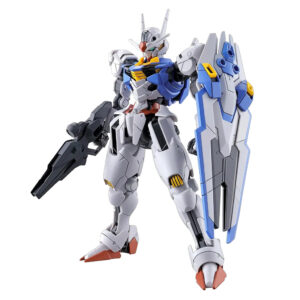
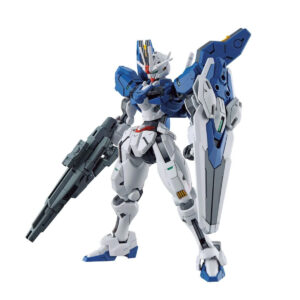
Gundam Aerial: for the beginner who wants the full hobby experience
HG 1/144 Gundam Aerial is the clearest step beyond Entry Grade in the
current range, and it shows why modern HG can be such a brilliant first
taste of the wider hobby. The build is approachable, the colour
separation is strong, the articulation is lively and the shield divides
into Bit Staves for alternative configurations. It gives a newcomer more
to do without making every stage feel like an entrance examination.
That makes it a good first Gunpla for somebody happy to use nippers
and spend longer at the desk. It is not simpler than an Entry Grade, but
it may be more satisfying for a beginner who wants assembly and display
options to be a larger part of the experience.
HG
Gundam Aerial Rebuild: for the builder drawn to bigger equipment
HG Gundam Aerial Rebuild remains approachable as a modern HG, but its oversized
rifle and Bit Stave system give it a more aggressive silhouette and a
different footprint from the original Aerial. Choose between them
because one design makes you grin more than the other, not because the
word “Rebuild” automatically means it is the superior beginner kit.
This is the decision framework doing its job: both can suit a
first-time builder, but they do not suit the same shelf or the same
taste.
Modern High Grades for a more involved first build
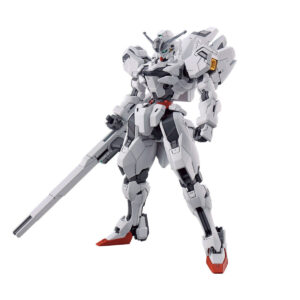
Aerial, Aerial Rebuild and Gundam Calibarn demonstrate how much colour separation, articulation and character a modern HG can deliver without jumping directly into RG complexity.
-
Bandai HG 1/144 Gundam Aerial
£14.25 -
Bandai HG 1/144 Gundam Aerial Rebuild
£15.50 -
Bandai HG 1/144 Gundam Calibarn
£18.50
First Gunpla choices
that deserve a pause
You do not need to fear every kit above High Grade, and there is no
hobby police force waiting to confiscate a Real Grade from a beginner.
Still, some choices introduce avoidable friction.
Think carefully before choosing:
- a Real Grade with very small parts and a dense build;
- a large Master Grade simply because bigger sounds easier;
- a transforming kit when you dislike reconfiguring delicate
parts; - a model dominated by a huge backpack or weapon when you have limited
space; - an unfamiliar older release based only on its grade label;
- an expensive limited edition that you would be nervous to
handle; - a kit whose finished appearance depends on stickers you already know
you will not enjoy.
These may all become excellent later projects. Your first kit does
not need to prove anything. Its job is to teach you whether you enjoy
building Gunpla and leave you keen to open another box.
What tools do you
need for your first Gunpla?
For Entry Grade, you can begin with very little. The parts are designed for easy separation and snap together without glue. Work slowly, follow the numbered diagrams and keep the runners organised. Our complete beginner’s guide to building your first Gundam model kit takes the assembly process from opening the box to the finished pose.
For High Grade, use plastic-model nippers rather than household
scissors. Cut slightly away from the part first, then make a careful
second cut closer to the surface. This reduces the risk of stress marks
and accidental damage.
A basic first setup can be as simple as:
- hobby nippers;
- a sanding stick or fine abrasive for cleanup;
- a small tray for loose pieces;
- good lighting;
- enough clear table space to keep runners visible.
Painting, panel lining, decals and weathering can wait. Build the
first model cleanly and learn what you want to improve on the
second.
Buying your first Gunpla in the UK
UK beginners should compare the complete starting cost rather than the box price alone. Check whether the exact kit is in stock, whether it needs nippers or a display base, and what delivery will add to the order. A slightly cheaper model is not better value if it is the wrong version or needs accessories you did not budget for.
Buy from a specialist retailer that identifies the full grade, scale and version clearly. That makes it easier to distinguish similar RX-78-2 releases, understand what is included and choose an Entry Grade or High Grade that fits the experience you actually want.
Frequently asked questions
What is the best Gunpla
for beginners?
There is no single best kit for everybody. A modern Entry Grade is
the safest recommendation for a complete beginner who wants minimal
tools and a quick result. A modern, straightforward High Grade can be
better for somebody who wants a longer build and is comfortable using
nippers. In either case, choose a mobile suit you genuinely like and
verify the exact release.
Is Entry
Grade or High Grade better for a first Gunpla?
Entry Grade is easier and quicker. High Grade usually offers more
parts, equipment and time at the desk. Entry Grade is best when you want
the gentlest introduction; High Grade is best when the building process
itself is a major part of the attraction.
Do Gunpla kits need glue or
paint?
Modern Bandai Gunpla are generally snap-fit and moulded in colour, so
glue and paint are not normally required to complete them. Optional
painting, panel lining and weathering can improve or personalise the
finish.
Do I need nippers for Entry
Grade?
Entry Grade parts are designed to separate from the runners without
requiring nippers. Many builders still use suitable hobby nippers for
greater control or tidier cleanup. Nippers are strongly recommended for
High Grade and more complex kits.
Is High Grade difficult
for a beginner?
Many HG kits are very approachable, but the exact release matters.
Modern engineering, sensible part sizes and good colour separation can
make an HG an excellent first model. Older kits, transforming designs
and models with many small accessories may require more patience.
Should my first
Gunpla be an RX-78-2 Gundam?
Only if you like it. RX-78-2 has several accessible kits and is a
dependable classic, but enthusiasm matters more than tradition. An Entry
Grade Wing Gundam or a modern HG Gundam Aerial may be a better first
build for the person who loves those designs.
Can a Real Grade be my
first Gunpla?
It can, but it is rarely the easiest introduction. RG kits pack
substantial detail and small components into 1/144 scale. A beginner who
enjoys precise model work may cope perfectly well, but EG or HG usually
provides a more forgiving first experience.
How much should I
spend on my first Gunpla?
Spend enough to buy a kit you actually want, plus suitable nippers if
required. You do not need a large tool collection, paints or premium
finishing products for your first build. Keeping the initial commitment
modest makes it easier to discover which part of the hobby appeals to
you.
The
right first Gunpla is the one that leads to a second
Your first Gunpla does not need the most parts, the newest
engineering or the loudest recommendation on the internet. It does not
need to impress experienced builders. It needs to meet you where you
are.
Choose a mobile suit that earns your attention. Decide whether you
want the speed of Entry Grade or the fuller rhythm of High Grade. Check
the exact version, its stickers, accessories and age. Measure the shelf.
Be honest about your budget and the evening you actually have
available.
Then clear the table, open the box and enjoy that first look at the
runners. Every Gunpla collection, from a single RX-78-2 on a desk to an
entire wall of mobile suits, begins with exactly that moment.
The best first Gunpla is not the kit that proves you can handle the
hobby. It is the one that makes you look at the finished model, feel
absurdly proud of it and start wondering what you should build next.