
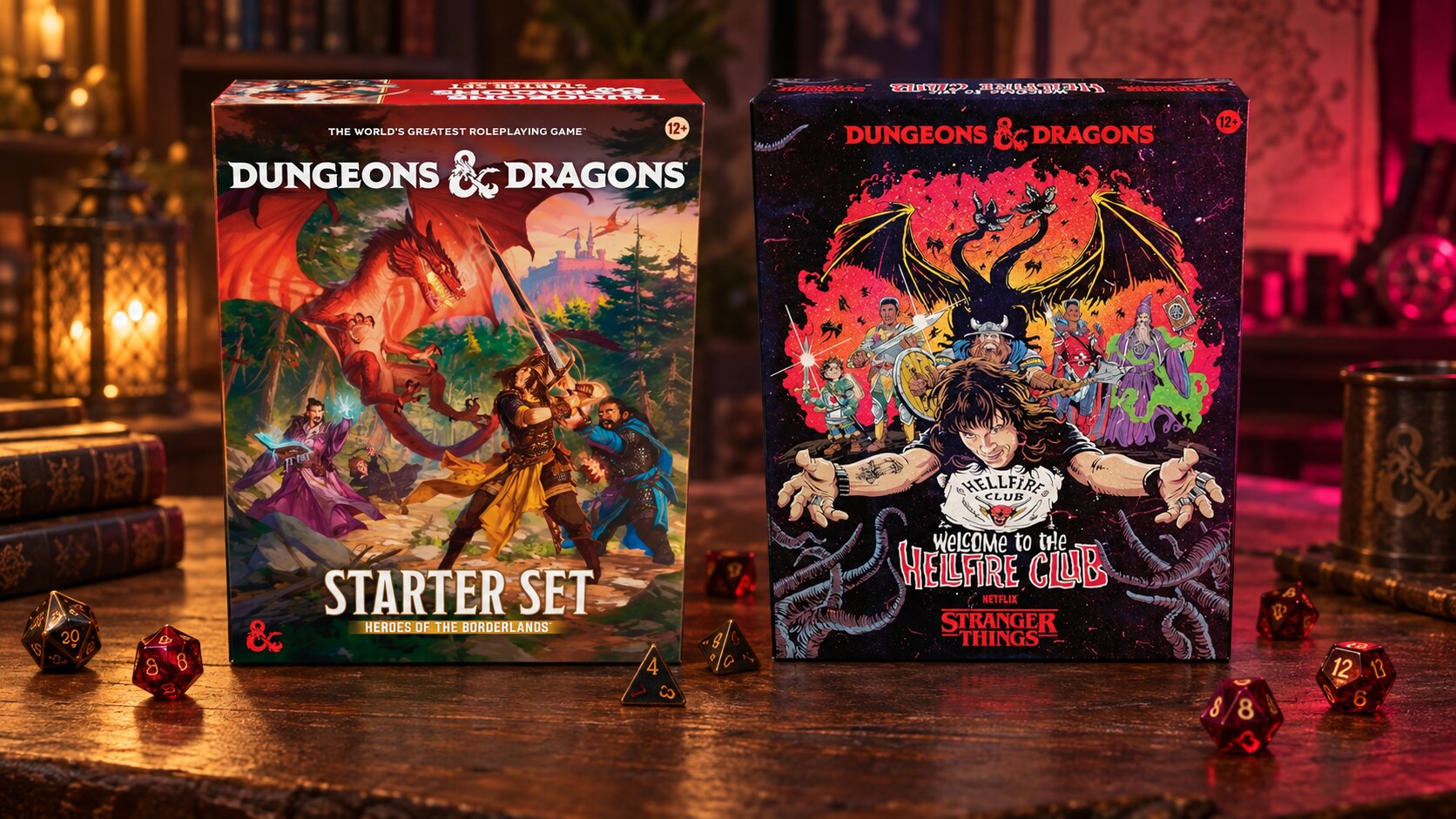
Choosing your first Dungeons & Dragons set ought to be the easy part. Gather some friends, find the funny-shaped dice and try not to annoy the first goblin you meet. Then you discover two current starter boxes sitting side by side, both promising everything you need, and the first decision arrives before the adventure has even begun.
For most new groups, Heroes of the Borderlands is the better all-round introduction to D&D. It gives players more say over their characters, covers different sides of the game and packs in an unusually large collection of maps, cards and tokens.
Welcome to the Hellfire Club is the better choice when Stranger Things is what brought everyone to the table. Its heroes are already prepared, its four adventures are steeped in Eddie Munson’s particular brand of heavy-metal fantasy, and it includes a Dungeon Master’s screen to complete the effect.
Both use the current revised fifth-edition D&D rules, both take characters from level 1 to level 3, and both contain everything required to begin. They simply offer two very different invitations. Heroes says, “Come and discover D&D.” Hellfire Club turns up the volume, slides an Eddie Munson character sheet across the table and asks whether Tuesday works for the campaign.
Bomran Guide summary
- Best for most complete beginners: Heroes of the Borderlands
- Best for Stranger Things fans: Welcome to the Hellfire Club
- Best for making your own hero: Heroes of the Borderlands
- Best for beginning with ready-made characters: Welcome to the Hellfire Club
- Best for maps, cards and reusable encounter pieces: Heroes of the Borderlands
- Best themed presentation: Welcome to the Hellfire Club
- Need extra books or dice? No. Both are complete introductory sets.
In this guide
- Starter sets at a glance
- What your first evening will look like
- Choosing and creating characters
- Support for the Dungeon Master
- Adventures and components
- Choosing the right set for your group
- What you may want afterwards
- Our final verdict
- Frequently asked questions
How we compared the starter sets
We compared the two current UK starter sets using their official contents, character options, adventure structure, support for first-time Dungeon Masters and usefulness beyond the introductory adventures. Prices and availability can change, so check the product pages for the latest position before choosing.
Heroes of the Borderlands vs Welcome to the Hellfire Club at a glance
| Feature | Heroes of the Borderlands | Welcome to the Hellfire Club |
|---|---|---|
| Players | 3-5 players | 3-5 players |
| Character levels | Levels 1-3 | Levels 1-3 |
| Adventures | Three adventure booklets | Four adventure booklets |
| Characters | Guided creation using class boards, species and background cards | Five prepared Stranger Things characters |
| Maps | Nine double-sided poster maps | Two double-sided poster maps |
| Cards | 210 | 91 |
| Tokens | 273 | 72 |
| Dice | 11 | 11 |
| Dungeon Master’s screen | Not included | Included |
| Style | Traditional Borderlands fantasy | Stranger Things and 1980s heavy-metal fantasy |
| Best for | Learning D&D as a wider hobby | Entering D&D through Stranger Things |
Compare the current D&D starter sets
-
Dungeons & Dragons Starter Set: Heroes of the Borderlands
£39.50 -
D&D Stranger Things: Welcome to the Hellfire Club
£40.00
Two boxes, two ways into D&D
At first glance, these sets look remarkably similar. Each is designed for three to five people, including a Dungeon Master. Both supply introductory rules, adventures, character materials, maps, reference cards, tokens and 11 polyhedral dice. You can open either box without owning the Player’s Handbook, Dungeon Master’s Guide or Monster Manual.
Both also borrow some of the clarity of a board game. Instead of expecting a new group to imagine every combatant’s position, the maps and tokens place the action on the table. Cards keep spells, equipment and monsters within reach. If someone has spent the past ten minutes asking which die is the d12, reducing the number of other things they need to remember is no bad thing.
They remain tabletop role-playing games, however. The map does not dictate where the story must go and the cards are not a menu of everything your character may attempt. Players describe their ideas, the Dungeon Master decides how the world responds, and the dice settle the moments when success is uncertain.
The important difference appears before the first roll. Heroes of the Borderlands gives the group pieces from which to build its own beginning. Welcome to the Hellfire Club supplies a cast, a distinctive atmosphere and Eddie’s unfinished business.
What will your first evening look like?
Open Heroes of the Borderlands and each player starts assembling a hero. They choose from four familiar D&D classes – Fighter, Rogue, Cleric and Wizard – then combine a class board with species and background cards. It is character creation with the intimidating edges sanded down. There are meaningful decisions to make, but nobody needs to arrive having studied the Player’s Handbook.
Once the party is ready, the adventure opens around a fortified outpost on the edge of dangerous country. The Keep provides people to meet and rumours to follow. The Wilderness invites exploration. The Caves of Chaos provide the sort of deeply suspicious holes in the ground that adventurers find impossible to leave alone.
Welcome to the Hellfire Club gets moving differently. Players choose from five prepared heroes: Lady Applejack, Nog the Dwarf, Sundar the Bold, Tayr the Paladin and Will the Wise. Each has a completed character sheet for levels 1, 2 and 3, so advancement means moving to the next sheet rather than stopping to recalculate the character.
The Dungeon Master sits behind a Hellfire Club screen and leads the group into Greyhawkins, a cheerfully unsubtle mixture of Greyhawk and Hawkins. Traditional fantasy threats share the stage with Demodogs, Demobats and other creatures touched by Stranger Things. The visual language is black ink, school-notebook fantasy and 1980s heavy metal. It knows exactly what it wants to be.
That contrast is more useful than simply counting components. Heroes asks new players to start making D&D their own. Hellfire Club lets them borrow a ready-made identity and get into the story quickly.
Do your players want to create characters?
For many people, inventing a character is half the attraction of an RPG. They may already know that they want to play a cautious halfling Rogue, a very uncautious dwarf Fighter or a Wizard whose confidence greatly exceeds the number of spells they can cast.
Heroes of the Borderlands serves that group better. Its guided system does not provide the full freedom of the Player’s Handbook, but choosing a class, species and background gives each player a sense that the hero belongs to them. Characters can advance to level 3 and choose between two subclasses for their class.
Hellfire Club removes that decision. Its five characters arrive ready to play, complete with the abilities and equipment needed for each level. That is excellent when character creation sounds like homework, or when the attraction is specifically playing the characters imagined by the Stranger Things gang. It is less suitable for someone who has spent all week planning their own dragonborn bard.
This is not a simple contest between depth and simplicity. A blank character sheet excites some newcomers and terrifies others. The better box is the one that removes your group’s particular obstacle to getting started.
What does the Dungeon Master receive?
The Dungeon Master is usually the person with the most questions. How much must I read? What happens when the party ignores the obvious door? How do I keep track of six monsters? Why has the Rogue adopted the goblin?
Both sets are intended to teach the role through play. Each includes a Quick-Start Guide, a fuller Play Guide, adventure booklets and a combat tracker. Their physical tools solve different problems.
Heroes of the Borderlands supplies nine double-sided poster maps, 273 tokens and 210 cards covering characters, equipment, spells, monsters and non-player characters. That is a great deal of information made visible. A new DM can place an encounter on the table instead of holding its entire geography in their head, while players can keep frequently used abilities in front of them.
Its three adventure areas also introduce different parts of the job. The Keep encourages conversations and investigation, the Wilderness introduces travel and discovery, and the Caves bring dungeon exploration and combat to the foreground. Taken together, they offer a useful apprenticeship in running D&D.
Hellfire Club supplies fewer maps and tokens, but it removes uncertainty elsewhere. The five player characters are already built, their progression is prepared and the tone of the campaign is unmistakable. The included Dungeon Master’s screen provides quick references and somewhere to hide notes, maps and whatever unpleasant surprise is waiting around the corner.
For a new DM who wants to learn skills they can carry into a home-made campaign, Heroes offers the broader foundation. For someone who mainly wants to host a memorable Stranger Things game night, Hellfire Club does more of the creative scene-setting before the box is even opened.
What are the adventures actually about?
Heroes of the Borderlands revisits The Keep on the Borderlands, a formative D&D adventure first published in 1979, without expecting new players to know or care about that history. The premise remains effective because it is so easy to grasp: civilisation ends at the Keep’s walls, danger waits outside, and the party decides what to investigate.
The three booklets cover The Keep on the Borderlands, The Wilderness and The Caves of Chaos. Rather than functioning as three unrelated stories, they form different parts of the same adventuring region. Players can fight, negotiate, explore or attempt a plan the Dungeon Master was quietly hoping they would not think of.
Wizards describes the set as providing up to 60 hours of replayable material. Treat that as a publisher estimate rather than a stopwatch guarantee. RPG groups move at wildly different speeds, particularly once they discover that every tavern keeper can be questioned for half an evening.
Welcome to the Hellfire Club contains four adventures for level 1-3 characters: The Vanishing Gnome, Scream of the Crop, Ballad of the Rat King and Devil, Metal, Die! They are presented as Eddie Munson’s lost adventures and include notes intended to help the Dungeon Master channel his style.
This is not a campaign about the ordinary lives of teenagers in Hawkins. It is the fantasy game imagined within Stranger Things, filtered through the monsters, humour and visual identity of the programme. That distinction matters. You are playing D&D as Eddie and the Hellfire Club might have imagined it, not role-playing a day at Hawkins High.
Does more cardboard mean better value?
Heroes wins the component count decisively. Alongside its guides and adventures, it contains eight class boards, nine double-sided maps, five handouts, 210 cards and 273 tokens. Groups that enjoy visible maps and tactical encounters receive a sizeable toolbox, and many of the maps and tokens can be reused after the introductory adventure.
Hellfire Club includes two double-sided maps, 91 cards, 72 tokens, four handouts, 15 prepared character sheets and a double-sided poster. Its most notable addition is the Dungeon Master’s screen, which Heroes does not include.
On quantity alone, Heroes is the stronger package. Value is not measured by weighing the cardboard, though. Hellfire Club spends more of its appeal on art direction, prepared characters and an unusually cohesive theme. If that theme is what persuades four Stranger Things fans to try their first RPG, those components have done their job rather better than a larger pile left unopened.
For experienced Dungeon Masters introducing a new group, Heroes probably provides more material to borrow later. Hellfire Club is the more distinctive gift and the more complete themed experience.
Which D&D starter set suits your group?
A group of complete beginners
Choose Heroes of the Borderlands unless Stranger Things is the group’s main reason for playing. It provides the broadest introduction to character choice, exploration, social encounters and combat.
Stranger Things fans trying D&D
Choose Welcome to the Hellfire Club. Familiar names, monsters and visual cues give everyone an immediate connection to the adventure. Enthusiasm is a better teaching tool than a theoretically perfect rules progression.
Players who love making characters
Choose Heroes of the Borderlands. Its options are deliberately controlled, but the players still assemble heroes of their own rather than selecting from a prepared cast.
A group that wants to start as quickly as possible
Choose Welcome to the Hellfire Club. Prepared character sheets remove one of the largest jobs before a first session. Heroes is also designed for quick setup, but it intentionally gives the group more choices to make.
A new Dungeon Master planning to continue with D&D
Choose Heroes of the Borderlands. Its varied adventure areas and larger collection of encounter tools introduce more of the wider hobby.
An experienced Dungeon Master teaching new players
Heroes is likely to provide the more reusable toolkit. Hellfire Club becomes the better option when the theme will engage the new players or the DM wants four prepared adventures and characters ready to go.
Someone buying a gift
For a known Stranger Things fan, Hellfire Club is the more personal choice. If you only know that the recipient wants to try D&D, Heroes is safer and leaves more room for the group to create its own identity.
Is Welcome to the Hellfire Club proper D&D?
Wizards describes Welcome to the Hellfire Club as a collaborative board game as well as a Dungeons & Dragons experience. That wording makes it sound more separate from D&D than it really is.
It uses the current rules, a Dungeon Master, character sheets, polyhedral dice and open-ended role-playing adventures. The maps, cards and tokens make everything easier to follow, but they do not impose the fixed choices or single winning condition of a conventional board game.
Heroes of the Borderlands takes a similarly tactile approach. In either box, a player can attempt something that is not printed on a card. The Dungeon Master decides how to handle it, the dice may become involved, and the adventure heads somewhere nobody expected. That freedom is the important bit.
Do you need to buy anything else?
No. Both boxes are complete introductory experiences. They contain the rules and physical materials required to begin, including 11 dice. You do not need the Player’s Handbook, Dungeon Master’s Guide, Monster Manual, miniatures or terrain for your first game.
Pencils, scrap paper and somewhere to keep notes will still be useful. Snacks are not listed among the official contents, which feels like a serious lapse in adventuring logistics.
Once the group decides to continue, the current D&D Player’s Handbook is the natural next step. It provides complete character-building rules, more classes and subclasses, additional spells and advancement beyond the starter material. A Dungeon Master can add the Dungeon Master’s Guide, Monster Manual or a longer published adventure when those books solve an actual need.
Our guide to what you need to play D&D separates the essentials from the attractive extras. If the whole hobby is still mysterious, the Dungeons & Dragons beginner guide explains what happens around the table.
What happens after level 3?
Both sets finish at level 3. That is long enough to understand the basic rules, see a character develop and discover whether everyone wants another session. It is not the end of D&D’s character progression.
Moving into the full game normally means using the Player’s Handbook to build or adapt characters, then choosing a longer published adventure or continuing into a campaign created by the Dungeon Master. Characters represented by simplified boards or prepared sheets may need to be rebuilt using the complete rules, but their personalities and the stories created around them need not disappear.
There is no need to buy the next campaign before the first die has been rolled. Let the group discover what it enjoys. A party obsessed with tactical battles may want something very different from one that spent the entire evening negotiating with a suspicious gnome.
Our verdict
Heroes of the Borderlands is the best current D&D starter set for most new groups. Its guided character creation, varied adventure region and large collection of maps, cards and tokens provide a broad introduction and a useful bridge into the full game.
Welcome to the Hellfire Club is the better invitation for Stranger Things fans. Its prepared heroes, four adventures, Dungeon Master’s screen and wonderfully committed 1980s presentation remove much of the work between opening the box and entering Eddie Munson’s world.
Choose Heroes if your group wants to discover what D&D can become. Choose Hellfire Club if Eddie is the reason everyone agreed to turn up. Either way, the real victory is getting a date into the group chat that people actually keep.
Browse the complete Dungeons & Dragons range at Bomran or continue exploring our Dungeons & Dragons Guides.
Sources and further information
Component lists and player numbers were checked against the official Wizards Play Network information for Heroes of the Borderlands and Welcome to the Hellfire Club.
Frequently asked questions
Which is the best current D&D starter set for beginners?
Heroes of the Borderlands is the best all-round option for most beginners. It combines guided character creation with adventures covering conversation, exploration and combat. Welcome to the Hellfire Club is better when the group wants prepared characters or is particularly excited by Stranger Things.
Are both boxes complete games?
Both are complete introductory D&D experiences containing rules, adventures, character materials, maps, tokens and dice. Neither requires an additional rulebook to begin, although both finish at level 3.
How many people can play?
Both Heroes of the Borderlands and Welcome to the Hellfire Club are designed for three to five people, including the Dungeon Master.
Can you create your own character in both sets?
Heroes of the Borderlands provides guided creation using classes, species and backgrounds. Welcome to the Hellfire Club instead supplies five prepared characters with separate sheets for levels 1, 2 and 3.
Does Welcome to the Hellfire Club use 1980s D&D rules?
No. Its artwork and presentation evoke the D&D played by the Hellfire Club in Stranger Things, but the game itself uses the current revised fifth-edition rules.
Do either of the starter sets contain miniatures?
No. Both use card tokens to represent characters and monsters on their maps. Miniatures are optional and are not required to play.
Do I need another set of dice?
No. Each box includes 11 polyhedral dice. Players can add their own dice later, but a separate set is not needed for the first game.
Is Dragons of Stormwreck Isle still the current D&D Starter Set?
No. Dragons of Stormwreck Isle was the previous starter set and has been discontinued. Heroes of the Borderlands and Welcome to the Hellfire Club are the two current introductory boxed sets compared here.
Can experienced players use these sets?
Yes, especially when introducing newcomers. Experienced Dungeon Masters can also reuse maps, tokens and adventure ideas. Neither box replaces the complete core rules for an established campaign, however, because their character material ends at level 3.